

Schools nationwide this year are confronting a torrent of consequential changes and substantial threats to their federal funding—with little relief in sight.
In its first months, President Donald Trump’s administration has moved to cut billions of dollars in education grant funding; terminate contracts for efforts to support students and support the educator workforce; and change rules for existing funding streams without warning. Some districts have temporarily lost access to money they were preparing to spend, and many are fretting over White House proposals to further shrink federal investment in schools.
Federal funding for K-12 schools has never been entirely predictable or easy to navigate. It collectively represents roughly a tenth of all the money spent on public K-12 schools nationwide—far less than funding from state and local sources.
Previous administrations, including Trump’s first, have enacted significant policy changes, emphasized varying federal priorities, and proposed major changes that often didn’t come to fruition.
But this year’s developments have been far more challenging and confounding for districts and their advocates than the typical turbulence that arises in a complex system serving 13,000 districts nationwide. Changes affecting even a small percentage of funding can have serious and tangible effects on schools—particularly those with larger concentrations of students from vulnerable groups that rely more heavily on federal investment.
The current situation with federal funding appears unlikely to promptly stabilize.
Less than two weeks remain before states and schools expect to start seeing federal funding for next school year show up.

But staffing at the U.S. Education Department remains in turmoil as court battles over the agency’s future continue to play out. The Trump administration is pursuing billions of dollars in cuts, which are now in the hands of lawmakers reluctant to challenge the president’s agenda. And top federal officials are continuing their push to expand executive branch power over federal spending, including by challenging longstanding interpretations of the U.S. Constitution.
Drawing on interviews with school district leaders, education advocates, researchers, and policymakers, here’s a look at how federal disruption is affecting schools and students.
Less time to plan future budgets
The Department of Education this spring delivered states’ routine notices of funding allocations months later than usual for key programs like Title I for low-income students, the Individuals with Disabilities Education Act for special education, the Rural Education Achievement Program, and the McKinney-Vento program for Homeless Children and Youth. District leaders’ requests for information or guidance from department staffers largely went unanswered—a sharp departure from the norm.
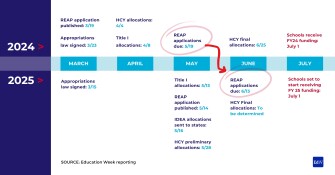
That means states notified districts of their funding levels later than usual, giving district budget officers less time than ever to factor federal funding projections into their budget plans.
Fewer opportunities to hire qualified staff
Budgeting for the upcoming school year is always an exercise in estimation. Funding allocations from various sources can change as the school year approaches, depending on political and economic conditions, enrollment projections, and evolving student needs.
But some decisions can’t wait until the last minute. In many states, hiring staff members any later than March or April is much harder because districts have already up snapped up many highly qualified job candidates by then. If a district can’t guarantee funding for a particular position, it may have to hold off on hiring for it altogether.
Concerns about federal changes without approval from Congress
Congress hasn’t passed a full budget for the current federal fiscal year, which determines K-12 education funding for the upcoming school year. Instead, Congress has passed a “continuing resolution�—a stopgap measure that typically amounts to carrying over funding levels from the previous fiscal year.
But the Trump administration has taken an unprecedented approach to withholding federal funds appropriated by Congress, at times drawing rebukes from members of Congress and federal courts. Fears are growing that the administration may try to preemptively withhold some of the funding from programs Trump has proposed to eliminate in the future, including Title II for teacher quality, Title III for English learners, and programs that support migrant students, before- and after-school programming, and instruction in civics and literacy.
In some cases, funding from those programs helps schools deliver services they’re required by law to offer. Without federal support, schools will have to either petition their states for additional resources, or cut other priorities.
Greater difficulty separating fact from fiction
Headlines in recent months have emphasized Trump’s proposals to eliminate funding for a wide range of programs.
But those proposals wouldn’t take effect until the federal fiscal year starting this October, which means they wouldn’t hit schools until the start of the 2026-27 school year.
Before that happens, Congress has to pass its own federal budget, which could differ dramatically from the wish list Trump put out last month.

Meanwhile, the Education Department under Trump has already moved to pull back funding appropriated by Congress and awarded to schools during the Biden administration, including for pandemic relief, teacher-preparation programs, and mental health services. That funding was already appropriated by Congress in previous budget cycles, and several judges have ruled that plaintiffs who challenged some of those decisions are likely to win their cases, in which they argued that those decisions violated the law.
Project 2025, the conservative policy document Trump has followed closely so far this year, pitches even bigger spending cuts that would affect K-12 schools. But there’s no guarantee Trump will pursue every proposal in that document, and no guarantee Congress will sign off on everything Trump proposes.
All these swirling proposals and policy change are contributing to broad unease among school leaders.
Rule changes keep even the savviest district leaders on edge
In some cases the Trump administration has reversed course on policy decisions within days or weeks—a recurring phenomenon telegraphed in late January when the administration announced a government-wide spending freeze, then revoked the announcement less than 48 hours later.
The Education Department canceled grant opportunities that were already in progress for charter schools, then restarted the same opportunities a few months later with adjusted fine print. Some states secured approvals from the department to spend remaining pandemic-relief aid past the original spending deadline, only to learn weeks later that the department had canceled those approvals, effective immediately.
All of these intermingled developments require school district leaders to keep a careful watch on news developments in order to sort out present-day from the future, and reality from speculation. They also have to regularly stay in touch with attorneys who help them navigate their frequently evolving legal obligations.


