Ķvlog

Law & Courts

Appeals Court Backs Fla. Law Barring Transgender Teacher’s Use of Her Pronouns

By Mark Walsh — July 02, 2025 4 min read
A new billboard welcoming visitors to "Florida: The Sunshine 'Don't Say Gay or Trans' State," is seen on April 21, 2022, in Orlando, Fla. Florida's state government and LGBTQ+ advocates have settled a lawsuit challenging a law that bars teaching about sexual orientation and gender identity in public schools.
  • Save to favorites
  • Print
Email Copy URL

A federal appeals court on Wednesday ruled against a transgender female teacher who challenged a Florida law that bars K-12 education employees from using their chosen personal titles or pronouns if they do not correspond to their sex assigned at birth.

A 2-1 panel of the U.S. Court of Appeals for the 11th Circuit, in Atlanta, said the teacher’s First Amendment rights were not violated by the 2023 law because it imposes a restriction on her in-class speech as a government employee, rather than her speech rights as an individual.

“When a public school teacher addresses her students within the four walls of a classroom—whether orally or in writing—she is unquestionably acting ‘pursuant to her official duties,’” the majority said, quoting from a U.S. Supreme Court decision from 2006, , which makes up part of the key test for analyzing public-employee speech under the First Amendment and held that most job-related speech by such employees is not protected.

“Interacting with students during class time, quite literally, is a teacher’s ‘official duty,’” said Judge Kevin C. Newsom, a first-term appointee of President Donald Trump.

The dissenter, Judge Adalberto Jordan, a President Barack Obama appointee, said the Florida law was one of several attempts by the state at “speech orthodoxy,” some of which have been struck down, he noted.

The teacher “has substantially demonstrated that her use of her preferred personal title and pronouns constitutes private speech on a matter of public concern rather than government speech,” Jordan said.

Teacher sought to wear a ‘she/her’ pin in class

The law at issue is one of several measures backed by Gov. Ron DeSantis, a Republican, and conservative lawmakers in Florida aimed at transgender individuals.

The challenged law prohibits public school teachers, employees, and contractors from providing to a student “his or her preferred personal title or pronouns if such preferred personal title or pronouns do not correspond to that person’s sex.” Teachers who violate the law face loss of their certification, among other penalties.

The law was challenged by Katie Wood, an algebra teacher at Lennard High School in the Hillsborough County school district. Wood was assigned male at birth and transitioned in 2020. She began using the honorific “Ms.” and the pronouns “she” and “her.” She also wanted to wear a “she/her” pin at school, including in her classroom.

A federal district court granted a preliminary injunction, ruling that Wood’s use of her chosen title and pronouns was speech as a private citizen, not as a government employee.

The lower court went on to hold that the teacher’s speech touched on a matter of public concern and that her interest in expressing herself outweighed the state’s interest in promoting workplace efficiency.

In its July 2 decision in , the 11th Circuit panel reversed the district court. The majority said there is still much that the 11th Circuit has not decided about the scope of a public school teacher’s official speech for First Amendment purposes. And the Florida law applies only to interactions with students, so it wasn’t deciding whether she would be barred from using her chosen pronouns with colleagues in the teachers’ lounge, Newsom said.

“Our decision is a narrow one,” he said. “We hold only that when Wood identified herself to students in the classroom using the honorific ‘Ms.’ and the pronouns ‘she,’ ‘her,’ and ‘hers,’ she did so in her capacity as a government employee, and not as a private citizen.”

Dissent distinguishes between curricular and non-curricular teacher speech

Jordan, the dissenting judge, said a teacher’s titles and personal pronouns are “significant markers of individual identity. They exist outside of, and do not depend on, the school or the government for their existence.”

Jordan said he would draw a distinction between curricular speech, would would be government speech governed by the Garcetti decision, and non-curricular speech, such as pronouns.

“We should be wary of holding that everything that happens in a classroom constitutes government speech outside the ambit of the First Amendment,” Jordan said. “Those who wield the power of the government today and are on one side of the gender and culture wars will be the ones at risk of being compelled to speak against their beliefs, or silenced, when their opponents are in charge.”

The Florida case is a twist on other legal cases involving gender titles and pronouns. Many school districts have policies requiring teachers to use a transgenders student’s chosen name and pronouns. The Trump administration this year removed guidance advanced by President Joe Biden’s administration that supported and made it so Title IX required such policies.

Meanwhile, another federal appeals court is weighing the case of an Indiana teacher who refused on First Amendment grounds to use transgender students’ chosen names and pronouns. Many legal observers expect that case to go to the Supreme Court.

The Florida teacher, meanwhile, could seek a rehearing before the full 11th Circuit or could appeal to the Supreme Court.
Events

This content is provided by our sponsor. It is not written by and does not necessarily reflect the views of Education Week's editorial staff.
Sponsor
Reading & Literacy Webinar
Unlocking Success for Struggling Adolescent Readers
The Science of Reading transformed K-3 literacy. Now it's time to extend that focus to students in grades 6 through 12.
Content provided by 
Jobs Virtual Career Fair for Teachers and K-12 Staff
Find teaching jobs and K-12 education jubs at the EdWeek Top School Jobs virtual career fair.
This content is provided by our sponsor. It is not written by and does not necessarily reflect the views of Education Week's editorial staff.
Sponsor
College & Workforce Readiness Webinar
Climb: A New Framework for Career Readiness in the Age of AI
Discover practical strategies to redefine career readiness in K–12 and move beyond credentials to develop true capability and character.
Content provided by 

EdWeek Top School Jobs

Teacher Jobs
Search over ten thousand teaching jobs nationwide — elementary, middle, high school and more.
Principal Jobs
Find hundreds of jobs for principals, assistant principals, and other school leadership roles.
Administrator Jobs
Over a thousand district-level jobs: superintendents, directors, more.
Support Staff Jobs
Search thousands of jobs, from paraprofessionals to counselors and more.

Read Next

Law & Courts Supreme Court Backs Parents in School Gender Disclosure Fight
The Supreme Court restored an injunction blocking California policies on student gender transitions
8 min read
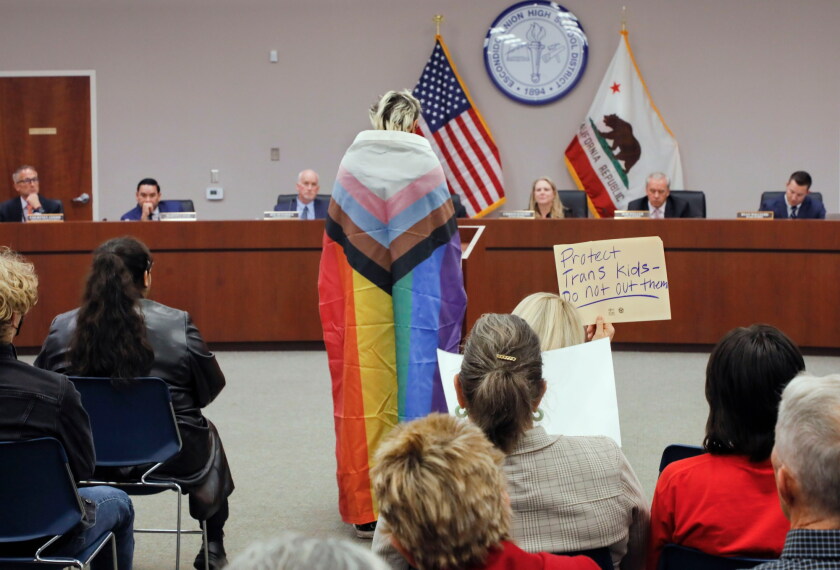
Teacher’s aide Amelia Mester, wrapped in a Pride flag, urges Escondido Union High School District not to have employees notify parents if they believe a student may be transgender in November 2025. A policy on the issue in the city’s elementary school district is the subject of a federal class-action lawsuit in which a judge just sided against the district.
Teacher’s aide Amelia Mester, wrapped in a Pride flag, urges Escondido Union High School District not to have employees notify parents if they believe a student may be transgender at a meeting in November 2025. Two parents and two teachers from the district sued in 2023, challenging California state guidance concerning student gender transitions and parental notification. The U.S. Supreme Court has now reinstated a lower-court decision overturning those state policies.
Charlie Neuman for The San Diego Union-Tribune/TNS
Law & Courts Appeals Court Allows Louisiana Ten Commandments Displays to Proceed
The court said it was premature to rule on the constitutionality of La. Ten Commandments displays.
3 min read
Students work under Ten Commandments and Bill of Rights posters on display in a classroom at Lehman High School in Kyle, Texas, Thursday, Oct. 16, 2025.
Students work under Ten Commandments and Bill of Rights posters on display in a classroom at Lehman High School in Kyle, Texas, Oct. 16, 2025. A federal appeals court has lifted a lower-court injunction blocking a Louisiana law that requires Ten Commandments displays, clearing the way for the law to take effect.
Eric Gay/AP
Law & Courts Supreme Court Strikes Trump Tariffs in Case Brought by Educational Toy Companies
Two educational toy companies were among the leading challengers to the president's tariff policies
3 min read
Members of the Supreme Court sit for a new group portrait following the addition of Associate Justice Ketanji Brown Jackson, at the Supreme Court building in Washington, Oct. 7, 2022. Bottom row, from left, Associate Justice Sonia Sotomayor, Associate Justice Clarence Thomas, Chief Justice of the United States John Roberts, Associate Justice Samuel Alito, and Associate Justice Elena Kagan. Top row, from left, Associate Justice Amy Coney Barrett, Associate Justice Neil Gorsuch, Associate Justice Brett Kavanaugh, and Associate Justice Ketanji Brown Jackson.
Members of the U.S. Supreme Court sit for a new group portrait following the addition of Justice Ketanji Brown Jackson, at the court building in Washington, Oct. 7, 2022. On Feb. 20, 2026, the court ruled 6-3 to strike down President Donald Trump's broad tariff policies, ruling that they were not authorized by the federal statute that he cited for them.
J. Scott Applewhite/AP
Law & Courts California Sues Ed. Dept. in Clash Over Gender Disclosures to Parents
California challenges U.S. Department of Education findings on state policies over gender disclosure.
4 min read
California Attorney General Rob Bonta speaks to reporters as Arizona Attorney General Kris Mayes, left, and Oregon Attorney General Dan Rayfield, right, listen outside the Supreme Court on Wednesday, Nov. 5, 2025, in Washington. (AP Photo/Mark Schiefelbein)
California Attorney General Rob Bonta speaks to reporters outside the U.S. Supreme Court in Washington on Nov. 5, 2025, with Arizona Attorney General Kris Mayes and Oregon Attorney General Dan Rayfield behind him. Bonta this week sued the U.S. Department of Education, asking a court to block the agency's finding that the state is violating FERPA by <ins data-user-label="Matt Stone" data-time="02/13/2026 4:22:45 PM" data-user-id="00000185-c5a3-d6ff-a38d-d7a32f6d0001" data-target-id="">not requiring schools to disclose</ins> students’ gender transitions <ins data-user-label="Matt Stone" data-time="02/13/2026 4:22:45 PM" data-user-id="00000185-c5a3-d6ff-a38d-d7a32f6d0001" data-target-id="">to</ins> parents.
Mark Schiefelbein/AP
