
This story is part of a special project called Big Ideas in which EdWeek reporters ask hard questions about K-12 education’s biggest challenges and offer insights based on their extensive coverage and expertise.
In May and December of last year, and March of this one, Congress dispensed nearly $200 billion to help schools pay for COVID-19 mitigation, technology tools, and academic support programs.
That’s a huge chunk of emergency cash that will meet a lot of needs—but not even close to all of them.
Overall K-12 spending in the U.S. declined precipitously after the Great Recession, and only in the last few years has it begun to inch back up. State aid and local revenue are volatile and widely varied from place to place. Surging cases of the Delta variant remind us that more societal disruptions and economic downturns could be on the horizon at any time.
All the while, we’re asking schools to accomplish more than what their funding allows and their employees to do far more than they’ve been trained to do. And we’ve been doing it for a long time.
COVID-19 aside, I’ve talked recently to school administrators facing mounting costs and pressures that show little sign of letting up. They’re worried about setting up drug treatment facilities for students affected by the opioid addiction crisis; about catching up on a seemingly endless backlog of deferred maintenance for leaky roofs and deteriorating pipes; about protecting against the ever-increasing threat of debilitating ransomware attacks; and about paying families’ internet bills so students can learn outside of school buildings.
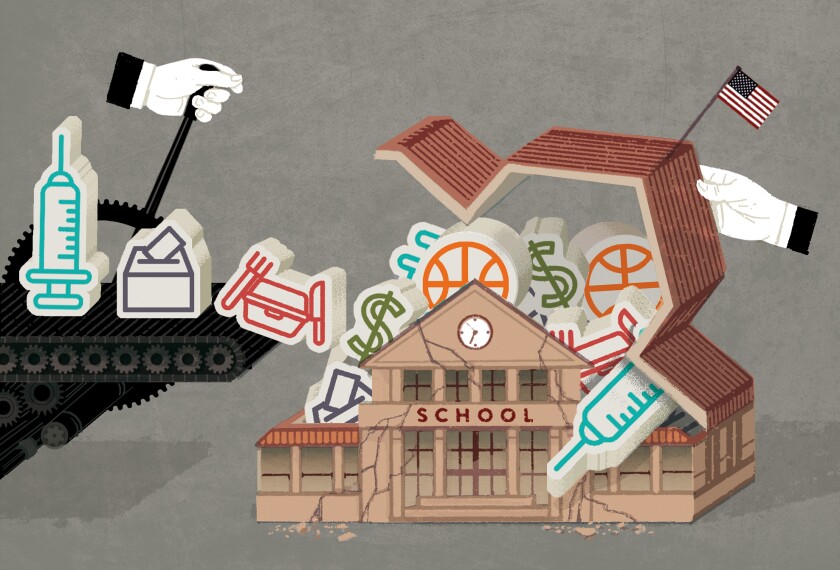
Schools have remained in operation during the pandemic as sites for mental health services, virus testing, meal distribution, voting, and vaccines. This summer, President Biden called on school leaders to host pop-up vaccine clinics at school buildings—even as they must support students academically and emotionally, navigate whiplash-inducing health guidance, retain and bolster burned out employees, expand technology access, and protect people from the still-spreading coronavirus.
Over the last few decades, schools have expanded to include more preschool programming, more career-technical offerings, more robust Wi-Fi service in classrooms, more gender-inclusive athletic facilities, more mental health services, more IT support. As the world has grown more connected and more unequal, schools have been forced to keep up.
These responsibilities highlight the essential role schools play as vital organs of their communities. But they also reflect the ways in which governments—federal, state, and local—expect more of schools than they’re willing to pay for. They establish expectations that schools will take care of these services so other systems don’t need to.
The most widely known example of this phenomenon is in special education. The federal government provides less than 50 percent of funding for students with disabilities than what it’s required to do under the Individuals with Disabilities Education Act (IDEA), which provides supplemental federal funding for students with disabilities and requires schools to spend the same or more each year on those services than during the previous year. This is an example of an “unfunded mandate,� which leaves schools to fend for themselves with what they can scrounge up from state and local sources.
Unfunded mandates are apparent all across school finance, though. Maryland offers a . In the last five years, the state has passed laws requiring schools to test and remediate lead from drinking water; ensure that 45 percent of high school graduates have career technology education certificates by 2025; conduct annual reviews of student assessment policies; and require CPR and defibrillator instruction. None of those requirements come with funding to achieve those goals.
The consequences of having to comply with unfunded mandates, according to a , include raising local property taxes, cutting or adjusting spending elsewhere in the district budget, or dipping into reserves intended for emergencies.
“I think the data bear out that people in society like and trust their local schools. So, it’s natural for politicians, government bureaucrats, and members of local organizations to say, ‘Hey, let’s have the schools do that,’� said Heath Oates, superintendent of the El Dorado Springs district in rural Missouri. “Each time anyone says that, they take a little focus off of the core mission.�
For Oates, that means “to create a well-educated citizenry who can read and write and function with numbers.� Others might define it differently.
It’s long past time to abandon the notion that more money is too much for schools to ask.
In the meantime, longstanding funding issues are an active legal issue in several states. Advocates in Tennessee are pursuing litigation to annually from the state, arguing that baseline teacher salaries are too low, that local governments have to scramble to cover costs of unfunded mandates, and that these shortfalls reflect a failure to adhere to the state’s constitutional right to education for all children. Similar suits are underway in Arizona and New Hampshire.
Critics of education spending argue that schools could meet these needs with fewer resources, despite robust academic research that shows students perform better when schools spend more. They also point to the importance of “local control� and balk at state and federal intervention in K-12 education.
They’re missing the point.
It’s long past time to abandon the notion that more money is too much for schools to ask—or that more money alone is enough to solve all problems and ensure students are successful.
Instead of incremental fixes, we need acknowledgments at all levels of government that the current school finance system isn’t working.
Instead of piling on complex responsibilities and expecting perfection, we need compassion for the people who keep schools running, and for the students they’re struggling to serve.
Perhaps most important, we need policies constructed with a full understanding of the all-encompassing role schools play in society. Three rounds of emergency relief aid were a start, but they can’t be the end of the story. If they fail to produce transformative change, we should be asking what more needs to be done, not arguing for less.
Rather than catching up to what schools are already doing, we should be broadening our vision for what they ought to accomplish and providing them with the resources to do so. If we don’t, one of the nation’s most essential public services will be failing millions of children—which means it will be failing all of us, for generations to come.
It’s essential that schools succeed in their mission. So it’s essential we set them up for that success. Anything less would be a further dereliction of duty.


