
President Bush last week renewed his pledge to expand educational accountability in U.S. high schools, promising to seek as much as $1.5 billion in his next budget for improvement in those grades.
Barely more than a week before his second inauguration, Mr. Bush used a visit to a suburban Washington high school to show that the education proposals he outlined at the Republican National Convention last summer remained high on the domestic agenda for his new term that begins Jan. 20.
“This is one of the first stops in the year 2005 for me,” the president said on Jan. 12 to students, teachers, and invited guests in the gymnasium here of J.E.B. Stuart High School, which has 1,400 pupils from more than 70 different countries. “And there’s a reason it’s one of the first stops. ... [w]e are dedicated to doing everything we can at the federal level to improve public education.”
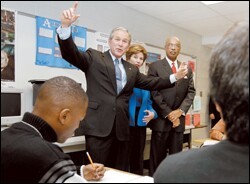
The backbone of his “high school initiative” is a plan to require reading and mathematics tests in 9th, 10th, and 11th grades. The federal No Child Left Behind Act, the signature education initiative of President Bush’s first term, requires testing in those subjects predominantly in the elementary and middle grades. The law currently requires testing only once at the high school level, and states are allowed to pick which grade is to be tested.
During his 40-minute speech, Mr. Bush spoke with passion at times about his administration’s refusal to retreat from the accountability demands of the 3-year-old federal law.
“Listen, I’ve heard every excuse in the book not to test,” he said. “My answer is, how do you know if a child is learning if you don’t test?”
The White House said the president’s fiscal 2006 federal budget proposal, which is likely to be released in early February, would contain the request for $1.5 billion for the high school initiative. Not all of that money would be new, as the initiative would roll some existing programs in with the proposals Mr. Bush announced last year and campaigned on in the fall.
The president said the plan would provide $250 million in the next fiscal year to the states for the additional testing, which aides to Mr. Bush have had to clarify in the past would be neither an exit test nor a federally designed test. (“Bush Test Proposal for High Schoolers Joins Wider Trend,” Sept. 15, 2004.)
The initiative also proposes funding for teachers to analyze the grades of incoming 9th graders so that an individual learning plan could be created for students at risk of falling behind their peers.
Focused Instruction
In addition, the initiative includes the president’s request to increase funding for his Striving Readers program, an adolescent-literacy program, to $200 million. The money would be used to help more than 100 school districts train teachers in methods to teach literacy to middle and high school students. Mr. Bush requested $100 million for that program for the current fiscal year, but Congress approved only $24.8 million.
Another $120 million will be proposed to improve high school math by training math teachers in methods that Mr. Bush said in his speech were “proven to succeed.”
In his speech, Mr. Bush frequently referred to his host school, Stuart High, which is in the 166,000-student Fairfax County, Va., school district. The school struggled with low test scores and poor achievement several years ago, but now is meeting all state and federal education standards.
“By focusing on results and stressing the importance of reading, by making sure that the measurement systems focus on each individual child, by not tolerating excuses for failure, this school has been turned around,” Mr. Bush said, to applause. “And how do we know? … I know because you measure.”
He added, “I want other schools who have got a student population as diverse as a Stuart High School to know that success and excellence is possible.”
Education advocates said last week that they supported a focus on improving high schools.
More Bureaucracy?
“Even if we give kids a strong start, we need to continue with good teaching and rigorous content through middle and high school,” said Susan Traiman, the director of education and workforce policy for the Washington-based Business Roundtable, an association of chief executive officers of many of the nation’s largest corporations.
“We are encouraged by the fact that he has turned his attention to secondary education,” Michael Carr, the associate director of public affairs for the Reston, Va.-based National Association of Secondary School Principals, said of the president. The literacy program and individualized plans for students who have below-grade-level skills are also positive initiatives, Mr. Carr said.
However, Mr. Carr and Reg Weaver, the president of the National Education Association, said last week that more testing along the lines required by the No Child Left Behind Act was problematic.
“All it does is put in place more paper and more bureaucracy,” said Mr. Weaver in an interview.
Mr. Carr said that measuring students in the same grade from year to year does not help teachers improve, because the same group of students is not being measured.
“That is where No Child Left Behind has not gone far enough,” he said. “I would have to guess this initiative isn’t going to be much different, so I’m not sure it’s going to be far enough.”


