Ķvlog

Law & Courts

Court Overturns Montana Funding System

By Mary Ann Zehr — November 16, 2004 3 min read
  • Save to favorites
  • Print
Email Copy URL

In the legislative session that begins in January, Montana lawmakers will be under the gun to come up with a definition for a “quality” public education, following the Montana Supreme Court’s decision last week to strike down the state’s school funding formula.

While it held that the financing system is fatally flawed, the court said the question of whether Montana schools have enough money can’t be resolved until the system is based on “educationally relevant factors.” For that to happen, the court found, the legislature needs to interpret the meaning of the state constitution’s reference to “a basic system of free quality public elementary and secondary schools.”

In a unanimous decision on Nov. 9, the state’s highest court gave the legislature a deadline of Oct. 1 of next year to come up with a better system. In doing so, it upheld the ruling in April of Helena District Judge Jeffrey Sherlock that state funding for public schools is insufficient. The three-page preliminary order also upheld Judge Sherlock’s finding that the public education system is violating a mandate in the state constitution for schools to teach children about the heritage of American Indians.

Order Is Preliminary

Having rushed to issue a preliminary order on the matter so the legislature could address it in its upcoming session, the high court will issue a full opinion at an unspecified later date. State legislators are set to resume work Jan. 3 for a session expected to last 90 days.

The decision marked the second time the state’s funding formula has been struck down since 1989.

Following the latest ruling, Montanans need to take a much closer look at the needs and true cost of public schooling, said Jack Copps, the executive director of the Helena-based Montana Quality Education Coalition, which filed the current lawsuit in 2002.

“We’ve only speculated in Montana the amount of resources our schools need,” he said. That has led to problems such as a difficulty in recruiting and retaining teachers, he said, because Montana’s schools don’t pay enough.

But Brian Morris, the state solicitor who defended Montana in the case, said he was disappointed by the ruling. “We had urged the court to look at output measures, such as graduation rates and what students are learning,” he said.

Montana’s schools measure up well nationally, he said. He noted, for example, that its students perform well above average on standardized tests and that their graduation rates are higher than many other states.

Linda H. McCulloch, Montana’s superintendent of public instruction, said she hopes the court decision will result in more money to pay teachers better salaries. Many Montana school districts offer a starting salary of less than $20,000 per year, and about 60 percent don’t provide health insurance for their faculty members, she said.

Spending Rise Foreseen

Both Republicans and Democrats who served on the state Senate’s education committee in the most recent legislative session surmised that revamping the funding system to satisfy the court would mean coming up with more dollars for schools.

“That doesn’t necessarily mean that on a given piece of property, the taxes will go up,” said Sen. William E. Glaser, a Republican who chairs the Senate education committee. “We’ve actually done quite well in our economy, when everyone else was struggling.”

“I’d be surprised if everyone isn’t resigned to the fact that we’ll have to put more money into education,” added Sen. Mike Cooney, a Democrat on the same committee. The difficulty of resolving the issue, he said, will be agreeing on what level of funding is appropriate.

Sen. Robert R. Story Jr., a Republican member of the education committee, said the state’s formula for financing public schools is based on the number of pupils in a school, and places caps on what local districts can spend in addition to what they receive from the state.

The system reflects revisions made more than a decade ago in response to a previous ruling by the supreme court, which held that the system wasn’t equitable, he noted. Mr. Story said the existing system worked when student enrollment was growing, but now that it has been declining districts haven’t been able to keep up with their fixed costs.

Montana provided $555 million for K-12 education in fiscal 2004, or 60 percent of the local and state total spent on public schooling.

On the separate issue addressed in the high court’s ruling last week, Joyce Silverthorne, the head of the tribal education department for the Salish/Kootenai tribes of Montana and a former state school board member, said she was pleased that the court affirmed the constitutional mandate that schools teach all Montanans about their state’s 12 Indian tribes.
Related Tags:

A version of this article appeared in the November 17, 2004 edition of Education Week as Court Overturns Montana Funding System

Events

This content is provided by our sponsor. It is not written by and does not necessarily reflect the views of Education Week's editorial staff.
Sponsor
Artificial Intelligence Webinar
Managing AI in Schools: Practical Strategies for Districts
How should districts govern AI in schools? Learn practical strategies for policies, safety, transparency, as well as responsible adoption.
Content provided by 
This content is provided by our sponsor. It is not written by and does not necessarily reflect the views of Education Week's editorial staff.
Sponsor
Reading & Literacy Webinar
Unlocking Success for Struggling Adolescent Readers
The Science of Reading transformed K-3 literacy. Now it's time to extend that focus to students in grades 6 through 12.
Content provided by 
Jobs Virtual Career Fair for Teachers and K-12 Staff
Find teaching jobs and K-12 education jubs at the EdWeek Top School Jobs virtual career fair.

EdWeek Top School Jobs

Teacher Jobs
Search over ten thousand teaching jobs nationwide — elementary, middle, high school and more.
Principal Jobs
Find hundreds of jobs for principals, assistant principals, and other school leadership roles.
Administrator Jobs
Over a thousand district-level jobs: superintendents, directors, more.
Support Staff Jobs
Search thousands of jobs, from paraprofessionals to counselors and more.

Read Next

Law & Courts Supreme Court Backs Parents in School Gender Disclosure Fight
The Supreme Court restored an injunction blocking California policies on student gender transitions
8 min read
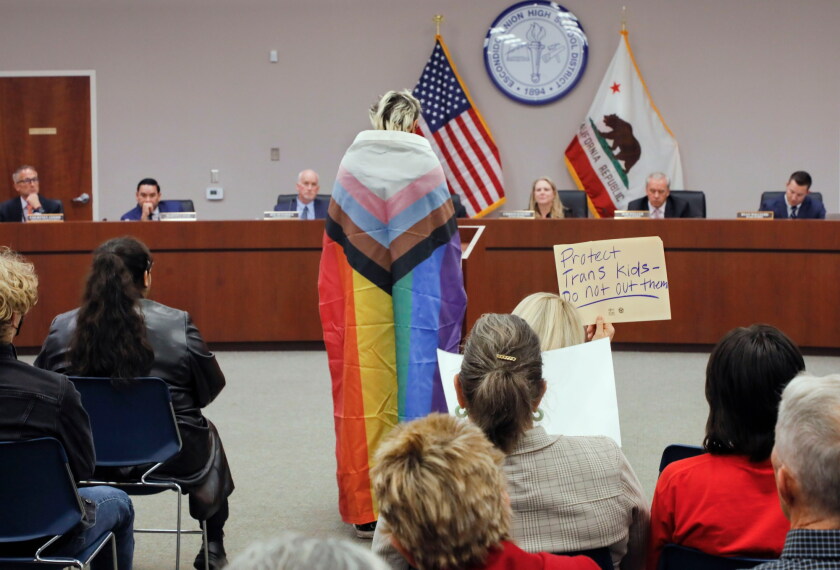
Teacher’s aide Amelia Mester, wrapped in a Pride flag, urges Escondido Union High School District not to have employees notify parents if they believe a student may be transgender in November 2025. A policy on the issue in the city’s elementary school district is the subject of a federal class-action lawsuit in which a judge just sided against the district.
Teacher’s aide Amelia Mester, wrapped in a Pride flag, urges Escondido Union High School District not to have employees notify parents if they believe a student may be transgender at a meeting in November 2025. Two parents and two teachers from the district sued in 2023, challenging California state guidance concerning student gender transitions and parental notification. The U.S. Supreme Court has now reinstated a lower-court decision overturning those state policies.
Charlie Neuman for The San Diego Union-Tribune/TNS
Law & Courts Appeals Court Allows Louisiana Ten Commandments Displays to Proceed
The court said it was premature to rule on the constitutionality of La. Ten Commandments displays.
3 min read
Students work under Ten Commandments and Bill of Rights posters on display in a classroom at Lehman High School in Kyle, Texas, Thursday, Oct. 16, 2025.
Students work under Ten Commandments and Bill of Rights posters on display in a classroom at Lehman High School in Kyle, Texas, Oct. 16, 2025. A federal appeals court has lifted a lower-court injunction blocking a Louisiana law that requires Ten Commandments displays, clearing the way for the law to take effect.
Eric Gay/AP
Law & Courts Supreme Court Strikes Trump Tariffs in Case Brought by Educational Toy Companies
Two educational toy companies were among the leading challengers to the president's tariff policies
3 min read
Members of the Supreme Court sit for a new group portrait following the addition of Associate Justice Ketanji Brown Jackson, at the Supreme Court building in Washington, Oct. 7, 2022. Bottom row, from left, Associate Justice Sonia Sotomayor, Associate Justice Clarence Thomas, Chief Justice of the United States John Roberts, Associate Justice Samuel Alito, and Associate Justice Elena Kagan. Top row, from left, Associate Justice Amy Coney Barrett, Associate Justice Neil Gorsuch, Associate Justice Brett Kavanaugh, and Associate Justice Ketanji Brown Jackson.
Members of the U.S. Supreme Court sit for a new group portrait following the addition of Justice Ketanji Brown Jackson, at the court building in Washington, Oct. 7, 2022. On Feb. 20, 2026, the court ruled 6-3 to strike down President Donald Trump's broad tariff policies, ruling that they were not authorized by the federal statute that he cited for them.
J. Scott Applewhite/AP
Law & Courts California Sues Ed. Dept. in Clash Over Gender Disclosures to Parents
California challenges U.S. Department of Education findings on state policies over gender disclosure.
4 min read
California Attorney General Rob Bonta speaks to reporters as Arizona Attorney General Kris Mayes, left, and Oregon Attorney General Dan Rayfield, right, listen outside the Supreme Court on Wednesday, Nov. 5, 2025, in Washington. (AP Photo/Mark Schiefelbein)
California Attorney General Rob Bonta speaks to reporters outside the U.S. Supreme Court in Washington on Nov. 5, 2025, with Arizona Attorney General Kris Mayes and Oregon Attorney General Dan Rayfield behind him. Bonta this week sued the U.S. Department of Education, asking a court to block the agency's finding that the state is violating FERPA by <ins data-user-label="Matt Stone" data-time="02/13/2026 4:22:45 PM" data-user-id="00000185-c5a3-d6ff-a38d-d7a32f6d0001" data-target-id="">not requiring schools to disclose</ins> students’ gender transitions <ins data-user-label="Matt Stone" data-time="02/13/2026 4:22:45 PM" data-user-id="00000185-c5a3-d6ff-a38d-d7a32f6d0001" data-target-id="">to</ins> parents.
Mark Schiefelbein/AP
