Over the past 40 years, the federal Elementary and Secondary Education Act has evolved from an effort primarily aimed at providing general aid to schools with large populations of disadvantaged students to a complex undertaking that includes a long list of education prescriptions for states.
A panel discussion here last week that included former and current federal policymakers as well as academics took a look back at steps the landmark law has taken to reach its current form.
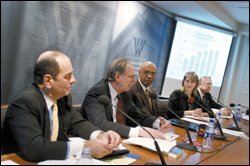
Although the March 15 event at the Woodrow Wilson International Center for Scholars was billed as a look at the history of the ESEA, which celebrates its 40th anniversary next month, most of the talk was of its latest incarnation: the No Child Left Behind Act of 2001.
Former Secretary of Education Rod Paige said that while previous versions of the federal law contained many good ideas, they often were not put into practice when states and school districts found them difficult to implement.
“The trend was, they don’t get it done,” he said. “Every time there was some kind of discomfort, there were applications for waivers and efforts to make changes.”
The difference between the previous versions of the law and the 3-year-old No Child Left Behind Act is that President Bush’s administration has insisted that states comply with the law’s accountability measures, said Mr. Paige, who stepped down as education secretary in January at the end of the president’s first term.
“We had to break this culture of delays and waivers,” he said.
Mr. Paige said that under his leadership, the Department of Education made it clear that states must fall in line, and that they have. The result, he maintained, is that the achievement gap between most minority students and their white peers is closing.
“It’s very important we keep a culture of carrying out the intent of the law,” said the recently departed secretary, who has joined the Wilson Center for a six-month appointment as a public policy scholar to study the achievement gap.
Rep. Michael N. Castle, R-Del., a member of the House Education and the Workforce Committee who had a hand in crafting the law, said that while many people would like to see the No Child Left Behind Act altered, that is unlikely to happen before the next reauthorization, which is scheduled for 2007.
“Politically, No Child Left Behind has sufficient support to stay in place,” Rep. Castle said. Significant changes to the law, he said, are “simply not going to happen under President Bush.”
Embracing the Concept
Bills proposing federal education aid to the states failed numerous times in Congress during the first half of the 20th century. It wasn’t until Lyndon B. Johnson—a former teacher—became president that a major program of federal aid to K-12 schools won passage, an essay by Don Wolfensberger, the director of the Congress Project at the Wilson Center, points out. In his 1965 State of the Union Address, President Johnson said the top item on his agenda was “a program to ensure every American child the fullest development of his mind and skills,” according to Mr. Wolfensberger’s essay, released at the conference.
President Johnson said the education legislation would contain a program for assistance to students from low-income families—which ultimately became the Title I program. The bulk of federal education help, Mr. Johnson assured Americans, would go to schoolchildren from needy families.
On April 11, 1965, President Johnson signed the ESEA into law, authorizing $1.3 billion (in 1965 dollars) in general aid to the nation’s elementary schools.
Although over the decades, Congress has provided an increasing amount of money for precollegiate education, not enough progress has been made in student achievement, Rep. Castle said.
“We have poured a lot of money [into the public school system],” he said. “Frankly, the results might not be all that we’d wish for.”
The No Child Left Behind law set about tackling the problem of achievement gaps between minority and white students, he said. Mr. Castle said it was significant that while some Republicans had lobbied to abolish the Education Department as recently as a few years ago, under President Bush both GOP and Democratic politicians have worked together on education legislation.
At first, Mr. Castle said, “Democrats embraced the concept. … Republicans embraced their president” when it came to the law.
Former Rep. John Brademas, a Democrat from Indiana who was a co-author of the 1965 ESEA and is now president emeritus of New York University, noted the “depth of partisanship” in Congress now. He called President Bush “the most radically right-wing president of my lifetime.”
That’s why, Mr. Brademas said, it is significant that the president put forward the No Child Left Behind Act and has made it such a cornerstone of his domestic policy.
But some states are looking to buck the law, introducing legislation that would blunt its impact. Though Mr. Paige said he believes states should comply, he said he supports the right they currently have to opt out of the law, at the cost of giving up their federal education funding.
“If states don’t want federal money and they find these requirements intolerable, they should be free not to accept it,” he said, “but I would feel sorry for the children.”


