ĚÇĐĶŻÂţvlog

Law & Courts

Federal Appeals Court Upholds Use of Race by Lynn, Mass., Schools

By Caroline Hendrie — June 17, 2005 3 min read
  • Save to favorites
  • Print
Email Copy URL

A federal appeals court in Boston has narrowly upheld a voluntary desegregation plan in the Lynn, Mass., school district in a case that is being closely followed by supporters and critics of race-conscious policies in K-12 schooling.

In a 3-2 ruling on June 16, the U.S. Court of Appeals for the 1st Circuit reversed a decision by a three-judge panel of the same court last October that had struck down the district’s student-assignment policy as unconstitutionally discriminatory.

The Comfort v. Lynn School Committee lawsuit was brought in 1999 by parents of students from a variety of races and ethnicities who had been denied requests to transfer to other schools because of the district’s policy. A lawyer for those families said they intended to appeal the decision to the U.S. Supreme Court.

Under the 15,000-student district’s assignment policy, students are guaranteed admission to their neighborhood schools. But if they wish to transfer to schools outside their attendance areas, the district weighs the move’s impact on the racial and ethnic balance of the affected schools.

The 1st Circuit court’s majority said the policy passed constitutional muster because “the Lynn plan is narrowly tailored to the defendants’ compelling interest in obtaining the benefits of racial diversity.”

The appeals court based its decision on the U.S. Supreme Court’s 2003 ruling in Grutter v. Bollinger, a case involving the use of race in admissions to the University of Michigan Law School. The high court held that obtaining the educational benefits that flow from a diverse student body could justify the use of race-conscious policies, at least in the context of an elite law school.

“The Lynn plan uses races in pursuit of many of the same benefits that were cited approvingly by the Grutter court, including breaking down racial barriers, promoting cross-racial understanding, and preparing students for a world in which â€race unfortunately still matters,’ ” the 1st Circuit court’s majority opinion says.

Headed for High Court

The Lynn case is the first time that a federal appeals court has upheld a voluntary integration policy in the K-12 context by applying the Grutter case and a companion case known as Gratz v. Bollinger, which involved undergraduate admissions to the University of Michigan.

The two judges who dissented from the majority opinion in Comfort v. Lynn concluded that the Lynn policy involved the inflexible, mechanistic use of race and therefore ran afoul of the principles the Supreme Court laid out in Grutter and Gratz.

“Many good things can be said about the Lynn plan,” the dissenting opinion says. “But the overriding fact is that it unnecessarily inflicts racially based wounds on a large and diverse group of its students and, consequently, fails to satisfy the narrow-tailoring requirements set out in the Supreme Court’s equal protection jurisprudence.”

Massachusetts Attorney General Thomas F. Reilly, who represented the Lynn district, hailed the ruling. “This case proves that race does matter and is a factor—a positive one,” he said in a statement. “We all benefit when people with different perspectives and different ethnicities come together in a learning environment.”

Chester Darling, a Boston-based lawyer for the plaintiffs, said the ruling did not surprise him, calling the Boston-based appeals court “a very liberal circuit.” “You can’t define people by their color and that’s what this has done,” he said, adding that he thought the court had misapplied the U.S. Supreme Court’s ruling in the Michigan law school case. “This has nothing to do with graduate school,” he said. “This is about little kids, and they’re just moving them around like Chinese checkers.”

Even though the Supreme Court takes up only a fraction of the appeals it receives, Mr. Darling said he thought this case would stand a strong chance of being heard because at least one other federal appeals court decision has gone the other way.

Last year, a San Francisco-based federal court held that the Seattle school system had failed to justify its integration plan under principles the high court laid out in Grutter and Gratz.
Related Tags:

Events

This content is provided by our sponsor. It is not written by and does not necessarily reflect the views of Education Week's editorial staff.
Sponsor
Artificial Intelligence Webinar
Managing AI in Schools: Practical Strategies for Districts
How should districts govern AI in schools? Learn practical strategies for policies, safety, transparency, as well as responsible adoption.
Content provided by 
This content is provided by our sponsor. It is not written by and does not necessarily reflect the views of Education Week's editorial staff.
Sponsor
Reading & Literacy Webinar
Unlocking Success for Struggling Adolescent Readers
The Science of Reading transformed K-3 literacy. Now it's time to extend that focus to students in grades 6 through 12.
Content provided by 
Jobs Virtual Career Fair for Teachers and K-12 Staff
Find teaching jobs and K-12 education jubs at the EdWeek Top School Jobs virtual career fair.

EdWeek Top School Jobs

Teacher Jobs
Search over ten thousand teaching jobs nationwide — elementary, middle, high school and more.
Principal Jobs
Find hundreds of jobs for principals, assistant principals, and other school leadership roles.
Administrator Jobs
Over a thousand district-level jobs: superintendents, directors, more.
Support Staff Jobs
Search thousands of jobs, from paraprofessionals to counselors and more.

Read Next

Law & Courts Supreme Court Backs Parents in School Gender Disclosure Fight
The Supreme Court restored an injunction blocking California policies on student gender transitions
8 min read
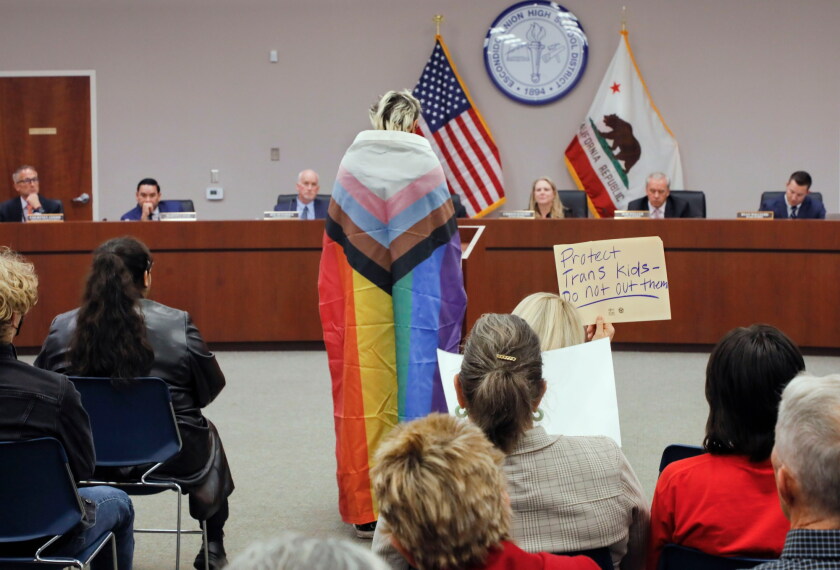
Teacher’s aide Amelia Mester, wrapped in a Pride flag, urges Escondido Union High School District not to have employees notify parents if they believe a student may be transgender in November 2025. A policy on the issue in the city’s elementary school district is the subject of a federal class-action lawsuit in which a judge just sided against the district.
Teacher’s aide Amelia Mester, wrapped in a Pride flag, urges Escondido Union High School District not to have employees notify parents if they believe a student may be transgender at a meeting in November 2025. Two parents and two teachers from the district sued in 2023, challenging California state guidance concerning student gender transitions and parental notification. The U.S. Supreme Court has now reinstated a lower-court decision overturning those state policies.
Charlie Neuman for The San Diego Union-Tribune/TNS
Law & Courts Appeals Court Allows Louisiana Ten Commandments Displays to Proceed
The court said it was premature to rule on the constitutionality of La. Ten Commandments displays.
3 min read
Students work under Ten Commandments and Bill of Rights posters on display in a classroom at Lehman High School in Kyle, Texas, Thursday, Oct. 16, 2025.
Students work under Ten Commandments and Bill of Rights posters on display in a classroom at Lehman High School in Kyle, Texas, Oct. 16, 2025. A federal appeals court has lifted a lower-court injunction blocking a Louisiana law that requires Ten Commandments displays, clearing the way for the law to take effect.
Eric Gay/AP
Law & Courts Supreme Court Strikes Trump Tariffs in Case Brought by Educational Toy Companies
Two educational toy companies were among the leading challengers to the president's tariff policies
3 min read
Members of the Supreme Court sit for a new group portrait following the addition of Associate Justice Ketanji Brown Jackson, at the Supreme Court building in Washington, Oct. 7, 2022. Bottom row, from left, Associate Justice Sonia Sotomayor, Associate Justice Clarence Thomas, Chief Justice of the United States John Roberts, Associate Justice Samuel Alito, and Associate Justice Elena Kagan. Top row, from left, Associate Justice Amy Coney Barrett, Associate Justice Neil Gorsuch, Associate Justice Brett Kavanaugh, and Associate Justice Ketanji Brown Jackson.
Members of the U.S. Supreme Court sit for a new group portrait following the addition of Justice Ketanji Brown Jackson, at the court building in Washington, Oct. 7, 2022. On Feb. 20, 2026, the court ruled 6-3 to strike down President Donald Trump's broad tariff policies, ruling that they were not authorized by the federal statute that he cited for them.
J. Scott Applewhite/AP
Law & Courts California Sues Ed. Dept. in Clash Over Gender Disclosures to Parents
California challenges U.S. Department of Education findings on state policies over gender disclosure.
4 min read
California Attorney General Rob Bonta speaks to reporters as Arizona Attorney General Kris Mayes, left, and Oregon Attorney General Dan Rayfield, right, listen outside the Supreme Court on Wednesday, Nov. 5, 2025, in Washington. (AP Photo/Mark Schiefelbein)
California Attorney General Rob Bonta speaks to reporters outside the U.S. Supreme Court in Washington on Nov. 5, 2025, with Arizona Attorney General Kris Mayes and Oregon Attorney General Dan Rayfield behind him. Bonta this week sued the U.S. Department of Education, asking a court to block the agency's finding that the state is violating FERPA by <ins data-user-label="Matt Stone" data-time="02/13/2026 4:22:45 PM" data-user-id="00000185-c5a3-d6ff-a38d-d7a32f6d0001" data-target-id="">not requiring schools to disclose</ins> students’ gender transitions <ins data-user-label="Matt Stone" data-time="02/13/2026 4:22:45 PM" data-user-id="00000185-c5a3-d6ff-a38d-d7a32f6d0001" data-target-id="">to</ins> parents.
Mark Schiefelbein/AP
