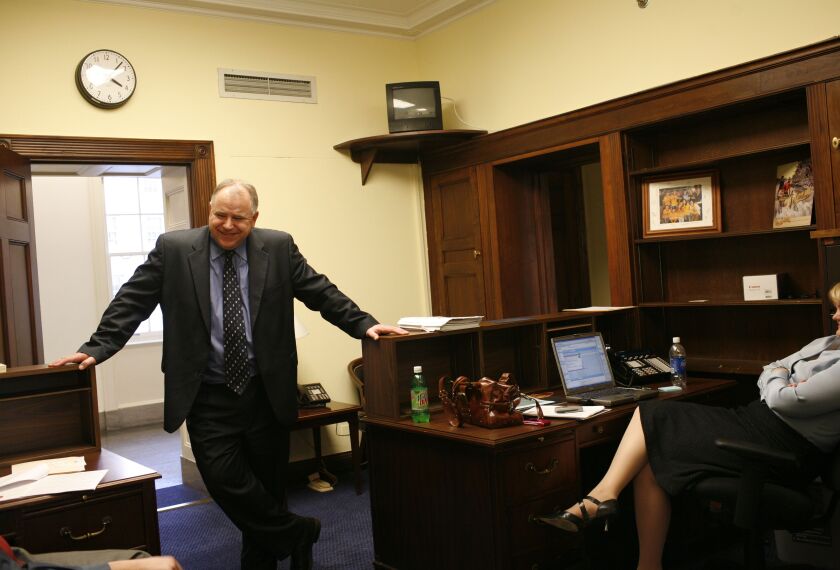
Until last spring, Tim Walz was a high school teacher and football coach from southern Minnesota. He had no political experience whatsoever, but he didn鈥檛 like the choices being made on Capitol Hill, and struggled to explain them to his social studies students.
So Walz made a decision: He would run for Congress as a Democrat. On the campaign trail, the barrel-chested former National Guardsman called for a new approach to the war in Iraq and sharply criticized the No Child Left Behind Act, calling it a 鈥渂ureaucratic nightmare.鈥�
He won.
We visited Walz in his congressional offices just weeks after he arrived. He gushed about his favorite perks鈥攖ours of the Capitol dome and the private reading room at the Library of Congress鈥攕eeming wide-eyed and still a little surprised to find himself in Washington, as though he has to occasionally pinch himself.
When we sat down to talk about how he came to power and what he hopes to change, though, Walz became all business, slipping into the polished persona of a far more experienced statesman.
How did you decide to run for Congress?
I was very frustrated by the direction of the country, and I鈥檇 been giving it some thought. Some of my neighbors and people in town thought that this was the time for a teacher鈥攕omeone who was more grounded in what people really care about鈥攁nd that鈥檚 when I said yes. A bit naively, I might add, but we did it.
How did your students and your teaching colleagues react?
They were inspired by the idea that if you think something needs to be changed, that you have an obligation to go out and do it.
Did you expect to win?
We believed we could win, and, as it turned out, I think the skill set of teaching served me well.
How so?
The biggest thing is communicating an idea. It鈥檚 trying to get people to be involved and to look at the facts. ... Teaching is the same way. You鈥檙e trying to present a system of facts; you鈥檙e trying to teach students what鈥檚 the best way to think about problems to solve them in a rational way.
Which is more challenging, teaching or politics?
Right now they鈥檙e about equal. Somebody said, 鈥淒o you feel like you鈥檙e juggling about 10 balls?鈥� and I said, 鈥淵eah, and that鈥檚 pretty much what I came from before.鈥� The biggest thing here is I actually get some support help. Of course, with budget cuts in education, we do our own copying, our own everything. Here I get some help.
Tell us about your experiences as a teacher with the No Child Left Behind law.
The goal and the ambition of NCLB is one that all teachers share. 鈥� My experience, though, is that NCLB and the application of it has had very little impact on real student achievement.
We do have large [achievement] gaps, especially in some of our subgroups. I鈥檓 a firm believer that the best way to eliminate those gaps is to never let them get started. So when we鈥檙e cutting money from early childhood education, we鈥檙e ending up with a gap.
It鈥檚 taught me, as a teacher, that we have to take ownership of this because we have the expertise in this, and we need to define what success is going to look like instead of having someone do that for us.
What did you see in your classroom that made you want to come to Washington?
The discourse in general in the country was very discouraging to our younger generation. They quite honestly don鈥檛 understand why we continue to circle and circle on some issues 鈥� and why we鈥檙e not addressing global warming, why we鈥檙e not addressing the crisis in the Middle East, why we鈥檙e not doing investments in cancer and AIDS research, and why we鈥檙e seeing cuts in all those things.

So your students鈥� frustration inspired you?
I didn鈥檛 think there was a civil discourse. I didn鈥檛 think people were actually here [on Capitol Hill] to solve problems. I thought this was more about a narrow agenda and more ideological than practical. It actually came up several times, students would say this: 鈥淲ell, what are you going to do about it?鈥� And [the answer] finally became, 鈥淚鈥檓 going to run for Congress.鈥� They thought that was all right. The thing that felt so gratifying was that they saw nothing crazy about it.
Do you think NCLB can be fixed?
It鈥檚 going to be hard. I think there鈥檚 going to be resistance to trying to fix it the way it needs to [be fixed].
If you could have your way, would you scrap the law or revamp it?
I would start over, because what I found is when you try [to fix a law], you get a monstrosity with a lot of attachments鈥擝and-Aids and duct tape.
What do you most hope to accomplish while you鈥檙e in Washington?
I want to make college more affordable. I want to make more students believe that they are an American dream. I want to have more Americans have faith that this works for them, not against them.


