Ķvlog

Federal

Guidelines Offered for Meaningful Studies of Achievement in Charters

By Erik W. Robelen — June 06, 2006 4 min read
  • Save to favorites
  • Print
Email Copy URL

A national panel is raising concerns about the quality of much of the research to date on charter school achievement, and has outlined recommendations to help ensure better analyses in the future.

The first in a series of white papers from the group of researchers, issued May 31, notes that while the volume of research on student performance in charters has grown dramatically, the actual quality of that research doesn’t seem to be improving.

is available from the .

“It’s actually fairly discouraging,” Julian Betts, an economics professor at the University of California, San Diego, said at a forum here last week.

The paper was drafted by the Charter School Achievement Consensus Panel, a group convened last year by the National Charter School Research Project at the University of Washington in Seattle.

The analysis concludes that 64 percent of research issued from 2001-03 on charter achievement used research designs that the panel judged to be fair or poor. When the time period was extended to 2001-05, the figures were only marginally better, with 61 percent of studies using fair or poor designs, the paper says.

“The literature has tripled in size between 2003 and 2005,” said Mr. Betts, a panel member who summarized the study May 31 at the Washington-based Brookings Institution. “That’s a huge acceleration. But we don’t see an acceleration of the [quality of] research designs being used.”

The report lays out specific recommendations on how to get the most meaningful results from research into student achievement in the nation’s roughly 3,600 charter schools.

“The bottom line of our white paper, really, is three words: Multiple methods needed,” Mr. Betts said.

No Approach Perfect

The white paper comes amid heated debate about whether charter schools offer a more promising education to students than regular public schools.

The consensus panel’s mission is to evaluate current research on charter school effectiveness and develop standards for future studies. The project also aims to influence the kinds of studies that receive funding and bills itself as a neutral voice in discussions on charter schools.

The panel’s eight members include researchers from different fields with diverse methodological traditions: sociology, economics, psychometrics, and political science. Besides Mr. Betts, they include Paul T. Hill from the University of Washington, who heads up the National Charter School Research Project; Jeffrey R. Henig, a professor of political science and education at Teachers College, Columbia University; and Laura Hamilton, a senior behavioral scientist at the RAND Corp.’s Pittsburgh office.

The paper suggests that the key research question on charter achievement is whether students in the independently run but publicly financed schools are learning more or less than they would have learned in regular public schools.

Of a range of approaches used to study charter achievement, among the strongest is a method that can approximate the conditions of a randomized experiment by comparing students who won a lottery for charter school seats with those who lost out in the lottery, the paper says.

One major limitation of that approach, though, is that it only works for charter schools that are overenrolled and fill seats via lotteries, the panel notes. That raises questions about how representative charter schools in such studies may be.

It said the weakest studies use such methods as comparing average test scores in charter versus noncharter schools using just one year’s test results.

Studies’ Scope Debated

Another weak approach, the study says, is to include controls for few student characteristics. Such a method cannot provide assurance that the charter students are truly similar to the comparison group in regular public schools, the paper says.

“Since no one method is problem-free, the only option is for researchers to use the best methods available to them and make sure the limitations of their results are evident,” the paper says.

Some participants in last week’s forum cautioned about the limits of broad-based comparisons given the wide diversity of charter schools and of state laws governing them, among other factors.

“Charter is a right to be different, a right to be heterogeneous,” said Chester E. Finn Jr., the president of the Washington-based Thomas B. Fordham Foundation and a former assistant education secretary in President Reagan’s administration. His group, which supports charter schools, recently issued a paper offering a typology of such schools, outlining 55 different categories.

Another participant suggested that the research should also pay attention to how different states weed out good charter schools from bad ones.

Mr. Betts agreed that it’s important to keep in mind the differences among charter schools. He also said there was considerable disagreement among panelists about the value of launching national studies on charter schools.

David Garcia, an assistant professor of education at Arizona State University who came to the event, echoed that point.

“There are no national decisionmakers” for charter policy, he said. “I’m not certain what a national study would tell Arizona that Arizona needs to know.”

A version of this article appeared in the June 07, 2006 edition of Education Week as Guidelines Offered for Meaningful Studies of Achievement in Charters

Events

This content is provided by our sponsor. It is not written by and does not necessarily reflect the views of Education Week's editorial staff.
Sponsor
Reading & Literacy Webinar
Unlocking Success for Struggling Adolescent Readers
The Science of Reading transformed K-3 literacy. Now it's time to extend that focus to students in grades 6 through 12.
Content provided by 
Jobs Virtual Career Fair for Teachers and K-12 Staff
Find teaching jobs and K-12 education jubs at the EdWeek Top School Jobs virtual career fair.
This content is provided by our sponsor. It is not written by and does not necessarily reflect the views of Education Week's editorial staff.
Sponsor
College & Workforce Readiness Webinar
Portrait of a Learner: From Vision to Districtwide Practice
Learn how one district turned Portrait of a Learner into an aligned, systemwide practice that sticks.
Content provided by Otus

EdWeek Top School Jobs

Teacher Jobs
Search over ten thousand teaching jobs nationwide — elementary, middle, high school and more.
Principal Jobs
Find hundreds of jobs for principals, assistant principals, and other school leadership roles.
Administrator Jobs
Over a thousand district-level jobs: superintendents, directors, more.
Support Staff Jobs
Search thousands of jobs, from paraprofessionals to counselors and more.

Read Next

Federal Trump Talks Up AI in State of the Union, But Not Much Else About Education
The president didn't mention two of his cornerstone education policies from the past year.
4 min read
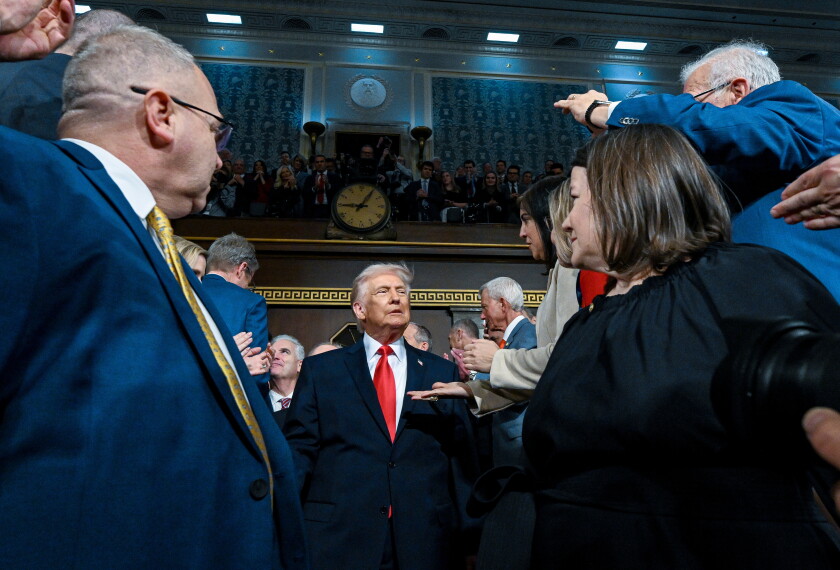
President Donald Trump enters to deliver the State of the Union address to a joint session of Congress in the House chamber at the U.S. Capitol in Washington, Tuesday, Feb. 24, 2026.
President Donald Trump enters to deliver the State of the Union address to a joint session of Congress in the House chamber at the U.S. Capitol in Washington, Tuesday, Feb. 24, 2026. The president devoted little time in the speech to discussing his education policies.
Kenny Holston/The New York Times via AP, Pool
Federal Education Department Will Send More of Its Programs to Other Agencies
Education grants for school safety, community schools, and family engagement will shift to Health and Human Services.
4 min read
Various school representatives and parent liaisons attend a family and community engagement think tank discussion at Lowery Conference Center on March 13, 2024 in Denver. One of the goals of the meeting was to discuss how schools can better integrate new students and families into the district. Denver Public Schools has six community hubs across the district that have serviced 3,000 new students since October 2023. Each community hub has different resources for families and students catering to what the community needs.
A program that helps state education departments and schools improve family engagement policies is among those the Trump administration will transfer from the U.S. Department of Education to the U.S. Department of Health and Human Services. In this photo, school representatives and parent liaisons attend a family and community engagement discussion on March 13, 2024, in Denver to discuss how schools can better integrate new students and families into the district.
Rebecca Slezak For Education Week
Federal New Trump Admin. Guidance Says Teachers Can Pray With Students
The president said the guidance for public schools would ensure "total protection" for school prayer.
3 min read
MADISON, AL - MARCH 29: Bob Jones High School football players touch the people near them during a prayer after morning workouts and before the rest of the school day on March 29, 2024, in Madison, AL. Head football coach Kelvis White and his brother follow in the footsteps of their father, who was also a football coach. As sports in the United States deals with polarization, Coach White and Bob Jones High School form a classic tale of team, unity, and brotherhood. (Photo by Jahi Chikwendiu/The Washington Post via Getty Images)
Football players at Bob Jones High School in Madison, Ala., pray after morning workouts before the rest of the school day on March 29, 2024. New guidance from the U.S. Department of Education says students and Ķvlog can pray at school, as long as the prayer isn't school-sponsored and disruptive to school and classroom activities, and students aren't coerced to participate.
Jahi Chikwendiu/Washington Post via Getty Images
Federal Ed. Dept. Paid Civil Rights Staffers Up to $38 Million as It Tried to Lay Them Off
A report from Congress' watchdog looks into the Trump Admin.'s efforts to downsize the Education Department.
5 min read
Commuters walk past the headquarters of the U.S. Department of Eduction, which were ordered closed for the day for what officials described as security reasons amid large-scale layoffs, on March 12, 2025, in Washington.
The U.S. Department of Education spent up to $38 million last year to pay civil rights staffers who remained on administrative leave while the agency tried to lay them off.
Mark Schiefelbein/AP