Ķvlog

Law & Courts

NEA, AFT Sue to Block Trump’s Education Department Dismantling

By Brooke Schultz — March 24, 2025 4 min read
Kim Anderson, the executive director of the National Education Association (NEA), speaks during a demonstration at the headquarters of the Department of Education, Friday, March 14, 2025, in Washington.
  • Save to favorites
  • Print
Email Copy URL

The nation’s two largest teachers’ unions have taken legal action to stop President Donald Trump and Education Secretary Linda McMahon’s push to dismantle the U.S. Department of Education, arguing that the president’s recent executive order telling McMahon to facilitate its closure exceeds his authority.

The separate legal challenges from the American Federation of Teachers and the National Education Association are the latest from the teachers’ unions as Trump has aggressively sought to whittle down the Education Department since taking office on Jan. 20.

The federal agency, already the smallest Cabinet-level department by headcount, has shrunk from a staff of more than 4,000 to roughly half of that through a mass reduction in force and repeated buyout offers. Last week, Trump directed McMahon through an executive order to “facilitate” the department’s shutdown and, seemingly off the cuff, began outlining where the department’s vast portfolio of responsibilities would move.

Trump and McMahon have said they would follow the law to close the department; only Congress has the authority to abolish a federal agency, and it would take 60 votes in the Senate for such a measure to pass. Congress would also have to approve the relocation of individual programs to different agencies.

But opponents, including the unions, say that Trump and McMahon are skirting that authority.

The American Federation of Teachers, along with six other plaintiffs, asking a federal judge in Massachusetts to deem Trump’s March 20 executive order unlawful, along with the massive reduction in force from earlier this month.

The National Education Association, joined by nine other plaintiffs, Monday in federal court in Maryland that asked a judge to halt McMahon from further dismantling the department.

Both argue that the department’s massive reduction in force, which eliminated entire divisions, has incapacitated the agency, preventing it from carrying out its statutorily required functions—like disbursing funding and grants and investigating civil rights violations.

See Also

Chloe Kienzle of Arlington, Va., holds a sign as she stands outside the headquarters of the U.S. Department of Education, which were ordered closed for the day for what officials described as security reasons amid large-scale layoffs, Wednesday, March 12, 2025, in Washington.
Chloe Kienzle of Arlington, Va., holds a sign as she stands outside the headquarters of the U.S. Department of Education on Wednesday, March 12, 2025, in Washington. The department this week announced it was shedding half its staff.
Mark Schiefelbein/AP
Federal Data: Which Ed. Dept. Offices Lost the Most Workers?
Brooke Schultz, March 13, 2025
3 min read

McMahon and the president are overstepping Congress’ authority in hobbling the department without lawmakers’ approval, the complaints argue. Congress established the department in 1979, something the NEA had long pushed for, creating offices and positions in statute that the president does not have the power to undo.

“Dismantling the Department of Education, including by firing half of the Department, will bring … activities to a halt, harming students, Ķvlog, and school districts across the country,” the AFT complaint says.

Madi Biedermann, a department spokesperson, said in a statement that sunsetting the department will be done with Congress and state leaders. She criticized the AFT for “misleading the American public to keep their stranglehold on the American education bureaucracy” and “forcing the Department to waste resources on litigation.”

“To date, no action has been taken to move federally mandated programs out of the Department of Education. The U.S. Department of Education continues to deliver on all programs that fall under the agency’s purview, including vigilantly enforcing federal civil rights laws in schools and ensuring students with special needs and disabilities have access to critical resources,” Biedermann said.

Districts, parents say dismantling ED will trickle down

The Somerville and Easthampton school districts in Massachusetts, which joined AFT in its litigation, say that federal funds help them pay for personnel, keep class sizes small, and cover transportation costs. Without “timely and predictable funding,” the districts predict making “premature cuts” to staff and programs.

Meanwhile, three parents who were on the complaint alongside NEA, say that their children’s education will be affected by the department’s closure and changes in services.

One parent, who submitted a complaint about disability discrimination to the department’s anti-discrimination investigation arm, worries that the elimination of seven regional offices will inhibit investigations and the department’s ability to redress violations.

Another parent’s child receives language services to support multilingual learners, and worries that abolishing the department will deprive the student of those services.

The third parent, Mara Greengrass, a Maryland mother, worried about disruptions to services for her son provided under the Individuals with Disabilities Education Act, which supports students with disabilities.

“I am deeply troubled by the severe cuts the Trump Administration has made to the Department of Education,” Greengrass said in a statement. “Funding for special education and the Department’s oversight have been crucial in ensuring my son receives the quality education he—and every child in this country—deserves.”

Events

This content is provided by our sponsor. It is not written by and does not necessarily reflect the views of Education Week's editorial staff.
Sponsor
Artificial Intelligence Webinar
Managing AI in Schools: Practical Strategies for Districts
How should districts govern AI in schools? Learn practical strategies for policies, safety, transparency, as well as responsible adoption.
Content provided by 
This content is provided by our sponsor. It is not written by and does not necessarily reflect the views of Education Week's editorial staff.
Sponsor
Reading & Literacy Webinar
Unlocking Success for Struggling Adolescent Readers
The Science of Reading transformed K-3 literacy. Now it's time to extend that focus to students in grades 6 through 12.
Content provided by 
Jobs Virtual Career Fair for Teachers and K-12 Staff
Find teaching jobs and K-12 education jubs at the EdWeek Top School Jobs virtual career fair.

EdWeek Top School Jobs

Teacher Jobs
Search over ten thousand teaching jobs nationwide — elementary, middle, high school and more.
Principal Jobs
Find hundreds of jobs for principals, assistant principals, and other school leadership roles.
Administrator Jobs
Over a thousand district-level jobs: superintendents, directors, more.
Support Staff Jobs
Search thousands of jobs, from paraprofessionals to counselors and more.

Read Next

Law & Courts Birthright Citizenship Case Raises Stakes for Schools and Undocumented Students
Educators are paying close attention to the case on Trump's birthright citizenship order.
10 min read
President Donald Trump signs an executive order on birthright citizenship in the Oval Office of the White House in Washington, Jan. 20, 2025.
President Donald Trump signs an executive order on birthright citizenship in the Oval Office of the White House on Jan. 20, 2025. The order, now before the U.S. Supreme Court, seeks to limit citizenship for some children born in the United States to immigrant parents without permanent legal status.
Evan Vucci/AP
Law & Courts Appeals Court Revives Lawsuit Over 1st Grader’s Black Lives Matter Drawing
A court revived a 1st grader 's claim she was punished for giving a drawing to a Black classmate.
4 min read
Seen is the drawing made by Viejo Elementary School first-grader B.B. that was entered into evidence. B.B. gave the drawing to her classmate, M.C., who is African American. M.C. thanked B.B.
Pictured is a drawing by a 1st grader in California and given to a Black classmate that is at the center of a First Amendment legal challenge over the student's alleged punishment.
U.S. Court of Appeals for the 9th Circuit
Law & Courts Supreme Court’s Gender Identity Ruling Leaves Schools Seeking Clarity
Advocates say they would welcome more from the Supreme Court on gender-notification policies.
7 min read
The Supreme Court is photographed, Friday, Feb. 27, 2026, in Washington.
The Supreme Court is photographed, Friday, Feb. 27, 2026, in Washington. The high court recently ruled that California policies that sometimes limit or discourage schools from disclosing information to parents about children’s gender transitions and expressions at school likely violate parents’ constitutional rights
Rahmat Gul/AP
Law & Courts Supreme Court Backs Parents in School Gender Disclosure Fight
The Supreme Court restored an injunction blocking California policies on student gender transitions
8 min read
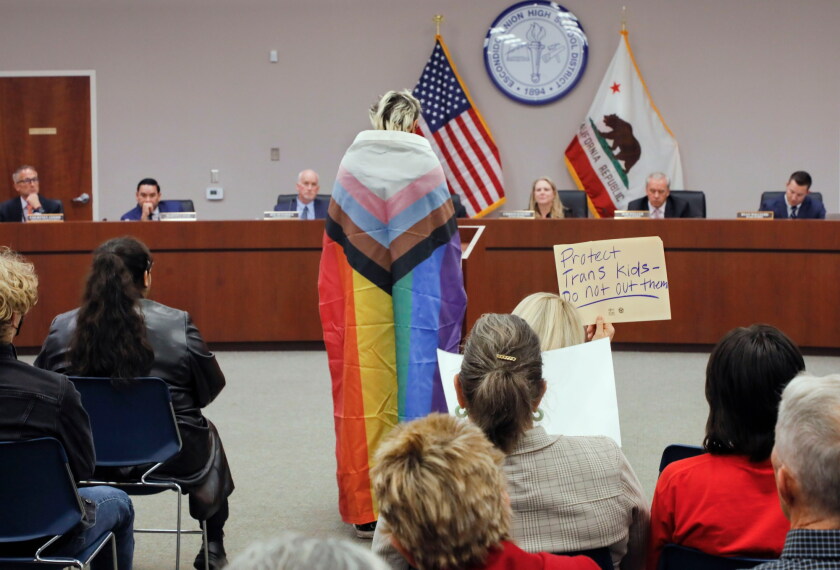
Teacher’s aide Amelia Mester, wrapped in a Pride flag, urges Escondido Union High School District not to have employees notify parents if they believe a student may be transgender in November 2025. A policy on the issue in the city’s elementary school district is the subject of a federal class-action lawsuit in which a judge just sided against the district.
Teacher’s aide Amelia Mester, wrapped in a Pride flag, urges Escondido Union High School District not to have employees notify parents if they believe a student may be transgender at a meeting in November 2025. Two parents and two teachers from the district sued in 2023, challenging California state guidance concerning student gender transitions and parental notification. The U.S. Supreme Court has now reinstated a lower-court decision overturning those state policies.
Charlie Neuman for The San Diego Union-Tribune/TNS