Ķvlog

Federal Federal File

Obama Introduces Bill on STEM Issues

By Sean Cavanagh — June 03, 2008 1 min read
  • Save to favorites
  • Print
Email Copy URL

Is there room for “STEM” on the stump?

That ubiquitous acronym—short for science, technology, engineering, and mathematics education—has become a major topic in recent years among federal lawmakers, who argue that improving student skills in those subjects is vital to future American prosperity.

Now, STEM is the subject of a bill sponsored by Sen. Barack Obama of Illinois, who is seeking the Democratic presidential nomination.

His proposal and a companion bill in the House, sponsored by Rep. Michael M. Honda, D-Calif., have Republican backers. The measure aims to “give students the resources and curriculum they need” to prosper in the future economy, Mr. Obama said in a May 21 statement.

The federal government currently spends an estimated $3 billion across several agencies on STEM education, but those efforts, Rep. Honda said in a statement, are neither “coordinated, nor coherent, nor cooperative.” The legislation would create a national “research repository” to highlight strong federal STEM education programs.

The bills would also establish a new office and an assistant secretary for STEM education in the Department of Education, and create a multistate consortium to develop common STEM content standards.

“If you ask anybody, is there a clear direction related to all these activities related to STEM, I don’t think anybody has a handle on it,” Rep. Honda, a former high school science teacher, said in an interview. (“Few Federal Math and Science Programs Deemed Effective,” May 16, 2007.)

While he hoped his bill would be judged on its merits, Rep. Honda said he didn’t mind the reflected light cast on it by having Sen. Obama on board.

“It doesn’t hurt,” he said.

At a campaign stop last week at the Expeditionary School of the Arts in Thornton, Colo., Sen. Obama didn’t mention his STEM bill, but he cited competitiveness concerns about U.S. high schools.

“Already, China is graduating eight times as many engineers as we are,” the senator said at the May 28 event, according to a transcript. “By 12th grade, our children score lower on math and science tests than most other kids in the world. And we now have one of the highest high school dropout rates of any industrialized nation in the world.”

Related Tags:

A version of this article appeared in the June 04, 2008 edition of Education Week

Events

This content is provided by our sponsor. It is not written by and does not necessarily reflect the views of Education Week's editorial staff.
Sponsor
Reading & Literacy Webinar
Unlocking Success for Struggling Adolescent Readers
The Science of Reading transformed K-3 literacy. Now it's time to extend that focus to students in grades 6 through 12.
Content provided by 
Jobs Virtual Career Fair for Teachers and K-12 Staff
Find teaching jobs and K-12 education jubs at the EdWeek Top School Jobs virtual career fair.
This content is provided by our sponsor. It is not written by and does not necessarily reflect the views of Education Week's editorial staff.
Sponsor
College & Workforce Readiness Webinar
Climb: A New Framework for Career Readiness in the Age of AI
Discover practical strategies to redefine career readiness in K–12 and move beyond credentials to develop true capability and character.
Content provided by 

EdWeek Top School Jobs

Teacher Jobs
Search over ten thousand teaching jobs nationwide — elementary, middle, high school and more.
Principal Jobs
Find hundreds of jobs for principals, assistant principals, and other school leadership roles.
Administrator Jobs
Over a thousand district-level jobs: superintendents, directors, more.
Support Staff Jobs
Search thousands of jobs, from paraprofessionals to counselors and more.

Read Next

Federal Ed. Dept. Wants to Revamp Assistance Program It Calls 'Duplicative,' 'Confusing'
The department's Comprehensive Centers have already been through a year of shakeups.
3 min read
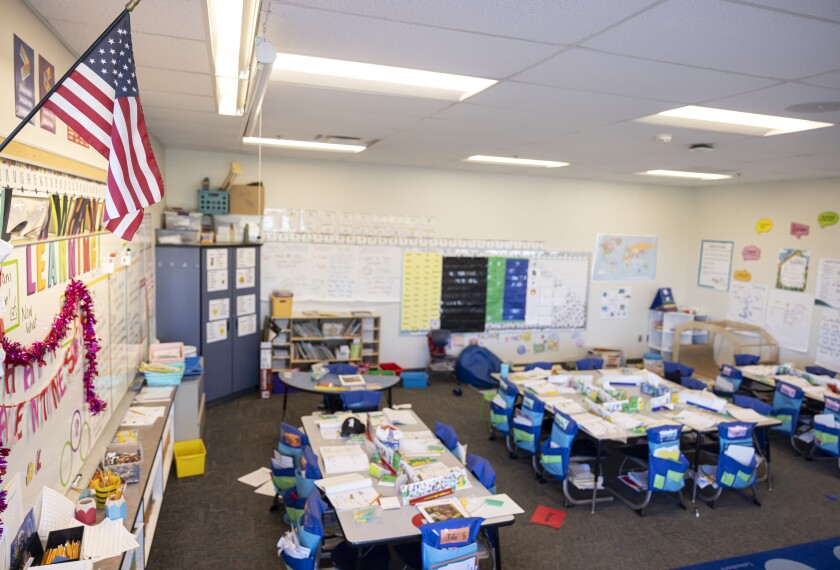
A first grade classroom at a school in Colorado Springs, on Feb. 12, 2026.
A 1st grade classroom at a school in Colorado Springs, Colo., on Feb. 12, 2026. The U.S. Department of Education released a proposal to rework a decades-old program charged with helping states and school districts problem-solve and deploy new initiatives, calling the current structure “duplicative” and “confusing.”
Kevin Mohatt for Education Week
Federal Will the Ed. Dept. Act on Recommendations to Overhaul Its Research Arm?
An adviser's report called for more coherence and sped-up research awards at the Institute of Education Sciences.
6 min read
The U.S. Department of Education building is pictured on Oct. 24, 2025, in Washington, D.C.
The U.S. Department of Education building in Washington is pictured on Oct. 24, 2025. A new report from a department adviser calls for major overhauls to the agency's research arm to facilitate timely research and easier-to-use guides for Ķvlog and state leaders.
Maansi Srivastava for Education Week
Federal Trump Talks Up AI in State of the Union, But Not Much Else About Education
The president didn't mention two of his cornerstone education policies from the past year.
4 min read
President Donald Trump enters to deliver the State of the Union address to a joint session of Congress in the House chamber at the U.S. Capitol in Washington, Tuesday, Feb. 24, 2026.
President Donald Trump enters to deliver the State of the Union address to a joint session of Congress in the House chamber at the U.S. Capitol in Washington, Tuesday, Feb. 24, 2026. The president devoted little time in the speech to discussing his education policies.
Kenny Holston/The New York Times via AP, Pool
Federal Education Department Will Send More of Its Programs to Other Agencies
Education grants for school safety, community schools, and family engagement will shift to Health and Human Services.
4 min read
Various school representatives and parent liaisons attend a family and community engagement think tank discussion at Lowery Conference Center on March 13, 2024 in Denver. One of the goals of the meeting was to discuss how schools can better integrate new students and families into the district. Denver Public Schools has six community hubs across the district that have serviced 3,000 new students since October 2023. Each community hub has different resources for families and students catering to what the community needs.
A program that helps state education departments and schools improve family engagement policies is among those the Trump administration will transfer from the U.S. Department of Education to the U.S. Department of Health and Human Services. In this photo, school representatives and parent liaisons attend a family and community engagement discussion on March 13, 2024, in Denver to discuss how schools can better integrate new students and families into the district.
Rebecca Slezak For Education Week