With the razor-thin Senate confirmation, Betsy DeVos has assumed the role of Secretary of Education as perhaps the . Among the chief purveyors of the narrative that public schools in America are failing, DeVos has done little to endear herself to public school 糖心动漫vlog whom she has maligned over the course of a philanthropic career focused on charter schools and vouchers programs.
As a former school teacher and recently recognized National Board Certified teacher, I know this narrative to be false. I know that one of our foremost challenges in education is not a dearth of great teaching, but the absence of mechanisms for elevating and spreading the expertise of our most accomplished teachers.
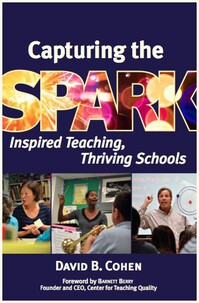
David Cohen, a Board Certified Teacher at Palo Alto High School (and regular ), has done just that in .
Over the course of a school year, Cohen set out to observe and publicize the high-quality instruction taking place in schools and classrooms throughout California.
While the teachers featured in the book are truly exceptional, they are not the exception. Top-notch teaching is happening all over the state; teachers simply need the time and space to learn from their colleagues.
Over coffee and a few follow-up emails, I tapped Cohen鈥檚 experience to find out how we might do so during what promises to be a tumultuous era for public schools.
KK: Capturing the Spark references 鈥�鈥� in public education, particularly one that paints public schools and teachers as failing students and their families. Given that one of the country鈥檚 leading critics of public schools is now leading the Department of Education, what lessons from your tour and observations should public 糖心动漫vlog bear in mind in the coming years? How can inspired teaching thrive amidst skepticism from the bully pulpit?
DC: The first thing I noticed about your question is that it鈥檚 more about the attitudes and messages than the specific policies that we鈥檒l have to address in the future. But yes, 鈥渃ritics鈥� and 鈥渟kepticism鈥� coming from leadership can have a demoralizing effect. I still remember Arne Duncan鈥檚 reaction to the struggles in Central Falls, Rhode Island. I鈥檓 about as far from Rhode Island as possible, but even I felt insulted when he applauded the firing of every teacher at Central Falls High School. Such a high-profile rebuke must have led to some 鈥減iling on鈥� and then more energy invested into fending off the verbal attacks. I鈥檓 sure it made things worse.
On a policy level, the Education Department under Obama and Duncan seemingly ignored or even rejected abundant evidence that value-added measures (VAM) don鈥檛 belong in teacher evaluations, and then compounded the problem by trying to strong-arm states into compliance on VAM usage. So, it鈥檚 a good question, because both the policies and the tone set at the top can have a significant impact.
I鈥檓 sure inspired teaching has always come from a variety of sources, and one message in my book regarding inspired teaching is that it looks and feels different from room to room and place, with a variety of origins as well.
For some people, the curriculum is the engine, and they love their subject matter so much that they draw students in, build relationships around that shared love of learning about whatever it might be. Other teachers are driven by student engagement and their attachment to any particular subject or curriculum only matters to them as a way to reach students. Some really hit their highest gears when they鈥檙e collaborating with peers, and they feed off that collegiality.
As for me, I鈥檝e sometimes compared myself to that veteran role-player athlete on any given team, the guy who may not start, certainly won鈥檛 go to the All-Star game, but continually focuses on learning the game, asking questions, observing, studying, finding ways to appreciate and work with everyone, improving the team atmosphere and helping the team reach its full potential.
Inspired teaching will thrive as long as school leaders recognize that teachers are variable, and need unique supports and opportunities to thrive in their school or district. There are very few iron-clad defenses against bad policy, and very few policies that can be bad enough to drive out teachers who have enough positives going for them that they feel able to succeed and grow.
KK: Work that we鈥檝e both done indicates that while , it鈥檚 not the one that matters most to teachers. In an era where National Board stipends have decreased, what other incentive structures can you imagine policymakers putting in place to encourage teachers to pursue the profession鈥檚 highest standard?
DC: I want to be clear before setting aside the question of compensation that teacher pay is incredibly important, for all teachers. While we can try to mitigate the problems arising from low salaries and diminished stipends, we can鈥檛 substitute these ideas for the hard work that needs to go into securing the kind of funding necessary to recruit and retain teachers in the coming years.
That said, what do accomplished teachers want in the workplace? More flexibility, autonomy, and opportunities to lead. Policy makers and school leaders could put more value on the board certification by giving National Board Certified Teachers (NBCTs) chances to reconfigure their job duties and responsibilities beyond their classrooms. It would be important to solicit their ideas about how to do this in any given context. Taken to a more formal level, national board certification could be considered as a qualification for certain positions such as a teacher leader responsible for induction or mentorship, instructional coaching, curriculum design and assessment, or other school or district initiatives.
(Note: When a team of 14 accomplished 糖心动漫vlog from across the country addressed a similar question regarding the , their conclusions mirrored those shared by Cohen)
KK: Led by Governor Jerry Brown鈥檚 example, California is positioning itself to that marginalize vulnerable groups in the state. What role do you foresee California teachers playing in that effort?
DC: It will be up to all of us to go a step or two further than we have in the past.
For some teachers, just beginning to share their work more publicly will be a stretch, but we need the public to see and understand the good work we do in classrooms, gymnasiums, art studios, science labs, etc. For teachers who鈥檝e been sharing out in social media, it鈥檚 time to write for a broader audience, present at conferences, attend an , then help start one.
For teachers who鈥檝e been public about their practice, the next step is to connect practice and policy. The story we need to tell has to go beyond the great learning that our students experience and show people how policies help or hinder our efforts. It鈥檚 a union imperative, too. We need all hands-on deck, with teachers proudly owning their union membership, and stepping up to help their unions be as strong as they can be. We need to show the connections between our advocacy and better outcomes for students.
KK: Capturing the Spark is a tremendous contribution to shifting the narrative on schools and teachers. What will it take to sustain the spark to ensure that stories like those you have captured are the norm rather than the exception?
DC: It鈥檚 important to note I didn鈥檛 break any new ground here. Grant Lichtman鈥檚 book came out right as I was finalizing plans to do something quite similar. Grant focused on innovation and drove to public, charter, and private schools all over the country.
My geographic range was California-limited, and the focus was to see what works to inspire and sustain good teaching; it might be the opportunity to do something truly innovative, but it might also be as fundamental as recognizing the value of strong pre-service training, or the opportunity to be a teacher leader.
Then there are books that went deep into a school or district. Kristina Rizga鈥檚 is outstanding for examining how a single school rides the waves of policy changes, budget changes, personnel and neighborhood changes. She鈥檚 a journalist with a great sense of the narrative arc of her subject, and she really captures her subjects well. David Kirp鈥檚 is focused on a district, and since he鈥檚 a public policy professor the tone is more academic and the research maybe more robust. And you can鈥檛 go wrong with Jos茅 Vilson鈥檚 , or the Sam Chaltain ten-part video production 鈥�.鈥� And those of us who want these kinds of stories to emerge have to help ensure there鈥檚 a market for them.
In the future, of course I鈥檇 love to see more projects set up to sustain that kind of narrative arc. There are some good sources for ongoing stories and reporting if you know where to look.
Anyone can get inspired and take to blogs and social media to help share the positive stories of public education. Teachers, schools, unions, family and community members all have something to contribute.
鈭� 鈭� 鈭� 鈭�
Kristoffer Kohl is a National Board Certified Teacher at the where he works to cultivate, incubate, and scale the bold ideas and expert practices of accomplished teachers. He co-authored , a report outlining a set of strategies to narrow the achievement gap in California by fueling the development of a teacher leadership system.