ĚÇĐĶŻÂţvlog

Law & Courts

Pa. Plans Less-Severe Penalties for Minors Caught â€Sexting’

By Kevin Amerman, The Morning Call, Pa. (MCT) & John L. Micek, The Morning Call, Pa. (MCT) — October 30, 2012 2 min read
  • Save to favorites
  • Print
Email Copy URL

After a teenage girl in Pennsylvania was slapped with felony child-pornography charges for posting a video on Facebook that showed two other teens engaging in a consensual sex act, a judge this summer dismissed the charges, calling them “an overreaction by law enforcement.”

Judge Robert L. Steinberg of Lehigh County said teens who text nude images of other teens should not face such charges and urged state lawmakers to create a more appropriate law.

He got his wish.

The state House and Senate approved a bill Oct. 17 designed to punish minors with less severe options than under current law for “sexting,” or sending nude photos of themselves or other teens who are 12 or older, by cellphone or other electronic transmission.

The new measure would make such acts a summary offense or a misdemeanor, depending on the circumstances, rather than the felony child-pornography charge currently filed in those cases. The bill awaits the signature of Gov. Tom Corbett, a Republican. His approval is likely, administration spokeswoman Janet Kelley said.

Though approaches vary from state to state, at least 19 states have enacted bills to address youth sexting since 2009, according to data from the National Conference of State Legislatures, based in Denver. Some states simply issue a warning for sexting, while other states require community service or counseling programs for those involved, said Pam Greenberg,a senior fellow in the NCSL’s Legislative Information Services Program.

“The balancing act is finding a way to deter kids from sexting and still not punishing them in the same way an adult would be punished,” Ms. Greenberg said.

Lifetime Impact

Under the new Pennsylvania measure, a minor who possesses or distributes a sexually explicit image of another minor who is 12 or older could be charged with a second degree misdemeanor for sending sexually explicit photos or videos. If the person in the photo or video is under 12, the teen could still be charged with a felony child-pornography offense.

To get a charge under the legislation expunged, a minor could be ordered to take part in an educational programdesigned to deter teens from sexting.

Sexting has been an issue throughout the country, although the prevalence of sexting among teenagers is unclear. A 2011 study from the University of New Hampshire in Durham found that roughly 1 percent of teens were engaged in sexting, compared with 7 percent in a 2011 Associated Press/mtv survey and 28 percent in a 2012 study from the University of Texas-Medical Branch at Galveston.

In Pennsylvania, authorities in 2008 threatened to file child-pornography charges against dozens of students at Parkland High School in Allentown after nude images of underage girls circulated on cellphones. No one ended up being charged.

“We recognize that this is an issue among teens, and we want to fight the issue, but not have it impact them for the rest of their lives,” said Shawn Wagner, the president of the Harrisburg-based Pennsylvania District Attorneys Association and a proponent of the bill.

The bill would punish teens without subjecting them to lifelong consequences, such as having to register as a sex offender under Megan’s Law, which makes information about registered sexual offenders available to the public through the Internet.

Editorial Intern Mike Bock contributed to this article.

Copyright © 2012, McClatchy-Tribune Information Services.
A version of this article appeared in the October 31, 2012 edition of Education Week as Pa. Moves to Ease Penalties for Minors Who Engage in â€Sexting’

Events

This content is provided by our sponsor. It is not written by and does not necessarily reflect the views of Education Week's editorial staff.
Sponsor
Artificial Intelligence Webinar
Managing AI in Schools: Practical Strategies for Districts
How should districts govern AI in schools? Learn practical strategies for policies, safety, transparency, as well as responsible adoption.
Content provided by 
This content is provided by our sponsor. It is not written by and does not necessarily reflect the views of Education Week's editorial staff.
Sponsor
Reading & Literacy Webinar
Unlocking Success for Struggling Adolescent Readers
The Science of Reading transformed K-3 literacy. Now it's time to extend that focus to students in grades 6 through 12.
Content provided by 
Jobs Virtual Career Fair for Teachers and K-12 Staff
Find teaching jobs and K-12 education jubs at the EdWeek Top School Jobs virtual career fair.

EdWeek Top School Jobs

Teacher Jobs
Search over ten thousand teaching jobs nationwide — elementary, middle, high school and more.
Principal Jobs
Find hundreds of jobs for principals, assistant principals, and other school leadership roles.
Administrator Jobs
Over a thousand district-level jobs: superintendents, directors, more.
Support Staff Jobs
Search thousands of jobs, from paraprofessionals to counselors and more.

Read Next

Law & Courts Birthright Citizenship Case Raises Stakes for Schools and Undocumented Students
Educators are paying close attention to the case on Trump's birthright citizenship order.
10 min read
President Donald Trump signs an executive order on birthright citizenship in the Oval Office of the White House in Washington, Jan. 20, 2025.
President Donald Trump signs an executive order on birthright citizenship in the Oval Office of the White House on Jan. 20, 2025. The order, now before the U.S. Supreme Court, seeks to limit citizenship for some children born in the United States to immigrant parents without permanent legal status.
Evan Vucci/AP
Law & Courts Appeals Court Revives Lawsuit Over 1st Grader’s Black Lives Matter Drawing
A court revived a 1st grader 's claim she was punished for giving a drawing to a Black classmate.
4 min read
Seen is the drawing made by Viejo Elementary School first-grader B.B. that was entered into evidence. B.B. gave the drawing to her classmate, M.C., who is African American. M.C. thanked B.B.
Pictured is a drawing by a 1st grader in California and given to a Black classmate that is at the center of a First Amendment legal challenge over the student's alleged punishment.
U.S. Court of Appeals for the 9th Circuit
Law & Courts Supreme Court’s Gender Identity Ruling Leaves Schools Seeking Clarity
Advocates say they would welcome more from the Supreme Court on gender-notification policies.
7 min read
The Supreme Court is photographed, Friday, Feb. 27, 2026, in Washington.
The Supreme Court is photographed, Friday, Feb. 27, 2026, in Washington. The high court recently ruled that California policies that sometimes limit or discourage schools from disclosing information to parents about children’s gender transitions and expressions at school likely violate parents’ constitutional rights
Rahmat Gul/AP
Law & Courts Supreme Court Backs Parents in School Gender Disclosure Fight
The Supreme Court restored an injunction blocking California policies on student gender transitions
8 min read
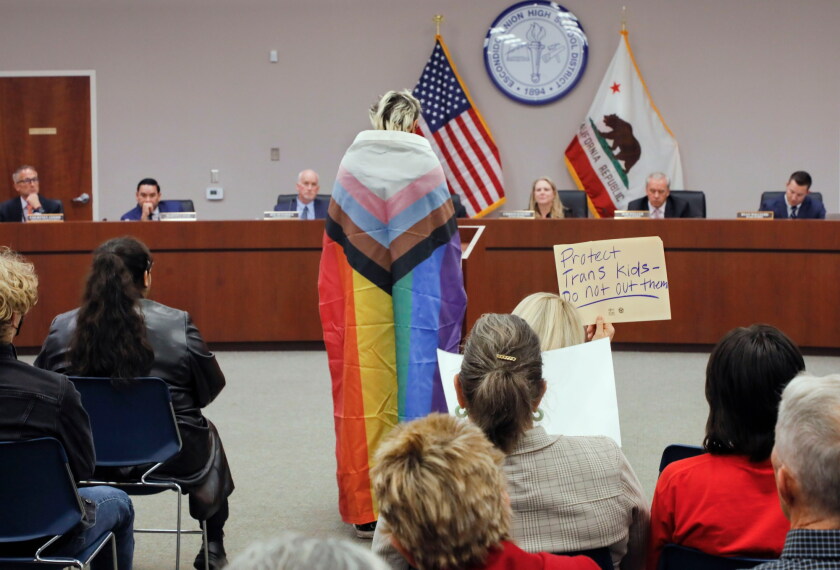
Teacher’s aide Amelia Mester, wrapped in a Pride flag, urges Escondido Union High School District not to have employees notify parents if they believe a student may be transgender in November 2025. A policy on the issue in the city’s elementary school district is the subject of a federal class-action lawsuit in which a judge just sided against the district.
Teacher’s aide Amelia Mester, wrapped in a Pride flag, urges Escondido Union High School District not to have employees notify parents if they believe a student may be transgender at a meeting in November 2025. Two parents and two teachers from the district sued in 2023, challenging California state guidance concerning student gender transitions and parental notification. The U.S. Supreme Court has now reinstated a lower-court decision overturning those state policies.
Charlie Neuman for The San Diego Union-Tribune/TNS