The U.S. Department of Education’s bottom line would shrink under President Bush’s proposed 2007 fiscal budget, but he made room in his education spending plan for several new initiatives, some of which have failed to win congressional approval in the past.
Under the president’s budget proposal, released Feb. 6, overall discretionary spending for the Education Department would shrink by 5.5 percent, to $54.4 billion, compared with Congress’ allocation of $57.5 billion for fiscal 2006. The 2006 allocation includes, however, $1.6 billion in a one-time care package to ease the education impact of Hurricanes Katrina and Rita. Without that spending, the proposed cut is about 3.8 percent.
A Feb. 6, 2006, the Education Department highlights the major elements of President Bush’s .
The department’s two largest programs—Title I, which gives money to schools to help low-income students improve their learning skills, and the program that helps educate students with disabilities—would basically be flat-lined under Mr. Bush’s plan, which covers the budget year that begins Oct. 1.
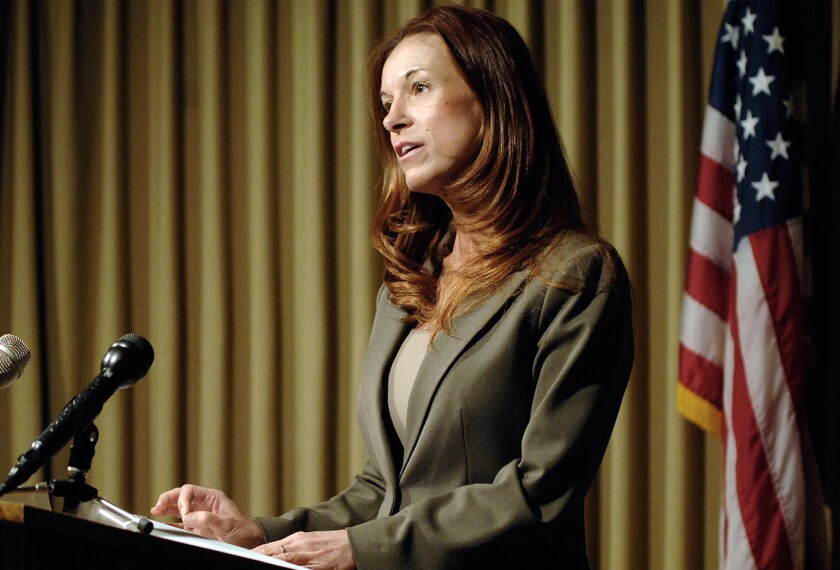
U.S. Secretary of Education Margaret Spellings said during a news conference that the proposed new funding for high school initiatives, vouchers, and struggling schools—as well as the even funding for programs that help educate low-income children and students with disabilities—reflected the president’s changing priorities four years after his No Child Left Behind Act became law.
“As No Child Left Behind matures, … this is an idea whose time has come,� Ms. Spellings said of the voucher proposal and new money to restructure struggling schools during the Feb. 6 session with reporters.
‘The Wrong Direction’
Under Mr. Bush’s plan, Title I funding would remain the same as the 2006 allocation, at $12.7 billion. Education for students with disabilities would see a nominal increase from $11.65 billion to $11.69 billion, based on budget figures that include the federal hurricane aid.
Mr. Bush also proposes eliminating 42 Education Department programs to save $3.5 billion. Those programs include Safe and Drug Free Schools and Communities, Perkins vocational education programs, and Education Technology State Grants, some of which have been on the chopping block before. In last year’s budget proposal, the president recommended eliminating 48 programs, but ultimately Congress provided funding for the majority of them.
“This budget is really terrible,� said Edward R. Kealy, the executive director of the Committee for Education Funding, a Washington-based loobying group. “We’re definitely racing downhill in the wrong direction for investing in education.�
President Bush is proposing several new education initiatives, some which have been rejected by Congress in the past. For 2007, Mr. Bush has requested $200 million for the restructuring of schools that have not met annual goals laid out by the No Child Left Behind Act and have been labeled “in need of improvement� for six years.
“Without real consequences, accountability is hollow,� Ms. Spellings said.
‘Opportunity Scholarships’
Mr. Bush also proposed $100 million for America’s Opportunity Scholarships for Kids. This voucher initiative would allow parents with children in schools slated for restructuring to get scholarships to transfer their children to a private school or to get intensive supplemental services, such as tutoring. Under the plan, parents could get up to $4,000 in tuition aid a year to send their children to private schools or $3,000 a year for supplemental services. Mr. Bush and other Republicans had failed to get a voucher plan into the No Child Left Behind Act. The only existing federal voucher program is for students in the District of Columbia.
Mr. Bush also laid out plans for the $380 million American Competitiveness Initiative that he unveiled during his State of the Union speech Jan. 31. That money would help train an additional 70,000 Advanced Placement teachers in mathematics and science, and be used to attract 30,000 new math and science teachers to the classroom from other professions. It would also fund “Math Now� programs in elementary and middle schools. Those programs would focus on helping students learn math and science, and would assist teachers in discovering the best ways to teach those subjects. The initiative would also establish a national mathematics panel to determine which methods of teaching math are most successful.
The 2007 budget proposal also contains a $1.4 billion high school improvement package, similar to one the president proposed last year. It would offer grants to states to improve the performance of students at risk of failing to meet state standards, and it would develop state reading and math assessments in two additional grades in high school. Currently, the No Child Left Behind Act requires that high school students be tested only once in those subjects. Last year, Congress did not approve a similar proposal.