Ķvlog

Federal

Public Dissatisfied Over Key NCLB Provisions, Report Says

By Alyson Klein — May 02, 2006 3 min read
  • Save to favorites
  • Print
Email Copy URL

The public is largely disenchanted with the way the federal No Child Left Behind Act measures student learning and teacher quality, and it would like greater input into the law’s implementation, a report scheduled for release this week by the Public Education Network finds.

The report from PEN, a Washington-based advocacy group of individuals and more than 80 local education funds around the country, is based on a series of public forums conducted in 10 states from fall 2005 through this past January. The meetings, which were modeled on congressional hearings, were attended by about 250 people each and held primarily in cities with a large number of Title I schools, including New York City, Orlando, Fla., and Austin, Texas.

Missing Voices

Federal Title I aid for schools with needy students is used in carrying out many provisions of the 4-year-old No Child Left Behind law, which was an overhaul of the Elementary and Secondary Education Act.

The report, drawn from the sessions, was intended to give a voice to students, parents, and community groups, who were left out of the process of drafting the NCLB law in 2001, said Arnold F. Fege, the director of public engagement and advocacy for PEN.

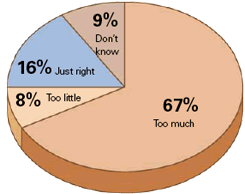
The Public and NCLB Testing

The Public Education Network received 8,000 responses to an online survey it conducted last fall, including to the question of whether the No Child Left Behind Act requires “too much testing, too little, or just right?”

The Public and NCLB Testing

SOURCE: Public Education Network

“When the NCLB table was set, parents and the community were missing from the table, and we’re now paying the price,” Mr. Fege said. Such groups should have a broader role in the reauthorization of the current law, which Congress is scheduled to begin working on next year, he said.

While many parents and students lauded the law’s goal of bringing more accountability to public education, they questioned the “adequate yearly progress” model, which requires states to meet yearly targets for the percentage of students scoring at least proficient on reading and math tests.

People at the forums dismissed the idea that “a single test can create an accurate portrayal of how well a school is performing,” the report says. Instead, many recommended using tests to measure how much students have learned from one year to the next, sometimes called “growth” models.

Mr. Fege noted that U.S. Secretary of Education Margaret Spellings has allowed some states to participate in a “growth model” pilot program, which allows states to get credit for students who make academic progress from year to year, even if they do not become proficient. But he said many parents and community members would like to see such an approach applied nationwide. (“U.S. Pilot of AYP ‘Growth’ Models Advances,” April 12, 2006)

More Coordination Sought

Some forum participants also suggested that the law’s definition of “highly qualified” teachers, which requires Ķvlog to meet state and federal standards for teaching skill and content knowledge, may need to be expanded. They said teacher preparation should include training Ķvlog to reach students from diverse backgrounds and with varying learning styles. The report recommends that financial incentives, including extra pay, tax credits, and student-loan forgiveness, be used to attract effective teachers to lower-performing districts.

The report suggests that the federal government require more coordination among schools and social-service agencies, both for higher-performing and for struggling districts.

It also recommends that the law’s parental-involvement provisions be strengthened to give parents more say in school improvement, possibly adding a complaint procedure for parents who believe their districts are not complying with the law.

Michael J. Petrilli, the vice president for national programs and policy at the Thomas B. Fordham Foundation, a Washington-based organization that supports accountability and choice in education, said low-performing schools may also need more governance authority, including for dealing with personnel issues.

“If you can make [more community involvement] work, of course, that’s great,” he said, noting that his organization supports charter schools, which he said are often based on community and parental involvement.

But Mr. Petrilli, who served as a U.S. Department of Education official from 2001 to 2005, added: “Our experience has been that support is not enough. … Schools are failing because of politics.”

He noted that the least-qualified teachers often work in the lowest-performing schools, a point the PEN report also makes. But some schools might need more power to remove ineffective teachers and gain concessions from their unions, he added.

The report, which was scheduled for release May 1, is the second in a series of PEN reports on the NCLB law. The first, released in March 2005, found that parents were concerned about funding and resources for the law and about the level of information available about it, among other issues.
A version of this article appeared in the May 03, 2006 edition of Education Week as Public Dissatisfied Over Key NCLB Provisions, Report Says

Events

This content is provided by our sponsor. It is not written by and does not necessarily reflect the views of Education Week's editorial staff.
Sponsor
Reading & Literacy Webinar
Unlocking Success for Struggling Adolescent Readers
The Science of Reading transformed K-3 literacy. Now it's time to extend that focus to students in grades 6 through 12.
Content provided by 
Jobs Virtual Career Fair for Teachers and K-12 Staff
Find teaching jobs and K-12 education jubs at the EdWeek Top School Jobs virtual career fair.
This content is provided by our sponsor. It is not written by and does not necessarily reflect the views of Education Week's editorial staff.
Sponsor
College & Workforce Readiness Webinar
Portrait of a Learner: From Vision to Districtwide Practice
Learn how one district turned Portrait of a Learner into an aligned, systemwide practice that sticks.
Content provided by Otus

EdWeek Top School Jobs

Teacher Jobs
Search over ten thousand teaching jobs nationwide — elementary, middle, high school and more.
Principal Jobs
Find hundreds of jobs for principals, assistant principals, and other school leadership roles.
Administrator Jobs
Over a thousand district-level jobs: superintendents, directors, more.
Support Staff Jobs
Search thousands of jobs, from paraprofessionals to counselors and more.

Read Next

Federal Trump Talks Up AI in State of the Union, But Not Much Else About Education
The president didn't mention two of his cornerstone education policies from the past year.
4 min read
President Donald Trump enters to deliver the State of the Union address to a joint session of Congress in the House chamber at the U.S. Capitol in Washington, Tuesday, Feb. 24, 2026.
President Donald Trump enters to deliver the State of the Union address to a joint session of Congress in the House chamber at the U.S. Capitol in Washington, Tuesday, Feb. 24, 2026. The president devoted little time in the speech to discussing his education policies.
Kenny Holston/The New York Times via AP, Pool
Federal Education Department Will Send More of Its Programs to Other Agencies
Education grants for school safety, community schools, and family engagement will shift to Health and Human Services.
4 min read
Various school representatives and parent liaisons attend a family and community engagement think tank discussion at Lowery Conference Center on March 13, 2024 in Denver. One of the goals of the meeting was to discuss how schools can better integrate new students and families into the district. Denver Public Schools has six community hubs across the district that have serviced 3,000 new students since October 2023. Each community hub has different resources for families and students catering to what the community needs.
A program that helps state education departments and schools improve family engagement policies is among those the Trump administration will transfer from the U.S. Department of Education to the U.S. Department of Health and Human Services. In this photo, school representatives and parent liaisons attend a family and community engagement discussion on March 13, 2024, in Denver to discuss how schools can better integrate new students and families into the district.
Rebecca Slezak For Education Week
Federal New Trump Admin. Guidance Says Teachers Can Pray With Students
The president said the guidance for public schools would ensure "total protection" for school prayer.
3 min read
MADISON, AL - MARCH 29: Bob Jones High School football players touch the people near them during a prayer after morning workouts and before the rest of the school day on March 29, 2024, in Madison, AL. Head football coach Kelvis White and his brother follow in the footsteps of their father, who was also a football coach. As sports in the United States deals with polarization, Coach White and Bob Jones High School form a classic tale of team, unity, and brotherhood. (Photo by Jahi Chikwendiu/The Washington Post via Getty Images)
Football players at Bob Jones High School in Madison, Ala., pray after morning workouts before the rest of the school day on March 29, 2024. New guidance from the U.S. Department of Education says students and Ķvlog can pray at school, as long as the prayer isn't school-sponsored and disruptive to school and classroom activities, and students aren't coerced to participate.
Jahi Chikwendiu/Washington Post via Getty Images
Federal Ed. Dept. Paid Civil Rights Staffers Up to $38 Million as It Tried to Lay Them Off
A report from Congress' watchdog looks into the Trump Admin.'s efforts to downsize the Education Department.
5 min read
Commuters walk past the headquarters of the U.S. Department of Eduction, which were ordered closed for the day for what officials described as security reasons amid large-scale layoffs, on March 12, 2025, in Washington.
The U.S. Department of Education spent up to $38 million last year to pay civil rights staffers who remained on administrative leave while the agency tried to lay them off.
Mark Schiefelbein/AP