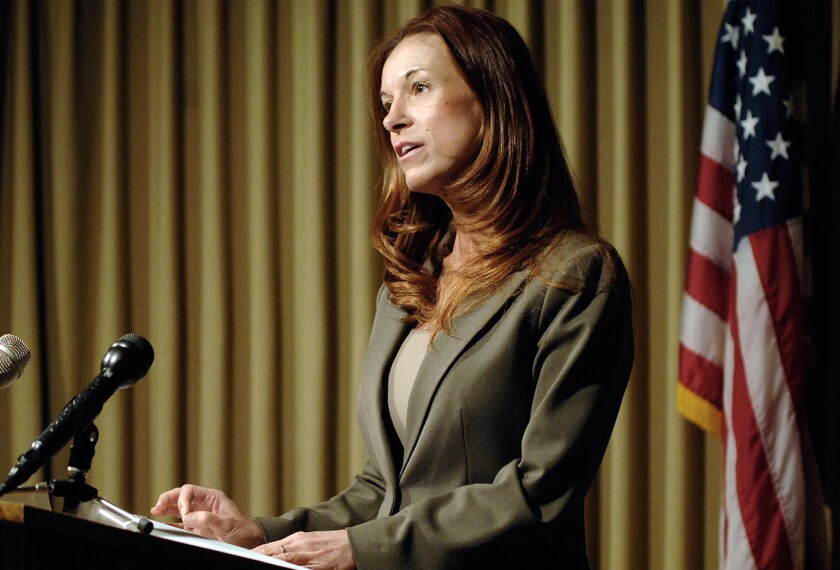
U.S. Secretary of Education John B. King Jr. sat down with Education Week Assistant Editor Alyson Klein in his office earlier this summer to talk about the many twists and turns in the implementation of the new Every Student Succeeds Act, as well as a few broader issues. Here’s an abridged transcript.
Education Week: You’ve made it clear since Day 1 that equity is going to be your number-one priority as secretary. Can you talk to me a bit about how the Every Student Succeeds Act and its regulations further that goal?
KING JR.: The Every Student Succeeds Act is reauthorization of the original Elementary and Secondary Education Act of 1965 and has to be viewed in the context of the Civil Rights Act of 1964 and the Voting Rights Act of 1965. That civil rights legacy was very important to the president and an important part of why the president felt it was a good law. One, by committing states to high standards for all students to make sure that all students graduate ready for college and careers, and, two, ensuring strong state systems of accountability with meaningful flexibility, but clear civil rights guardrails. Three, maintaining the commitment that Title I resources [for disadvantaged students] will go to the highest-needs students and help the highest-needs students to be successful. And four, the commitment to preschool and the commitment to innovation, which have both been priorities for the administration from the start.
You are calling for states to come up with one summative rating for their schools. Some are concerned that the one summative rating is too limiting. Why did you require it, and is there any flexibility there?
KING JR.: There is flexibility for how states implement that summative rating, and so states could use the A through F approach that some states have used. States could use categories of schools similar to the approach that is in place today in many states. So there’s room for states to take different approaches to get to that summative rating. ... But we think there’s real value in parents, ÌÇÐĶ¯Âþvlog, policymakers having a clear sense of which schools are struggling and need the most support and which schools are excelling, and there’s evidence from many areas around the country that that clarity is helpful for directing resources and ensuring improvement in schools that need help.
There’s been some early criticism of your requirements around consistently underperforming subgroups of students—some, including the Education Trust, worry that the requirements you put around this aren’t strong enough and could allow states to set the bar too low. What’s your response?
KING JR.: The law importantly says you have to focus on the performance of every subgroup. The regulations importantly propose flexibility for every state in setting goals and interim targets. We set a limit on the time period that can be used for defining consistently underperforming [subgroups], which we think will help to ensure that states and districts act meaningfully when they have subgroups that are underperforming.
Are you concerned when you leave office that states will challenge your regulations in court? Does that worry you, keep you up at night?
KING JR.: What keeps me up at night is the inequity between schools. What keeps me up at night is that you can go 10 blocks [within a district] and see many more resources in a school that serves affluent kids than a school that serves low-income kids. ... We know what those resource inequities translate into for students. They translate into some students having access to college counselors, other students not, some students having access to Advanced Placement, other students not, some students having access to effective teachers ... other students not. It’s the resource inequities that worry me.
ESSA puts some restrictions on the education secretary. What do you see as the most important lever you have remaining? Regulations? Civil rights enforcement? The bully pulpit?
KING JR.: I think it’s a combination of all of those. Implementation of ESSA has the potential to be a tremendous lever ... to get there, we will need strong regulations. We will need to provide technical assistance and guidance for states [on meeting needs of particular students] such as students in foster care, homeless students, students in special education. ... It’s important that we are calling attention to the benefits of diversity in schools and looking at how we support states and districts in voluntary efforts to improve socioeconomic integration in schools through the equity-assistance centers, through the [Investing in Innovation grant] program. ... I think the role of the department is to advance equity and excellence.
Would you be willing to stay on at the helm of the Education Department, if a Democratic president asked you to?
KING JR.: I’m very focused on what we need to do between now and January of 2017, and that’s my only focus.