糖心动漫vlog

Law & Courts

Retired Justice Souter, Advocate for Civics and Church-State Split, Dies at 85

By Mark Walsh 鈥 May 09, 2025 4 min read
Retired Supreme Court Justice David Souter smiles during a new lecture series titled, "Constitutionally Speaking" on Sept. 14, 2012 in Concord, N.H. Souter spoke to more than 1,300 who packed a small theater to hear him.
  • Save to favorites
  • Print
Email Copy URL

Retired U.S. Supreme Court Justice David H. Souter, a staunch defender of racial equity and the constitutional separation of church and state in education, died Thursday at home in New Hampshire, the court announced on Friday. He was 85.

Souter was appointed by President George H.W. Bush in 1990 to succeed liberal stalwart Justice William J. Brennan Jr. Over the next 19 years, he became a reliably liberal vote in several areas of school law before being succeeded by Justice Sonia Sotomayor in 2009.

He wrote to a 1995 decision that struck down a broad remedial desegregation plan for the Kansas City, Mo., schools, and in 2007 joined the dissent to in assigning students to schools.

That same year, Souter was in dissent in a upholding the discipline of a student who displayed a 鈥淏ong Hits 4 Jesus鈥 banner at an Alaska high school.

In 2009, just before he stepped down from the court, Souter wrote the majority opinion in , which held that the strip search of a middle school student by school officials looking for drugs was unconstitutional.

鈥淗ere, the content of the suspicion failed to match the degree of intrusion,鈥 Souter wrote, adding that requiring students to undress before school officials for the purposes of a search was 鈥渇airly understood as so degrading that a number of communities have decided that strip searches in schools are never reasonable.鈥

Warning about aid to religious schools

Souter was a strong proponent of a strict separation when it came to government embrace of religion in public education or state aid to religious schools.

In a 1992 decision, , Souter joined the 5-4 majority that ruled clergy-led graduation prayers at a middle school violated the First Amendment鈥檚 prohibition against government establishment of religion.

鈥淲hen public school officials, armed with the state鈥檚 authority, convey an endorsement of religion to their students, they strike near the core of the establishment clause,鈥 Souter wrote in a concurrence.

In 2002, in , Souter wrote a bitter dissent from the court鈥檚 decision to uphold an Ohio program that created a pilot voucher program for Cleveland in which parents of that city鈥檚 schoolchildren could choose to send them to private religious schools at public expense. The majority said such vouchers were a neutral program resulting in aid to religious schools only through the 鈥渢rue private choice鈥 of parents.

U.S. Supreme Court justices pose for a group portrait at the court in Washington on Nov. 9, 1990. Clockwise from top left are Justice Sandra Day O'Connor, Antonin Scalia, David Souter, John Paul Stevens, Thurgood Marshall, and Chief Justice William Rehnquist.

Souter said, 鈥淩eligious teaching at taxpayer expense simply cannot be cordoned from taxpayer politics鈥 and will lead to 鈥渆xpectable friction鈥 in society.

鈥淭he ban on supporting religious establishment has protected free exercise鈥 of religion, Souter added.

Just last month, in Oklahoma Statewide Charter School Board v. Drummond, the court considered similar arguments against the idea that states must fund religious charter schools.

In retirement, Souter regularly sat on panels of the U.S. Court of Appeals for the 1st Circuit, in Boston, including on several education cases. In one of those, he was a member of a unanimous three-judge panel that in 2020 upheld the state of Maine鈥檚 exclusion of 鈥渟ectarian鈥 schools from its program of paying private school tuition for its communities that lacked public high schools.

The Supreme Court reversed that decision in its 2022 ruling in , holding that the exclusion violates the free exercise clause. The Carson decision was cited by supporters of religious charters in the Oklahoma case that is pending a decision.

A commitment in retirement to civics education

Souter also became an advocate for civics education in his retirement, though he was not as much in the spotlight on the issue as the late Justice Sandra Day O鈥機onnor, who started the iCivics program after she left the court, or Sotomayor, who sits on the board of directors for iCivics and has been outspoken on the issue.

鈥淐ivic education in the United States is not good enough, and we have to do something about it,鈥 Souter said in an address to the American Bar Association in 2009, just months after he had retired, adding that there is a 鈥渞isk to constitutional government when a substantial portion of the American populace鈥 fails to learn basic civics.

Louise Dub茅, the executive director of iCivics, recalled in an interview Friday traveling with O鈥機onnor to New Hampshire in 2014 for a public appearance with Souter about civics.

Dub茅 was new to working with O鈥機onnor, and the former justice was being a bit hard on her when Souter chimed in to say, 鈥淕ive the kid a break,鈥 she recalled. 鈥淗e was incredibly kind and just a very humble person.鈥

Souter worked on civics efforts in New Hampshire, but he preferred to stay in the background, she said.

鈥淗e didn鈥檛 want it to be about him,鈥 Dub茅 said. 鈥淚t was always about the country.鈥

In his 2009 address to the ABA, Souter offered an observation that sounds familiar to points being made in recent speeches by current members of the Supreme Court, who appear to be responding to rhetorical attacks on judges by President Donald Trump or members of his administration.

鈥淚鈥檒l ask you to consider the danger to judicial independence when people have no conception of how the judiciary fits within the constitutional scheme,鈥 Souter said.

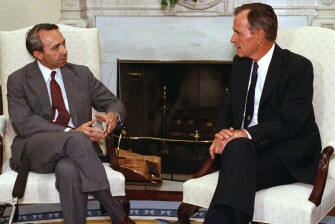
President George H.W. Bush talks with Supreme Court nominee Judge David Souter in the Oval Office of the White House, Sept. 13, 1990.

A version of this article appeared in the June 04, 2025 edition of Education Week as Retired Justice Souter, Advocate for Civics and Church-State Separation, Dies at 85

Events

This content is provided by our sponsor. It is not written by and does not necessarily reflect the views of Education Week's editorial staff.
Sponsor
College & Workforce Readiness Webinar
Smarter Tools, Stronger Outcomes: Empowering CTE Educators With Future-Ready Solutions
Open doors to meaningful, hands-on careers with research-backed insights, ideas, and examples of successful CTE programs.
Content provided by 
This content is provided by our sponsor. It is not written by and does not necessarily reflect the views of Education Week's editorial staff.
Sponsor
Reading & Literacy Webinar
Improve Reading Comprehension: Three Tools for Working Memory Challenges
Discover three working memory workarounds to help your students improve reading comprehension and empower them on their reading journey.
Content provided by 
Recruitment & Retention Webinar EdRecruiter 2026 Survey Results: How School Districts are Finding and Keeping Talent
Discover the latest K-12 hiring trends from EdWeek鈥檚 nationwide survey of job seekers and district HR professionals.

EdWeek Top School Jobs

Teacher Jobs
Search over ten thousand teaching jobs nationwide 鈥 elementary, middle, high school and more.
Principal Jobs
Find hundreds of jobs for principals, assistant principals, and other school leadership roles.
Administrator Jobs
Over a thousand district-level jobs: superintendents, directors, more.
Support Staff Jobs
Search thousands of jobs, from paraprofessionals to counselors and more.

Read Next

Law & Courts Appeals Court Halts Ruling Letting Teachers Disclose Students' Gender Identity
A federal appeals court has temporarily paused enforcement of the ruling but has not yet decided whether to grant a longer-term stay.
Kristen Taketa, The San Diego Union-Tribune
3 min read
Students carrying pride and transgender flags leave Great Oak High School in Temecula, Calif., on Sept. 22, 2023, after walking out of the school in protest of the Temecula school district policy requiring parents to be notified if their child identifies as transgender.
Anjali Sharif-Paul/The Orange County Register via AP
Law & Courts Schools Can鈥檛 Bar Teachers From Telling Parents If Kids Are Transgender, Judge Rules
The injunction bans any public school employee from misleading parents about their child鈥檚 gender presentation at school.
Kristen Taketa, The San Diego Union-Tribune
5 min read
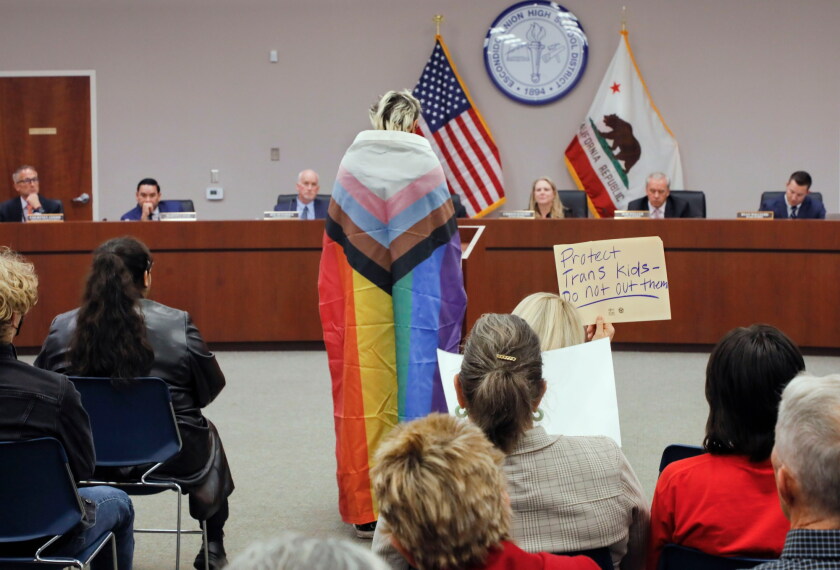
Teacher鈥檚 aide Amelia Mester, wrapped in a Pride flag, urges Escondido Union High School District not to have employees notify parents if they believe a student may be transgender in November 2025. A policy on the issue in the city鈥檚 elementary school district is the subject of a federal class-action lawsuit in which a judge just sided against the district.
Teacher鈥檚 aide Amelia Mester, wrapped in a Pride flag, urges Escondido Union High School District not to have employees notify parents if they believe a student may be transgender. A policy on the issue in the city鈥檚 elementary school district is the subject of a federal class-action lawsuit in which a judge just ruled against the district.
Charlie Neuman for The San Diego Union-Tribune/TNS
Law & Courts Federal Appeals Court Upholds 8th Grader's Expulsion Over Gun Comments in Class
Shortly after a nearby mass school shooting, a student allegedly discussed bringing a gun to school.
3 min read
Photo of stone columns.
E+
Law & Courts Trump's Education Policies Spurred 72 Lawsuits in 2025. How Many Is He Winning?
The legal challenges show which policies have had a big impact and how 2026 could go.
5 min read
President Donald Trump holds up an executive order after signing it at an indoor Presidential Inauguration parade event in Washington, Jan. 20, 2025.
President Donald Trump holds up an executive order after signing it at an indoor presidential inauguration parade event in Washington on Jan. 20, 2025. Trump's executive actions prompted legal challenges virtually from the moment he took office, and education-related policies were not immune.
Matt Rourke/AP