

The U.S. Department of Education’s massive firing of staff is an illegal overreach of the Trump administration’s authority because the move seeks to incapacitate the agency, argues a lawsuit filed Thursday by nearly two dozen Democratic attorneys general.
The , filed in federal court in Massachusetts by 21 Democratic attorneys general from across the nation, asks a judge to halt the Education Department’s effort to halve its staff, a move that the attorneys argue is “causing immense damage” to state education systems.
The filing comes just days after the Education Department announced it would shrink its staff of more than 4,000 employees to fewer than 2,200. Education Secretary Linda McMahon confirmed in that the reduction-in-force was a “first step” toward ultimately abolishing the department.
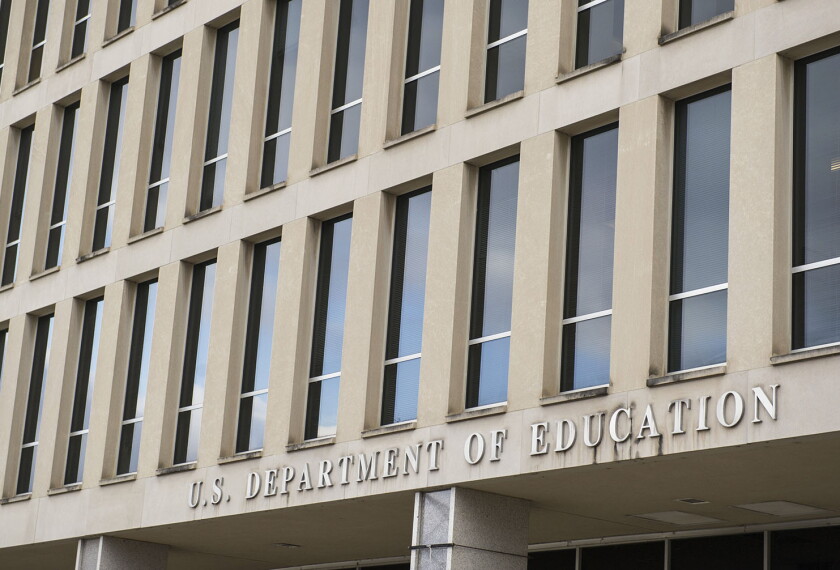
The department’s elimination has been a long-standing campaign promise from President Donald Trump, who has been weighing an executive order to direct McMahon to prepare the department for closure. But shuttering the agency is an act that requires congressional approval.
The attorneys general argue that the massive reduction is “so severe and extreme” that it prevents the department from carrying out its congressionally mandated functions. As a result, it goes beyond the president’s authority, they argue.
“The RIF is part and parcel of President Trump’s and Secretary McMahon’s opposition to the Department of Education’s entire existence,” the lawsuit says.
Madi Biedermann, a department spokesperson, said in a statement that the reduction in force was “implemented carefully and in compliance with all applicable regulations and law.”
She added that no employees were terminated who work on programs for student loans, formula and grant programs, and student with disabilities, and the office for civil rights will continue fulfilling its role.
“They are strategic, internal-facing cuts that will not directly impact students and families,” Biedermann said.
The attorneys general suing represent Arizona, California, Colorado, Connecticut, Delaware, the District of Columbia, Hawaii, Illinois, Maine, Maryland, Massachusetts, Michigan, Minnesota, Nevada, New Jersey, New York, Oregon, Rhode Island, Vermont, Washington, and Wisconsin.

Nothing allows the president to �gut an agency such that it can no longer meet its statutory obligations,’ lawyers argue
The Education Department, since it was created by Congress in 1979, touches nearly every level of the nation’s education system—from early education through higher education. It is the smallest Cabinet agency by employee headcount, overseeing a budget of approximately $80 billion. It distributes funding to schools, with its two largest funding streams supporting low-income students and students with disabilities, totaling roughly $34 billion. It manages more than $1.6 trillion in federal student loans from 45 million borrowers, as of 2024.
Beyond its financial charge, the department collects data, disseminates research, and investigates discrimination in schools and universities.

Under the reduction in force, employees will be placed on leave beginning March 21, and will receive pay until early June. The firings disproportionately affected the department’s office for civil rights, its research arm, and its financial aid office—which is the largest by headcount.
The mass firings come as the department has already diminished its staff through a series of buyout offers and by firing probationary employees who didn’t yet have full civil servant protections. (A federal judge and ordered those employees be reinstated at six other federal agencies Thursday).
The attorneys general argue that the reduction in force violates the separation of powers, alleging that the president and McMahon are hurting the agency’s ability to fulfill its statutorily mandated responsibilities.
“Congress has granted the Secretary of Education limited discretion to reallocate functions within the Department, but that authority is modest, and in no way includes the power to eliminate statutorily-created functions,” the lawsuit argues.
Already, the cuts have caused system breakdowns and unresponsive administrators, the lawsuit argues. Losses of or delays in funding could harm funding to pay teacher salaries, curtail professional development for ĚÇĐĶŻÂţvlog, and pause services for students with disabilities, the lawsuit argues.
Abolishing the department has been a perennial cause for Republicans.
Though Trump proposed its elimination in his first term, and his secretary of education at the time sought to consolidate offices within her limited authority, the effort did not pick up much steam. But the president’s administration has set an aggressive pace in his second term, and since he returned to the White House on Jan. 20, the Education Department has been a focus of the administration’s aggressive cost-cutting.
Dismantling the department is part of Project 2025, a 900-page conservative public policy agenda. Its authors have joined Trump’s administration, and Trump has already acted on several of its policy pieces.
During her confirmation hearing, McMahon echoed some of its outline for where to move key department functions if the agency were eliminated. She agreed shutting down the department would require Congress, and vowed to lawmakers that funding would not be touched if the agency were eliminated.