Ķvlog

Special Report
Reading & Literacy

4 Ways Reading and Writing Interlock: What the Research Says

By Stephen Sawchuk — January 17, 2023 3 min read
v42 19SR Reading Writing 4 Things to Know 1439825899
  • Save to favorites
  • Print
Email Copy URL

In putting together this special report on how writing instruction can and should build on the science of reading, Education Week reporters read through dozens of studies and spoke to leading researchers in the field.

From this reporting, we landed on four main research takeaways, each of which are worth reiterating here and consulting as school districts assess the strength of their own writing programs.

1. Reading and writing are intimately connected.

Research on the connections between the two disciplines began in the early 1980s and has grown more robust with time. Although there are elements specific to each, like handwriting, that need to be practiced on their own, reading and writing instruction appear to be effective when combined.

Among the newest and most important additions are three research syntheses conducted by Steve Graham, a professor at the University of Arizona, and his research partners. One of them examined a second examined the inverse question. Both found significant positive effects for reading and writing.

A third meta-analysis gets one step closer to classroom instruction. Graham and partners examined 47 studies of instructional programs that —no program could feature more than 60 percent of one or the other. The results showed generally positive effects on both reading and writing measures.

2. Writing matters even at the earliest grades, when students are learning to read.

Studies show that the carries meaningful signals about their decoding, spelling, and reading comprehension later on.

Reading experts say that students should be supported in writing almost as soon as they begin reading, and evidence suggests that both spelling and handwriting are linked to the ability to connect speech to print—a process known as encoding—and to oral language development.

3. Like reading, writing must be taught explicitly.

Writing is a complex task that demands much of students’ cognitive resources. Researchers generally agree that writing must be explicitly taught—rather than left up to students to “figure out” the rules on their own. That way, they can spend more time focusing on what they want to say, rather than trying to determine how to say it effectively.

There isn’t as much research about how precisely to do this. One 2019 review, in fact, found significant overlap among , and concluded that all showed signs of boosting learning. Debates abound about the amount of structure students need and in what sequence, such as whether they need to master before moving onto paragraphs and lengthier texts.

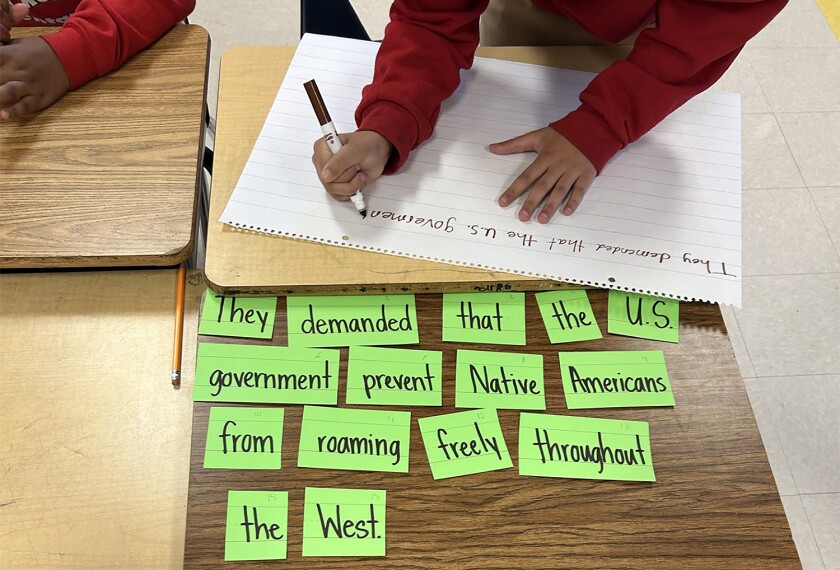
But in general, students should be guided on how to construct sentences and paragraphs, and they should have access to models and exemplars, the research suggests. They also need to understand the iterative nature of writing, including how to draft and revise.

A number of frameworks incorporating various degrees of are available, though most of them have not been studied empirically.

4. Writing can help students learn content—and make sense of it.

Much of reading comprehension depends on helping students absorb “world knowledge”—think arts, ancient cultures, literature, and science—so that they can make sense of increasingly sophisticated texts and ideas as their reading improves. Writing can enhance students’ absorption of this background knowledge, and should be emphasized rather than taking a back seat to the more commonly taught exercises, such as stories and personal reflections.

Graham and colleagues conducted looking at this idea of “writing to learn” in mathematics, science, and social studies. The studies included a mix of higher-order assignments, like analyses and argumentative writing, and lower-level ones, like summarizing and explaining.

This bibliography is by no means comprehensive, but it includes some of the studies and commentaries that we found most helpful in putting together this special report.

Berninger V. W., Abbott, R. D., Abbott, S. P., Graham S., & Richards T. (2002). Writing and reading: Connections between language by hand and language by eye. Journal of Learning Disabilities. Special Issue: The Language of Written Language, 35(1), 39–56
Berninger, Virginia, Robert D. Abbott, Janine Jones, Beverly J. Wolf, Laura Gould, Marci Anderson-Younstrom, Shirley Shimada, Kenn Apel. (2006) “Early development of language by hand: composing, reading, listening, and speaking connections; three letter-writing modes; and fast mapping in spelling.” Developmental Neuropsychology, 29(1), pp. 61-92
Cabell, Sonia Q, Laura S. Tortorelli, and Hope K. Gerde (2013). “How Do I Write…? Scaffolding Preschoolers’ Early Writing Skills.” The Reading Teacher, 66(8), pp. 650-659.
Gerde, H.K., Bingham, G.E. & Wasik, B.A. (2012). “Writing in Early Childhood Classrooms: Guidance for Best Practices.” Early Childhood Education Journal 40, 351–359 (2012)
Gilbert, Jennifer, and Steve Graham. (2010). “Teaching Writing to Elementary Students in Grades 4–6: A National Survey.” The Elementary School Journal 110(44)
Graham, Steve, et al. (2017). “Effectiveness of Literacy Programs Balancing Reading and Writing Instruction: A Meta-Analysis.” Reading Research Quarterly, 53(3) pp. 279–304
Graham, Steve, and Michael Hebert. (2011). “Writing to Read: A Meta-Analysis of the Impact of Writing and Writing Instruction on Reading.” Harvard Educational Review (2011) 81(4): 710–744.
Graham, Steve. (2020). “The Sciences of Reading and Writing Must Become More Fully Integrated.” Reading Research Quarterly, 55(S1) pp. S35–S44
Graham, Steve, Sharlene A. Kiuhara, and Meade MacKay. (2020).”The Effects of Writing on Learning in Science, Social Studies, and Mathematics: A Meta-Analysis.” Review of Educational Research April 2020, Vol 90, No. 2, pp. 179–226
Shanahan, Timothy. “History of Writing and Reading Connections.” in Shanahan, Timothy. (2016). “Relationships between reading and writing development.” In C. MacArthur, S. Graham, & J. Fitzgerald (Eds.), Handbook of writing research (2nd ed., pp. 194–207). New York, NY: Guilford.
Slavin, Robert, Lake, C., Inns, A., Baye, A., Dachet, D., & Haslam, J. (2019). “A quantitative synthesis of research on writing approaches in grades 2 to 12.” London: Education Endowment Foundation.
Troia, Gary. (2014). Evidence-based practices for writing instruction (Document No. IC-5). Retrieved from University of Florida, Collaboration for Effective Educator, Development, Accountability, and Reform Center website:
Troia, Gary, and Steve Graham. (2016).“Common Core Writing and Language Standards and Aligned State Assessments: A National Survey of Teacher Beliefs and Attitudes.” Reading and Writing 29(9).

A version of this article appeared in the January 25, 2023 edition of Education Week as 4 Key Things to Know About How Reading and Writing Interlock

Events

This content is provided by our sponsor. It is not written by and does not necessarily reflect the views of Education Week's editorial staff.
Sponsor
Special Education Webinar
Hidden Costs of Special Ed Vacancies: Solutions for Your District
When provider vacancies hit, students feel it first. Hear what district leaders are doing to keep IEP-related services on track.
Content provided by 
This content is provided by our sponsor. It is not written by and does not necessarily reflect the views of Education Week's editorial staff.
Sponsor
Privacy & Security Webinar
How Technology Is Reshaping Childhood
How do we protect kids online while embracing innovation? Learn about navigating safety, privacy, and opportunity in the Digital Age.
Content provided by 
Budget & Finance Webinar Creative Approaches to K-12 Budget Realities
What are districts prioritizing in 2026? New survey data reveals emerging K-12 budgeting trends.

EdWeek Top School Jobs

Teacher Jobs
Search over ten thousand teaching jobs nationwide — elementary, middle, high school and more.
Principal Jobs
Find hundreds of jobs for principals, assistant principals, and other school leadership roles.
Administrator Jobs
Over a thousand district-level jobs: superintendents, directors, more.
Support Staff Jobs
Search thousands of jobs, from paraprofessionals to counselors and more.

Read Next

Reading & Literacy Yes, Teachers Do Still Assign Full-Length Books. But Numbers Vary
Most middle and high school teachers have students read books—but often just one or two a year.
4 min read
Laura Patranella, a 5th grade teacher at Vogel Elementary School in Seguin, Texas, distributes copies of “Bud, Not Buddy” to her students to read in class on Nov. 3, 2025.
Students in Laura Patranella's 5th grade class at Vogel Elementary School in Seguin, Texas, read copies of <i>Bud, Not Buddy</i> on Nov. 3, 2025. On average, middle and high school teachers assign four full-length books a year, a new survey shows.
Brenda Bazán for Education Week
Reading & Literacy Quiz Quiz Yourself: How Much Do You Know About Helping Struggling Students Get Back on Track?
Too many students struggle with reading. Test your knowledge of what works—and discover strategies to help them get back on track.
Reading & Literacy How the Science of Reading Is Reshaping Teaching: What the Data Say
A nationally representative survey shows how reading curriculum, PD, and teacher practice have shifted.
9 min read
Anjanette McNeely teaches a reading block with her kindergarten students at Windridge Elementary School in Kaysville, Utah, on Dec. 4, 2025.
Anjanette McNeely teaches a reading block with her kindergarten students at Windridge Elementary School in Kaysville, Utah, on Dec. 4, 2025. New research shows significant shifts in how teachers are teaching reading, as well as the materials and PD they receive, but some still use older methods.
Niki Chan Wylie for Education Week
Reading & Literacy How a School's Language Lab Teaches Non-Phonics Reading Skills
In 'language lab,' teachers work on vocabulary and syntax to help students understand complex text.
5 min read
5th grade classroom in February. A morpheme word sort, sentence combining practice, and syntax surgery.
In a 5th grade classroom at Rock Rest Elementary, near Charlotte, N.C., students practice combining sentences and participate in "syntax surgery" to order the parts of complex sentence.<br/>
Madison Hart, Rock Rest Elementary