
As organizations across the country hosted events to mark the 50th anniversary this week of Brown v. Board of Education of Topeka, the Smithsonian Institution unveiled its own exhibit tracing how the historic U.S. Supreme Court case opened doors for minorities and fueled the civil rights movement.

The National Museum of American History, one of the 17 Smithsonian museums, was scheduled to open the yearlong exhibit, “Separate Is Not Equal: Brown v. Board of Education,� on May 15, two days before the anniversary.
The exhibit examines race relations in the century before Brown and in the half-century afterward, exploring how minorities’ struggles for good schools advanced a broader fight for equality, and how that fight continues today on an array of issues, including affirmative action.
A teachers’ guide, is available from the .
Two years in the making, the exhibit documents how some black slaves, forbidden by law in most Southern states to learn how to read or write, managed to attend secret schools in the Civil War era. They wrapped their books in paper to avoid detection on the way, the exhibit shows.
After the Civil War, Congress amended the Constitution to guarantee freedom and equality for all citizens. But the rise of Jim Crow laws, which mandated racial separation in public facilities and prohibited black men from voting, perpetuated the oppression of black Americans.
Visitors to the museum can sit in a re-created 1950s-era classroom, divided in half to show the inequalities of schools for black and white children. In one half, there are rough wood floors and benches; in the other, a neat linoleum floor and modern chairs with desks attached.
Early Legal History
The walls of the exhibit show photos of the separate schools created for black, Asian, Latino, and Native American children across the country in the pre-Brown era, including a photo of future President Lyndon B. Johnson surrounded by the Mexican-American students he taught at a Texas school in 1928.
The exhibit outlines the early legal battles taken up by parents of African, Chinese, and Mexican ancestry to obtain good schooling for their children.
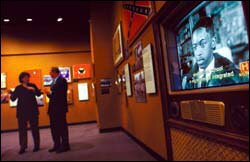
|
| Members of the media attend a preview last week of an exhibit at the National Museum of American History, “Seperate Is Not Equal,� explaining the struggle for desegregated schools. —Photograph by Allison Shelley/Education Week |
Highlighted are three cases that set the stage for Brown years later. Benjamin Roberts’ unsuccessful 1840s bid to enroll his daughter, Sarah, in a school for white children in Boston sparked protests by black parents and led the Massachusetts legislature to pass the nation’s first law banning school segregation.
Joseph and Mary Tape’s effort in 1884 to enroll their daughter, Mamie, in a San Francisco school that barred Chinese children, and a 1945 lawsuit by parents FelÃcitas and Gonzalo Méndez to end segregated schools in Westminster, Calif., fueled decades of legal fighting over school integration that wouldn’t produce a victory until 1947.
The rooms trace the organized, national legal campaign against school segregation that took shape in the 1930s, highlighting the pivotal roles played by Howard University’s law school in training lawyers to take on civil rights cases, and by the NAACP in developing the cases.
Separate alcoves are devoted to the stories behind each of the five cases that were part of the Supreme Court’s proceedings in Brown, tracing the struggles of black families in Topeka, Kan.; New Castle County, Del.; Prince Edward County, Va.; Clarendon County, S.C.; and the District of Columbia, and how they wound their way to the highest court in the land.
The final rooms of the exhibit recount the civil rights efforts sparked in part by Brown, including the 1960 sit-in by four black college students at the segregated Woolworth lunch counter in Greensboro, N.C.; the March on Washington in 1963; and the 2003 Supreme Court decision on affirmative action at the University of Michigan.
The curators said during a preview of the display for reporters last week that they hoped the exhibit captured the courage and dedication of those who fought to end school segregation, and would enhance public understanding of the role Brown played in a broad range of civil rights struggles.
“You can’t adequately assess what these black lawyers [who argued the Brown case] achieved without understanding the impact on so many groups of people, which is really what civil rights is all about,� said co-curator Alonzo N. Smith, a research historian with the National Museum of American History.
The museum was scheduled to conduct “electronic field trips� on May 19, enabling middle and high school students to “visit� the museum via the Internet, and it will host public programs throughout the year.



