

Today鈥檚 post kicks off a series on scaffolding instruction for students.
This first column in the series focuses on scaffolds for English learners.
鈥楽caffolds Are Essential鈥�
Irina McGrath, born and raised in St. Petersburg, Russia, is an assistant principal at Newcomer Academy and an adjunct professor at the University of Louisville, Indiana University Southeast, and Bellarmine University.
Scaffolds are essential, though temporary, supports that allow multilingual learners to fully engage in the learning process and demonstrate their knowledge alongside their English-speaking peers. There are many scaffolding strategies used to support multilingual learners, but the ones I find most effective are grounded in both my teaching and personal experiences.
For the past 24 years, I have supported multilingual learners in various roles as an multilingual learner teacher, an instructional coach, and now as an assistant principal. I also bring a personal perspective to this work, as English is my second language; my first language is Russian. The scaffolds that made the greatest impact on me and my students have been visual supports.It is truly remarkable how much a simple image can improve comprehension when attached to a word or phrase in a new language. A visual can instantly clarify meaning and significantly boost understanding of any text or task.
Another highly effective scaffold for supporting input is the use of simplified texts. Traditional textbooks often rely on academic language and complex sentence structures鈥攆eatures that can take multilingual learners five years or more to fully develop, and that鈥檚 too long to wait. That鈥檚 why it鈥檚 essential to present information using simplified language. Once students understand the concept, they鈥檙e better equipped to revisit the same content using academic vocabulary and continue building on their foundational knowledge.
Extended time is another crucial scaffold. Even as multilingual learners grow in their English proficiency, having extra time remains beneficial especially in high-pressure situations like tests. Increased anxiety can interfere with comprehension and memory, so giving multilingual learners more time allows them to process information fully and demonstrate what they know without the added stress of a time constraint.
Finally, teacher modeling is a powerful scaffold that directly supports multilingual learners鈥� academic output. When teachers model how to complete a task and provide clear examples, multilingual learners can see exactly what is expected of them. This reduces confusion, increases confidence, and helps students produce higher-quality work.
To sum it up, the four most effective scaffolds in my experience have been visual supports, simplified texts, extended time, and teacher modeling. When used intentionally, these supports can make a meaningful difference in student learning and engagement.

鈥楽caffolds Act as Bridges鈥�
Altagracia (Grace) Delgado is the director of Texas initiatives for the English Learners Success Forum:
Effective scaffolding is essential for supporting all students but especially for multilingual learners who are developing content knowledge and language proficiency simultaneously. Scaffolds act as bridges, connecting what students already know to the new concepts they are learning, while also making the language of instruction accessible and meaningful.
The most effective scaffolds are those that are intentional, temporary, and responsive to students鈥� cultural and linguistic backgrounds. In my experience, the most impactful scaffolding strategies combine visual supports, structured academic talk, strategic use of students鈥� home languages, and clear linguistic modeling across content areas.
One of the most universally effective scaffolds is the consistent use of visuals, like graphic organizers, anchor charts, sentence frames, and realia, which make abstract concepts concrete. For example, in science or social studies, complex vocabulary and processes can be overwhelming for multilingual learners without access to visual cues.
Graphic organizers such as Venn diagrams, flowcharts, or cause-and-effect maps help students structure their thinking while acquiring content-specific language. These tools not only support comprehension but also provide models for how to express that understanding in academic language. Similarly, anchor charts that include visuals and bilingual labels serve as ongoing reference points that reduce cognitive overload and increase student independence.
Another powerful scaffold is structured academic discourse. Too often, multilingual learners are given limited opportunities to use academic language in meaningful ways. By integrating structured talk routines, like think-pair-share, sentence stems, and academic-conversation prompts, teachers can help students practice using content language in a low-stakes, collaborative environment. For example, in a math class, students might use a sentence frame like, 鈥淚 solved the problem this way because 鈥︹�� to articulate their thinking, practice academic vocabulary, and hear how others use language to express reasoning. These routines also create inclusive spaces where all voices are heard and valued.
Equally important is the intentional use of students鈥� home languages as a scaffold, rather than treating English-only instruction as the default. Encouraging students to brainstorm ideas, preview texts, or discuss concepts in their first language before engaging in English output strengthens comprehension and affirms their linguistic identities.
Research consistently shows that developing literacy and conceptual understanding in one language supports learning in another. Whether through bilingual glossaries, strategic partner grouping, or dual-language resources, leveraging students鈥� linguistic assets enhances their ability to make connections across languages and content areas.
Language modeling is another critical scaffold. Teachers must be explicit in showing students how to use language for different academic purposes, like explaining, describing, analyzing, and comparing. This can be done through modeled writing, read-alouds with intentional language focus, and co-constructed responses. When teachers think aloud and draw attention to how language functions in different contexts, they demystify the academic language students are expected to produce. For multilingual learners, these models provide a clear road map for how to engage with both language and content.
Finally, scaffolding is most effective when it is responsive and gradually released. It is not about simplifying content but about making it accessible and amplifying language. This means assessing where students are, anticipating where they may struggle, and providing just enough support to move them forward. Over time, these supports should be reduced as students gain confidence and independence.
In all subjects, the most effective scaffolds are those that recognize the interplay between language and content, honor students鈥� linguistic resources, and promote active engagement. For multilingual learners, these supports are not add-ons but essential tools for equity, access, and academic success.

鈥楽caffolds Are Temporary鈥�
Paula Polk is an advocate, coach, author, and instructional leader in support of multilingual learners. Her book Enhancing Instruction for Multilingual Learners details her coaching work:
Implementing linguistic scaffolds with multilingual learners is essential in growing students into independent learners. Often, linguistic scaffolds are used to ensure multilingual learners can access content. To that end, scaffolds such as visuals, realia, and gestures support students in having enough comprehensible input to understand the lesson objective. However, equally as important are scaffolds that allow students to demonstrate their understanding. In order for teachers to respond to student learning, students must be able to demonstrate their understanding.
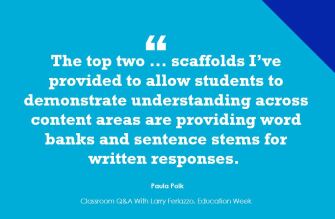
The top two low-lift, high-yield scaffolds I鈥檝e provided to allow students to demonstrate understanding across content areas are providing word banks and sentence stems for written responses. Planning and providing scaffolds that support student output helps determine to what degree students understand the content. Writing is a challenge for both monolingual and multilingual students and is often cited as the last domain of language for students to master.
Word banks and sentence stems on writing assignments reduce multilingual learners鈥� focus on selecting the right vocabulary word or second guessing their syntax and verb tenses. Instead, they can focus on the content, allowing me to see if they grasped objectives such as the way energy flows through a food chain, the purpose of the three branches of government, or the plot of the narrative.
During lesson planning, this meant crafting lessons strategically to ensure that I provided students significant exposure to the concepts and vocabulary so that they were prepared to demonstrate understanding. Key questions I asked myself during planning are listed below and can also be found .
- What background knowledge do students have that will anchor learning?
- What background knowledge will students need to be successful?
- Which vocabulary word needs to be specifically taught?
- What academic vocabulary can I include in the sentence stems?
- How many opportunities to speak or orally process will students be given during this lesson?
Intentionality in lesson planning is essential. The more precision I applied when planning lessons the more engagement and understanding I noticed among my students. One prompt given to my students is shown below:
Reread the book Declaring Our Independence on Google Classroom.
Think about the causes that lead the colonists to write the Declaration of Independence.
Write a paragraph explaining the purpose of the Declaration. Why did the colonists write it?
Include three reasons it was written. Include a final sentence stating your opinion on why the document is important to United States history.
Your paragraph should be at least five sentences long and include the words below. Be sure to highlight the words before you turn it in.
- Declaration of Independence
- Colonists
- Rights
- Government
Use these sentence stems as you write.
One reason the colonists wrote the Declaration of independence was 鈥�
An additional reason 鈥�
They believed that the government 鈥�
Part of introducing this structure included writing a model paragraph with students. This form of shared writing allowed students to hear me think aloud (another scaffold), giving them language to use when they transitioned to independent writing. The quality of written assignments I received after providing these scaffolds increased greatly. My students鈥� confidence increased, and they took much less time to get started because the scaffolds increased their clarity.
It is important to keep in mind that scaffolds are temporary. The ultimate goal is moving multilingual learners from being dependent on linguistic scaffolds to independent learners with the internal language structures needed to write a paragraph. As students were ready, I gradually removed scaffolds. The requirements remained the same based on the rubric, including using academic vocabulary, transition words, and five complete sentences.
By planning and implementing word banks and sentence stems with multilingual learners, I saw an increase in both concept attainment and language proficiency. Providing these linguistic scaffolds to my students taught me the importance of meeting learners at their point of need and supporting them toward greater independence. I now think of linguistic scaffolds as training wheels and an essential part of learning a new language.
Thanks to Irina, Grace, and Paula for sharing their thoughts!
Today鈥檚 post answered this question:
What are the most effective scaffolds鈥攊n any subject鈥攄o you provide students to support their learning?
Consider contributing a question to be answered in a future post. You can send one to me at lferlazzo@educationweek.org. When you send it in, let me know if I can use your real name if it鈥檚 selected or if you鈥檇 prefer remaining anonymous and have a pseudonym in mind.
You can also contact me on X at or on Bluesky at .
Just a reminder; you can subscribe and receive updates from this blog via . And if you missed any of the highlights from the first 13 years of this blog, you can see a categorized list here.


