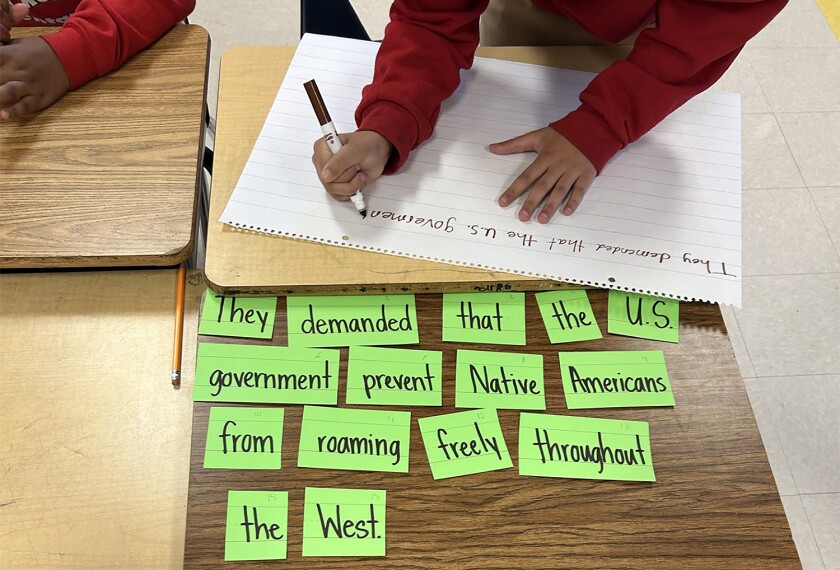
Public schools must devote more time and resources to improving students’ writing proficiency if they hope to raise achievement overall and prepare students for future success, a report by the National Commission on Writing in America’s Schools and Colleges concludes.
The report, is available from the .
“American education will never realize its potential as an engine of opportunity and economic growth until a writing revolution puts language and communication in their proper place in the classroom,� says the report, “The Neglected ‘R': The Need for a Writing Revolution,� released last week.
“Of the three R’s,� it contends, “writing is clearly the most neglected.�
The 20- member panel was convened by the College Board, the New York City-based sponsor of the SAT, in anticipation of adding a writing assessment on the college-entrance exam beginning in 2005. The commission included university officials, public school superintendents, teachers, and an advisory panel of writing experts.
According to data from the 1998 National Assessment of Educational Progress, only about one-fourth of 4th, 8th, and 12th graders demonstrated grade-level proficiency in writing. Moreover, the new report points out, about half of college freshmen are unable to write papers free of grammatical errors and cannot adequately analyze and synthesize information in their written work.
National Agenda
The report calls for a national agenda for improving writing proficiency. Such an undertaking, it adds, should include a stronger focus in state and local academic standards on the importance of developing students’ writing skills as well as providing opportunities for writing in all subjects.
The commission recommends a doubling of the amount of time students spend writing in school, a task that it says can extend beyond English lessons to other subjects. Currently, the report maintains, most 4th graders spend less than three hours a week writing— about 15 percent of the time they spend watching television. Regular writing assignments have dwindled in many American classrooms because of curricular constraints and the amount of time teachers must spend grading the resulting papers. (“Relegating Student Research to the Past,� Nov. 20, 2002.)
In addition, the panel recommends that school officials increase resources for assessments that feature extended writing exercises, use technology to expand writing opportunities, and provide professional development to prepare teachers in every subject at every grade level to incorporate writing into their lessons.
Lucy McCormack Calkins, the director of the Reading and Writing Project at Teachers College, Columbia University, said that the current focus on raising reading and mathematics achievement, as well as budgetary concerns, are barriers to increasing the time and resources devoted to writing instruction. But she praised the report for calling attention to the potential for writing to help improve student learning across the curriculum.
“I get the feeling they are trying to use this report to rally people around the importance of writing,� said Ms. Calkins. “It is sensitively written and,� she added, “it acknowledges the breadth of writing opportunities that students should have.�
Advisers to the commission were also pleased with the final product.
Richard Sterling, the director of the National Writing Project, a federally financed project based at the University of California, Berkeley, that sponsors workshops for some 130,000 teachers a year, said he had initially feared that the commission’s work would primarily reflect the interests of the College Board. The report, however, suggests a sincere effort to transform writing instruction throughout K-12 and higher education, Mr. Sterling said.
“It draws attention to an area that is neglected. ... In discussions about school reform, the importance of improving reading through writing is lost,� he said.
The College Board has launched an implementation plan, called the Writing Challenge to the Nation. The project will help ÌÇÐĶ¯Âþvlog address the recommendations.