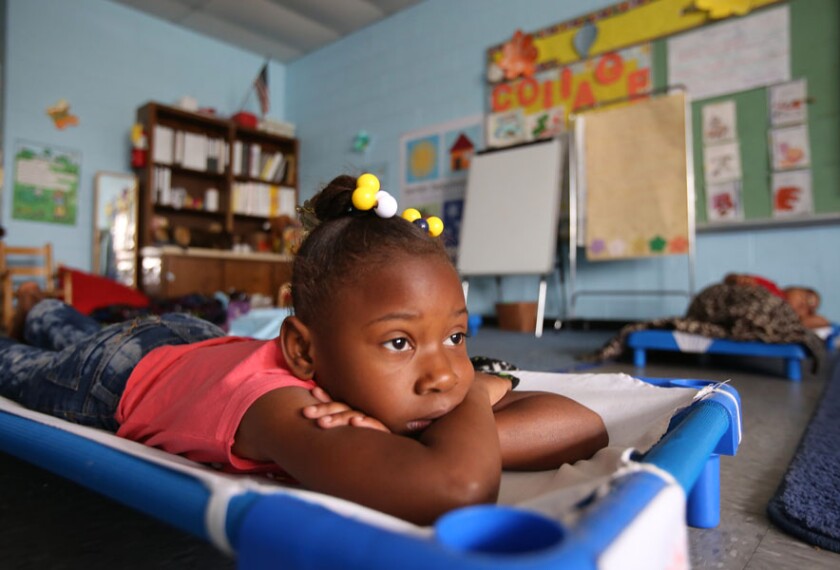
Nine years after it began, one of the nation’s oldest city-run preschool programs—San Francisco’s —has significantly boosted minority enrollment in early-childhood education and made a marked difference in all participants’ numeracy, literacy and social skills, its administrators report.
An assessment of participants found that Latino and African-American enrollment in public prekindergarten jumped from 54 percent and 68 percent, respectively, in the 2007-08 school year to 80 percent for both in the 2009-10 school year, said Executive Director Laurel Kloomok, in an email interview. Pre-K enrollment for all racial and ethnic groups during those years went from 72 percent to 83 percent during that same time period, she added.
In addition, Preschool for All students tested three to four months ahead of peers in mathematics and three months beyond them in letter-word recognition in the 2012-13 school year, according to the report from Applied Survey Research, an independent firm, which was released in August of this year.
Among the social gains the program claims at the nine-year mark: Children enrolled in Preschool for All scored an average of 6 percentile points higher on a 2012-13 exam testing self-regulation skills than students who had not participated, Ms. Kloomok said. The scores of Spanish-speaking children were nearly double—12 points, she added.
“San Francisco’s preschool success stems from a combination of factors, but primarily from an unwavering emphasis on both improving equal education opportunity and increasing preschool program quality,� Ms. Kloomok said.
Cities Push Pre-K
San Francisco is one of a growing number of cities to offer city-run pre-K programs, along with Boston, Miami, San Antonio, and Seattle, among others, according to W. Steven Barnett, the director of the New Brunswick, N.J.-based National Institute for Early Education Research at Rutgers University.
In 2004, San Francisco voters agreed to channel $20 million annually to Preschool for All with the intent of offering half-day pre-K to any child who was 4 years old and lived in the city.
The First 5 agency was charged with running the early-childhood program, and then partnered with various vendors including the 55,000-student San Francisco Unified School District, the federal Head Start program, nonprofits, for-profit centers and family child-care providers, Ms. Kloomok said. Families often qualify for more than one program and thus are able to build a full-day model for their children.
Today, 3,400 4-year-old children are participating in the Preschool for All program in the 2013-14 school year, Ms. Kloomok said. A sliding scale based on income is used to determine what each family will pay; many children attend for free.
“Preschool shouldn’t be considered a luxury,� said San Francisco parent Joanna Koon, who is unemployed but was afforded the opportunity to send her now 6-year-old son to Preschool for All. “It benefits children for the rest of their lives.�
But Susan Solomon, the executive vice president of the United Educators of San Francisco, worries about quality and consistency.
Independent Providers
Currently, there are 137 providers in the Preschool for All program—many of which are run independently of the public school system.
“Having more [providers] underthe [school district] would be preferable,� Ms. Solomon said.
Parent John Monson, however, said Preschool for All exceeded his expectations.
“The experience was astonishing,� said Mr. Monson, who picked the public program for his son after assessing 10 different preschools, including some “swanky� options. “The teacher-to-student ratio was great,� he said. “They adopted all these modern teaching methods which are conceptual and child-led.�
Mr. Monson’s son, now a 1st-grader, matriculated to the elementary school where the Preschool for All program is located along with a cohort of fellow graduates who, he says, are changing the culture there for the better. The graduates, he said, are excited to learn, sit quietly, pay attention, and set the bar for others.