Roman Catholic elementary school teachers in St. Louis are directing more than 2,000 letters to the Vatican from community members supporting the teachers’ efforts to form a union.
The letter-writing campaign is the latest action that the Association of Catholic Elementary Educators, a group of teachers at elementary schools in the Archdiocese of St. Louis, has taken in its nine-year struggle to become officially recognized as a union.
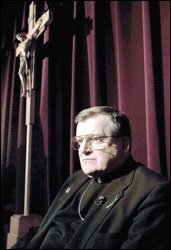
Just this August, the group filed a canonical recourse, the equivalent of a lawsuit, with the Vatican, asserting that the head of the archdiocese, Archbishop Raymond L. Burke, has denied the group its right under church law to collective bargaining.
The group has been told it could take several months to receive a decision.
The teachers want a union so that they can have more say in decisionmaking about schools, said Mary Chubb, the president of the Association of Catholic Elementary Educators in St. Louis, which is affiliated with the Philadelphia-based National Association of Catholic School Teachers.
“The teachers feel they are second-class citizens with the decisions coming from the top down,� she said. “They want to be equal partners.�
But George Henry, the superintendent of education for the St. Louis Archdiocese, said the current process for elementary school teachers to voice their concerns over salaries and benefits or administrative matters is working fine. Catholic schools in the archdiocese employ about 2,300 teachers at the elementary level and 450 teachers at the secondary level. The schools serve some 53,200 children.
Teachers and parishes now elect 20 people to represent them on the Parent Teacher Compensation Committee, which makes recommendations to the archdiocese on salary and other matters affecting teachers’ work life.
By contrast, high school teachers in the archdiocese have been unionized for decades.
Mr. Henry said the committee structure, rather than a union, works best for elementary school teachers because they are officially employed by local parishes rather than the archdiocese. High school teachers are employed by the archdiocese itself.
Right to Organize?
The archdiocese should allow the teachers to unionize if they wish to, according to Rita L. Schwartz, the president of the National Association of Catholic School Teachers. She has been traveling to St. Louis every couple of months to support the teachers in their organizing activities. “I’ve been out there rather frequently, trying to get Archbishop Burke to practice what he preaches,� she said. “The church preaches that one of the basic rights is to have a union if you want one. In all matters of labor relations, the church should be exemplary. We shouldn’t be telling other people how to handle their labor problems if we can’t handle our own.�
Mr. Henry countered that church law doesn’t say that unions are the only way for church employees to interact with Catholic officials in deciding matters such as pay. “Recent church teaching speaks of other collaborative models,� he said.
Archbishop Burke, who was traveling last week, was not available for comment.
No Collective Bargaining
In a June 9 letter that he sent to teachers, Archbishop Burke said the archdiocese planned to stick with the current system of interaction with elementary teachers through a parent-teacher committee. “Neither the archdiocese nor individual parishes will recognize or bargain collectively with any organization as a representative of teachers,� he wrote. The association picked up on that statement to spur its letter-writing campaign.
Ms. Chubb said most of the letter writers used content suggested by the association in which they contrast Archbishop Burke’s comment with a 1986 document from U.S. bishops that says Catholic institutions must “recognize the rights of employees to organize and bargain collectively with the institution through whatever association or organization they freely choose.�
The association sent the letters this month to Archbishop Gabriel Montalvo, Pope John Paul II’s official envoy in Washington. Archbishop Montalvo is expected to forward them to Cardinal Zenon Grocholewski, who heads the Vatican office that deals with Catholic education. The St. Louis Archdiocese also received copies of the letters.
“We’re trying to cut into the hierarchical picture,� Ms. Chubb said last week.


