High school senior Ian Lindfors navigated an underwater maze, bubbles rising as he passed beds of sea kelp. Rounding a corner, he saw the enemy and fired.
Except no sound came out as green “bullets� punctured Mr. Lindfors’ virtual foe—a blue cube on the screen of his school computer. So he quickly punched in some changes to the programming code controlling Bacteria Bash, the video game he was busy customizing during his second-period class. “I’m going to use a splash sound,� the 17-year-old declared.
Far from telling him to stop fooling around, teacher Paul J. Ackerman merely nodded in approval. “These kids are learning algebra without knowing it,� said Mr. Ackerman one morning last month, as he watched Mr. Lindfors and his classmates in one of several courses on video game design that he teaches at Edgewater High School here in suburban Orlando.
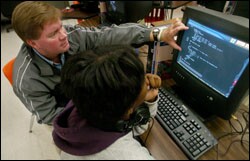
“They’re doing things that my [Advanced Placement computer science] class isn’t,� he said. “They may not master the concepts, but they’re exposed to them.�
Such exposure is growing more common, experts say, as video games start to trickle out of family rec rooms and into K-12 classrooms. While many ÌÇÐĶ¯Âþvlog may see such games as distractions from schoolwork, others are starting to view them as a vehicle for honing students’ mathematical, problem-solving, and reading-comprehension skills.
Five high schools in five states, for example, are piloting a science video game called Immune Attack, developed by the Washington-based Federation of American Scientists.
In January, two elementary schools in Port Charlotte, N.C., will pilot an interactive game called Cool School: Where Peace Rules!,which teaches conflict resolution and may be available to all schools by next fall. The Federal Mediation and Conciliation Service, a U.S. agency better known for resolving labor disputes, created the game with the help of an interactive designer who has worked with the Burbank, Calif.-based Walt Disney Co. and the commercial video-game company Realtime Associates, of El Segundo, Calif.
The trend is apparent in other countries as well. Schools in Scotland piloted a multiplayer game called Eduteams, for instance, while a financial-literacy game called Goonzu may be rolled out in K-5 schools nationwide in South Korea next year, according to Jong-Hyun Wi, an assistant professor in the school of business administration at Chung-Ang University in Seoul.
‘Serious Games’
Mr. Wi was among the speakers at the Serious Games Summit, a conference held Oct. 30-31 in Washington for video-game makers in education, national defense, and health care.
He and other conference presenters said that ÌÇÐĶ¯Âþvlog are realizing that video games don’t have to be violent. Instead, a new breed of games, imbedded with core academics and analytical and problem-solving skills, teaches through a method some ÌÇÐĶ¯Âþvlog call “stealth learning.â€�
Michelle Lucey-Roper, the learning-technologies manager at the Federation of American Scientists, helped design and promote a role-simulation video game for students called Discover Babylon.
“We designed [the game] figuring that an immersive environment might … provide a different perspective to convey certain complex concepts,� she said. “It’s a different sort of experience from reading a textbook, or even traveling to a major city to see objects locked in glass cases—and one that is proving to be very engaging.�
Learning at Play
Software companies and nonprofit organizations are developing an increasing number of educational video games—both for free and for sale—that are targeted at students and schools.
Click on “View List� below to see programs for each subject.
� ;} else { echo “
� ;} ?>
";} else { echo “
� ;} ?>
";} else { echo “
� ;} ?>
| HISTORY | |
|---|---|
| Virtual History: Ancient Egypt | |
| Grades: 5-10 | |
| Synopsis: A CD-based simulation game on the culture, economics, government, and geography of ancient Egypt that lets students play the role of village leaders. | |
| Developer: Knowledge Matters, a Florence, Mass.-based educational technology company. The company is also expected to release a video game on life in the early United States in March 2007. | |
| Website: www.KnowledgeMatters.com | |
| Discover Babylon | |
| Grades: 3-9 | |
| Synopsis: A multiplayer, role-playing game about ancient Mesopotamia, the site of present-day Iraq, and the origins of writing. | |
| Developer: Washington-based Federation of American Scientists; the Cuneiform Digital Library Initiative at the University of California, Los Angeles; and Escape Hatch Entertainment, based in Austin, Texas, with funding from the National Science Foundation. | |
| Website: www.discoverbabylon.org | View List |
| MATH | |
| Video Game Development | |
| Grades: 6-12 | |
| Synopsis: Playing the role of virtual interns at a fictitious software company, students learn how to use computer-programming language to create video games. | |
| Developer: Olathe, Kan.-based software company I Support Learning Inc. | |
| Website: www.isupportlearning.com | |
| Hot Shot Business | |
| Grades: 4-7 | |
| Synopsis: Students learn financial-literacy and entrepreneurship skills as they build a virtual factory making custom skateboards and “market� its products. | |
| Developer: The Kansas City, Mo.-based Ewing Marion Kauffman Foundation and Disney Online, based in Lake Buena Vista, Fla. | |
| Website: www.hotshotbusiness.com | |
| View List | |
| SCIENCE | |
| Hidden Agenda Games | |
| Grades: 6-8 | |
| Synopsis: Free online games, including MeChem, on material science; Elemental, on the periodic table of elements; and Waste of Space, on the physics of space travel. | |
| Developer: Created by college students with funding from the Austin, based Liemandt Foundation. | |
| Website: www.hagames.com | |
| Immune Attack | |
| Grades: 6-8 | |
| Synopsis: Students learn basic concepts of biology and immunology through the online game, which has not yet been released to the public. | |
| Developer: The Federation of American Scientists, Brown University, and the University of Southern California, with funding from the National Science Foundation. | |
| Website: http://fas.org/immuneattack/index.html | |
| Uncharted Depths: The Game of Scientific Literacy | |
| Grades: 6-12 | |
| Synopsis: Students simulate the exploration of an undersea environment in a high-tech submersible in the video game, which is to be available in late 2007. | |
| Developer: Filament Games, a company based in Madison, Wis. | |
| Website: www.filamentgames.com | |
| Wonderville | |
| Grades: 1-8 | |
| Synopsis: A virtual learning community with games on such topics as photosynthesis; solar, geothermal, and other alternative energies; and the environment’s effect on tree growth. | |
| Developer: The nonprofit Science Alberta Foundation, based in Calgary, Alberta, with funding from various organizations and energy companies. | |
| Website: www.wonderville.ca | |
| View List |
With Bacteria Bash, students are given only a “shell� of the online game, in which a virtual antibody seeks and destroys a microbe that causes bacterial meningitis, said Mr. Ackerman, who teaches computer science at the 3,300-student Edgewater High. That means students must augment the programming language to make the game work.
If they want the antibody to move faster through the online maze, for instance, they must figure out and change the programming to speed up the antibody’s progress.
“The kids have to do math; … they have to manipulate numbers,� Mr. Ackerman said. “They’re having fun, but they’re asking a lot of questions, because it’s complex.�
Tenth grader Tevin Reid seemed to agree as he stared in frustration at his computer during Mr. Ackerman’s class, the minutes ticking toward the end of the period. “I can’t get my music to load,â€� the 15-year-old complained. “It’s a big ³ó±ð²¹»å²¹³¦³ó±ð.â€�
In Mr. Ackerman’s view, teaching video-game development has few downsides. One challenge arose, though, when some students started lending their daily class worksheets to classmates. “We commonly refer to that as ‘cheating,’ � he said. “They were obviously missing the point of going through the requirements of learning the ins and outs of the software so they can better manipulate the code.�
The teacher now requires students to hand in their worksheets at the end of class.
Marketable Skills
School technology experts say such “design-literacy skills� as analysis and problem-solving are becoming more important to young people looking for jobs after graduation.
“We want kids to be creators and innovators,� said Steve Waddell, the lead developer of I Support Learning Inc., the Olathe, Kan.-based software company that created Bacteria Bash. “Those are the jobs that will be safe in the future.�
I Support Learning hopes to bring out students’ innovative side by sponsoring a contest at Edgewater High and other schools that are using the Bacteria Bash software. The winning customization will be given to child patients in Orlando-area hospitals, the company said.
And the winning student? He or she is to get an iPod.
“What it all comes down to is trying to get kids to learn in a different way, and to achieve more than [other students] did in the past,� Mr. Ackerman said. “The idea is to change how education is viewed, and to reach as many kids as you can.�


