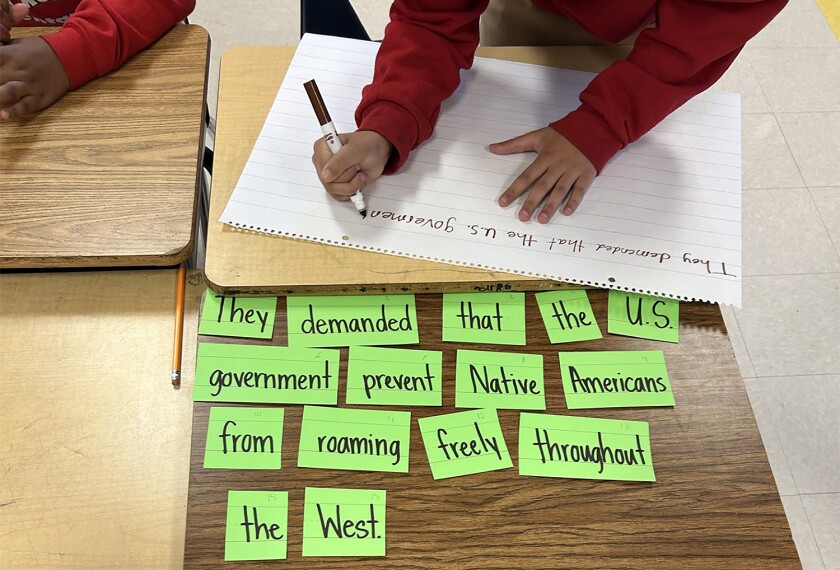
Ask an early educator to explain the science of reading, and phonics will likely headline the response. But phonics, and its emphasis on word recognition, covers only part of the reading-proficiency puzzle. Oral language skills are equally important.
Yet, too often, oral language skills are not getting the emphasis they deserve in early education classrooms, say literacy experts.
hopes to help teachers change that.

Cabell, an associate professor in the School of Teacher Education and the Florida Center for Reading Research at Florida State University, believes there’s a straightforward way for teachers to improve the oral language skills of young learners, starting as early as preschool: Engage in meaningful one-on-one conversations with students throughout the school day. They don’t have to be long or complicated, Cabell explained. In fact, she and fellow educational researcher Tricia A. Zucker co-authored a that provides a simple framework for time-strapped teachers to have these interactions with students that take as little as a minute but can have long-lasting, positive consequences.
Cabell recently spoke to Education Week about this approach for boosting students’ oral language skills The interview has been edited for length and clarity.
Why should teachers focus on improving students’ oral language skills?
Unlike reading, which is a secondary skill, oral language is a biological primary skill of humans. So the idea that we’re hard-wired to learn oral language does raise the question: Why do teachers have to focus on oral language development? It really is about gaining exposure to the more formal language used by teachers in the classroom—language to which children need exposure in order to read and write proficiently.
How early should teachers focus on oral language skills?
Some of my own research has shown that the conversations in preschool classrooms relate to children’s vocabulary growth and that the language teachers use, and the complexity of that language, matters.
But, as you point out in your book, Strive-for-Five Conversations, the back-and-forth of conversations is critical, right?
That’s right. The benefits of going back-and-forth and having multiturn conversations, some call them “serve and return,� is well-documented in the literature. The idea is that you’re building on what students say and then providing them with another opportunity to be an active participant in the conversation.
In these multi-turn conversations, what’s the ideal number of turns?
The idea is that you try to have five conversational turns with a student: I say something, you say something, and so on. It doesn’t take very much time. Each of these conversations takes about one minute of instructional time, but they accomplish a lot.
How does the ‘five-turn conversation’ compare with a typical teacher-student exchange?
What tends to happen [in typical interactions] is that I, as the teacher, ask a question, the student says something in return, and then the teacher stops the conversation by saying something like: “Good job!� Most teacher-student conversations stop at that third turn.
How can teachers extend these conversations?
Based on whether the student responded correctly, partially correctly, or incorrectly, you think about how you as the teacher might scaffold them. For instance, if the student responded correctly, you might scaffold them upward, providing them with an additional challenging question. If they answered incorrectly, you could scaffold them downward by helping them to come to a more correct answer. You might do that by reducing the choices they have or you might ask them to fill in the blank, pushing them to give you another turn. It’s that piece of sticking with that child that seems to not happen very frequently.
Are these conversations designed to be one-on-one?
Yes, but they can take place in a whole group as well. For example, in book reading, you ask guiding questions, telling students before you begin reading: “I want you to think about this.�
During this exercise, teachers are encouraged to use [Popsicle] sticks—every student will be thinking about the question because they all know their name could be called. Then you read the book and come back to that earlier [guided] question. You pick one Popsicle stick out of the group and take at least five conversational turns with the student you call on. You can then ask that same guiding question to three other kids.
Do many teachers balk at all the classroom time these conversations could take?
We’re not saying that every conversation has to be a five-turn conversation. But we are saying: Deliberately have these conversations with each child every day.
Which students benefit most from these five-turn conversations?
Research has shown that it’s those students who have lower-language skills or who are English learners or who are shy and who won’t come to the teacher and say, “I want to talk to you about something�—they typically have fewer conversations with their teacher in class. They aren’t getting the same practice with oral language skills because they aren’t asking for it. The five-turn conversation is a way for teachers to make sure the learning is equitable.
What is your message to teachers who think this approach is not worth their time?
We don’t want teachers to see this strategy as rigid. But we do want to encourage teachers to be more deliberate about their conversations with students. We’re asking teachers to make a marginal shift in what they’re already doing, which is having conversations with kids all day long. We also see this as a way for teachers to give students a language boost without actually saying: “Now, we’re going to do an oral language lesson.�