One sentence appears on the screen of the video lesson, and then we hear English teacher Diana Neebe read it aloud: “She wasn’t petal-open anymore with him.�
Neebe, who is narrating , tells her students to go ahead and find the passage in their copies of Zora Neale Hurston’s Their Eyes Were Watching God. Chapter six, pages 71-72. An audio recording of the passage by actress Ruby Dee begins to play, and the text appears on the screen one sentence at a time. Neebe launches into what she calls a “model think-aloud,� highlighting sentences to show her students “what an experienced reader might pick up on in the passage.�
“So in this scene we know that Janie is 24 years old and has been married for seven years,� Neebe begins when the audio recording of the passage is completed. “And it seems like something happens here that triggers a shift in her, that she’s no longer happy. …�
Neebe is an English teacher and instructional-technology peer coach at Sacred Heart Preparatory School in Atherton, Calif. In late June, she will receive at . Each year the International Society for Technology in Education presents the award to a leader in digital education under 35. Neebe will travel to Atlanta to attend the conference, where she will also give a presentation on professional-development workshops for 1-to-1 learning.
It will be Neebe’s 11th conference presentation. Over the last six years, Neebe has spoken about teaching and digital education in Las Vegas, Chicago, Orlando, Fla., San Antonio, Ojai, Calif., Los Angeles, San Diego, and Atherton, Calif. Now, as a result of conversations she had at some of those conferences, she is on teaching in a 1-to-1 classroom.
Real-Time, Nonlinear Instruction
Neebe started teaching at Sacred Heart in 2011—the same year that the school implemented a 1-to-1 iPad program. Teachers began using tools like educational apps, online discussion forums, and wikis. Neebe helped develop the English department’s iPad curriculum—which led her to reconceptualize her own instruction.
All of Neebe’s students have iPads, which means Neebe has free reign to use digital tools in as many of her lessons and assignments as she chooses. When she teaches writing, she delivers every lecture via video tutorial. Students listen to the lectures at home, at their own pace. If they miss anything, they can pause or rewind the videos.
When Diana Neebe wanted to make The Scarlet Letter more accessible to her high school students, she created video footnotes to help contextualize difficult parts of the novel.
“We’re looking for words that stand out and show power,� Neebe says in this guided close reading of chapter 22.
“In the ‘analog’ model, students would come to class, I’d lecture about how to write an introduction, or a thesis, or a body paragraph, then students would go home to write, inevitably hitting some writer’s block or realizing some underlying confusion,� Neebe writes on her website. “Too bad I wasn’t there to help!�
Under Neebe’s model, students write their essays during class on a shared Google Document, and she can immediately help students who are confused, stalled, or have questions. She can also explore ideas with them.
“My instruction is dynamic and real-time, not linear and prescribed,� Neebe writes. “We have had conversations about everything from skills development to race, gender, being the outcast, and how that relates to social power and discrimination … conversations I didn’t get to have with students while they were writing at home.�
Teacher-Cloning
Neebe’s students still read at home, but they’re not always assigned particular books. Sometimes, they read books they’ve picked out themselves—and then they update their progress on Goodreads, a social-networking website oriented around books and reading. When Neebe assigns the classics, students typically read the first half of each novel during class time, and the second half at home. “If it’s challenging enough to warrant class instruction,� she writes, “it’s probably challenging enough to read in class.�
The most challenging book she assigns is The Scarlet Letter, and last year, Neebe created to help students struggling with the text. The iBook contains what Neebe calls “video footnotes,� which are meant to give context to parts of the novel that are particularly hard to understand. In one of these, for instance, Neebe gives of American Romanticism. In another, a former art museum guide gives of light and color patterns in the text.
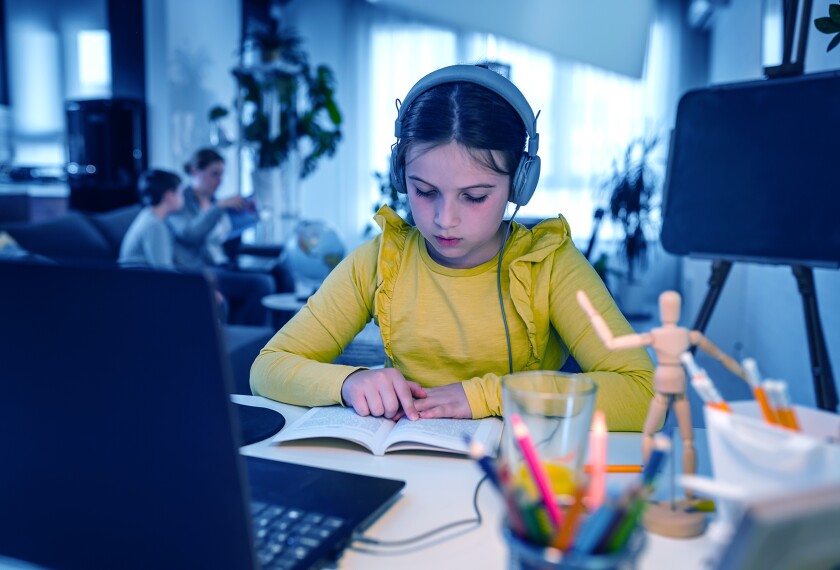
By prerecording her lecture material, she can teach multiple lessons at once. In she made on Sacred Heart’s 1-to-1 program, Neebe shows two of her students sitting at desks in her classroom. One of them is speaking to Neebe, while the other sits in the background with headphones on. He is on his iPad, rewatching one of Neebe’s lessons.
“I’ve cloned myself,� Neebe says. “It’s like every teacher’s dream.�
As part of her nomination package for the ISTE award, Neebe showing how she uses technology in her lessons. Learning is personal, she says, and teaching in a 1-to-1 environment helps her provide instruction and feedback based on students’ individual needs.
“I’m astonished at the change that’s possible when powerful tools set us free to create, innovate, and educate,� she says. “There’s nothing traditional about how we’re doing school these days—and honestly, I wouldn’t have it any other way.�