
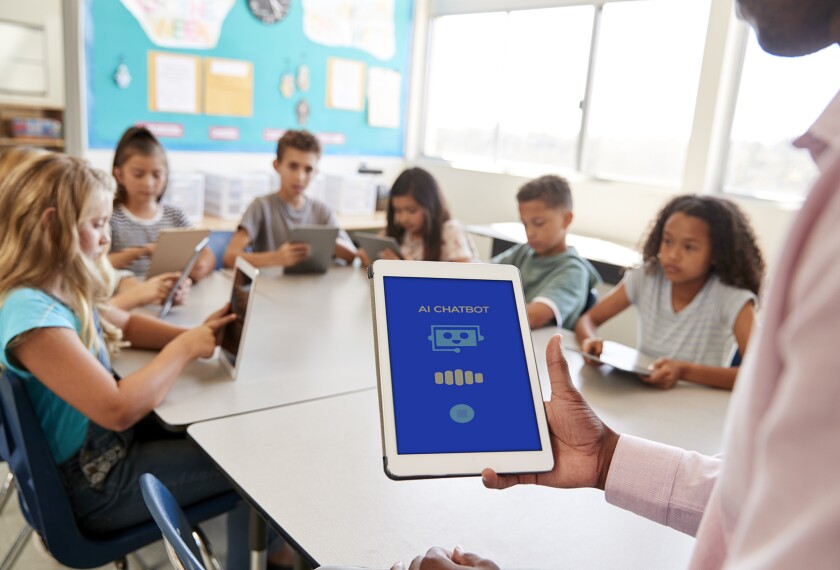
The percentage of teachers who are using artificial intelligence-driven tools in their classrooms nearly doubled between 2023 and 2025, according to data from the EdWeek Research Center.
In 2023, a little more than a third of teachers (34%) said they used AI “a little,� “some,� or “a lot.� While the percentage dipped slightly in 2024 to 32%, 2025 saw a huge increase, with 61% saying they used the technology in their work in some capacity, according to EdWeek Research Center survey data.
A few factors are contributing to the huge increase, experts say. The first is professional development. It’s important for teachers to learn about the technology so they can use it responsibly in their work and model appropriate use for students, according to experts.
“As more schools and districts invest in AI training, teachers are seeing practical use cases and gaining the confidence to try these tools themselves,� said Jessica Garner, the senior director of innovative learning for ISTE+ASCD, a nonprofit organization that provides professional development for AI use in schools.
In 2025, 50% of teachers reported having at least one single professional development session or more on using AI in their work, according to an EdWeek Research Center survey conducted between September and November. That’s almost double the percentage from the survey conducted from January to March 2024, when 29% of teachers said the same.
Another factor that likely explains the increase is that “AI is now embedded in common tools—teachers don’t have to go looking for it,� said Waymond Jackson, the president of Ed Farm, a nonprofit focused on expanding digital skills through tech-focused learning programs across the Southeast. For instance, the most popular ed-tech companies—such as Canva, Google, Kahoot!, Khan Academy, and Microsoft—have embedded generative AI in their tools.
Teachers are also navigating a significant workload, and “AI is increasingly seen as a high-value tool for planning, differentiation, and feedback,� said Carolyne Quintana, the CEO of Teaching Matters, a nonprofit focused on teacher development. “When you are managing multiple competing demands on your time, the ability to use AI for these labor-intensive tasks becomes an incredibly helpful resource.�
Teachers need continuous professional learning
Although more teachers are using AI, experts say there is still a lot of work to be done to ensure AI use is meaningful.
“The headline numbers are interesting, but the real story is in the definitions,� Garner said. “What does ‘a little’ or ‘a lot’ of AI use actually look like in practice? I’m encouraged to see more teachers engaging with these tools, but that growth is only meaningful if it’s paired with foundational AI literacy.�

The next question, Jackson said, “is whether teachers have the support to use AI in ways that strengthen learning, not just speed up tasks.�
There needs to be continued professional support for teachers as they navigate this fast-evolving technology, experts say.
“If we don’t provide teachers with the professional learning to be discerning, confident users, we risk an environment where only some ÌÇÐĶ¯Âþvlog benefit from the efficiencies of AI, while others are left behind due to a lack of guidance and/or infrastructure,â€� Quintana said.
The experts were also struck by the percentage of teachers who say they have never used AI and don’t plan to use it in their classrooms.
“I want to understand what’s behind that 21% who aren’t planning to use AI,� said Garner. “Is it access? Philosophy? Grade level? Those answers matter—because they should shape how we design professional learning and support.�


