

Crystal Curtis, a health-care professional whose son attends a school in Plano, Texas, spoke with Education Week’s Stephen Sawchuk about the challenges of ensuring quality schooling amid a school staffing shortage, her discomfort with the state’s and district’s , and the complications of raising a Black child in a suburban district as policies shift.
The interviews were conducted at the end of January and the beginning of February and have been edited for length and clarity. A spokesperson for the district said that in January, COVID required the district to make adjustments to classroom configurations, “which included combining classes into larger groups, due to staff absences and a shortage of substitutes. This may have included activities that were atypical to regular classroom instruction, but that would have been the exception and not the norm.” Its full statement is appended to the as-told-to.
I watched the Bill Maher show [on Jan. 21], in which this woman, and it literally ruined my Saturday. I called my mom. I was just ready to blow a gasket. You’re over it? Do you know what over it looks like?
I’m the director of an HIV clinic at [a Dallas hospital], and I just finished working a shift in the hospital cafeteria because we have so many staff out that we are having to pull everyone from anywhere in the hospital. The IT people, the cleaning people, VPs, directors—we are all filling in wherever we can right now because on average, we’re having 700-800 staff out a day.
I live in a suburb of Dallas—Plano, Texas—which is very red and conservative. We had masking for the first six weeks of the school year. And that was a sense of peace for my kid. At least everyone has to wear a mask. But that changed, and all these people were saying, “My kids don’t need to be wearing masks, it’s against their civil liberties.” But no one cares about my kid’s right to feel safe in his school.
That is taking a toll on him, and this takes a toll on me. My son’s counselor and I took him out of basketball because of omicron, and he was born with a basketball in his hand and went all of 7th grade not playing any sports. I talked to my son about it, and he said, “I don’t want to get sick.” We’re one of the lucky ones who have not had COVID, and the only way we can figure why is that we’ve been very diligent.
Earlier that week, my son had been saying things like, “I’m going to get COVID. I know I’m going to get it. I’m just going to school so I can get it.” Then, that same week, on that Friday [Jan. 21], he told me: “I spent three hours in the cafeteria.”
When I heard that, my mind: “Who sent you to the cafeteria? And why? Are they singling you out?” COVID was the last thing I thought about, and then I felt stupid for thinking about COVID last, but then that’s just being Black in America. That was how my brain categorized it.
My son was like, “OK, Malcolm X, hold on.” It turned out it was because those teachers were out, either with COVID or taking care of family members who had it.
He said that, basically, they used those periods as an advisory. If you’ve got homework, go do homework. But it was just a body in a room where they could put a lot of kids. And he said he has been doing color-by-number in science all year—he’s in Honors science—and he only feels like he’s learning in math class, and sometimes English.
And it reminded me that this is affecting the quality of education, too; it’s not just about the psychological welfare of masks. When we are in these schools, and some teachers are wearing masks and some aren’t, we’re just perpetuating the cycle of teachers being out, and kids being out for five days, having substitutes, and having principals stand in a cafeteria telling kids to color. Eighth graders!
Recently we were filling out his potential class schedule for 9th grade, and I was like, “Are you sure about Honors Algebra?” Because I’m not sure he’s prepared.


My son was one of the kids who, in 6th grade, went on spring break and didn’t go back to in-person schooling for a year and a half. In the first half of 7th, I was lucky enough to have a community. My son’s best friend’s mom was a stay-at-home mom, and she created a pod, and the boys went to her house for online school. I brought the food for the week. But over the course of the year, I pulled my son out of the pod; they were sick of each other and getting into arguments.
Then he’s at home, having to navigate 7th grade, while I’m an essential worker having to go into the office. My son is a straight-A, honor-roll student and he was getting F’s on his report card. I had purchased a computer for him; financially it was not a burden for us, and even in the district they passed out Chromebooks. But even though it should have been easier for [my son], it wasn’t good for his socialization. I can remember several nights where we both sat at this table I’m sitting at now and cried.
My son was exhausted by online learning. But as much as we hated it online—and believe you me, we hated it—we need an online option if you’re going to let in the people who don’t believe in masks. [Editors’ note: The district offers a virtual academy for K-6 students, but not lower secondary students.]
I live in Plano because I was trying to put my kids in the best public schools I could, and like a lot of Black people, that’s why we’re in the suburbs. That tide is kind of changing. I think we’re kind of realizing what it is we’re sacrificing to do that, and it’s a lot more than just paying more money in mortgages and rent and property taxes.
‘I’ve never been out of a surge’
When it comes to the mask mandates—everyone was wearing masks. It’s cool, right? When they took it away, now I have to think about my Black son wearing this mask. And I’m embarrassed to say this, I switched him from this mask that was black and camouflage-y, and I switched him from that to wearing surgical masks. I felt like they were more nonthreatening. It’s just the kind of stuff you think about.
I felt like he was going to be a target because no matter what, they feel here like if you wear one you’re a Democrat and if you don’t, you’re a Republican. I have been trained by the 1990s, by a person who grew up in the 1960s and 70s, that this is what we do to survive. We straighten our hair, we don’t wear Afro-centric stuff, we don’t listen to rap music in front of white people. And they are silly, but the things that get us murdered are silly.
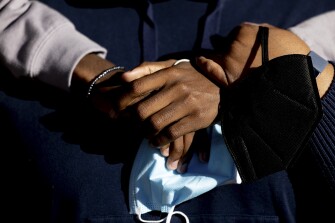
I did send the counselors and all the teachers a message that Jordan will be wearing a mask, and I need everyone to understand I work for a hospital. Not one person said anything.
Since that week, I have received only one of the notices [that another student in class had COVID], and Jordan has not had to go sit in the cafeteria. But he has had some substitutes and a counselor in a couple of his classes.
And here I am. I’m watching people literally not be able to breathe. I’m the director of an outpatient clinic, and I’m pouring coffee and scooping fruit cocktail and things into trays because our staff is so low.
I think that if there were people who really were boots-on-the-ground with COVID, they would be completely different. I’m tired of this cycle. I’ve never been out of a surge.
And that’s why when I’m watching this woman talk on TV, saying things like, “I’m over it,” I get angry. I’m just as liberal as anybody, and I’m over COVID, too. But COVID is not over us.
The Plano school district’s statement:
In January, some Plano ISD schools did make adjustments to classroom configurations, which included combining classes into larger groups, due to staff absences and a shortage of substitutes. This may have included activities that were atypical to regular classroom instruction, but that would have been the exception and not the norm. This was during a resurgent peak of COVID-19 when, like many districts nationwide, Plano ISD was experiencing a low substitute fill rate, creating a critical need to find solutions to keep schools open and continue providing instruction to students.
Plano ISD took several proactive measures, which resulted in a 30 percent increase in teacher substitute coverage, increasing from a 55 percent fill rate to an 85 percent fill rate from January to February. Actions taken by Plano ISD to attract more substitutes include:
- Increasing substitute teacher pay;
- Offering a critical needs daily bonus;
- Offering a super substitute stipend;
- Hosting job fairs and doing advertising pushes on social media.


