
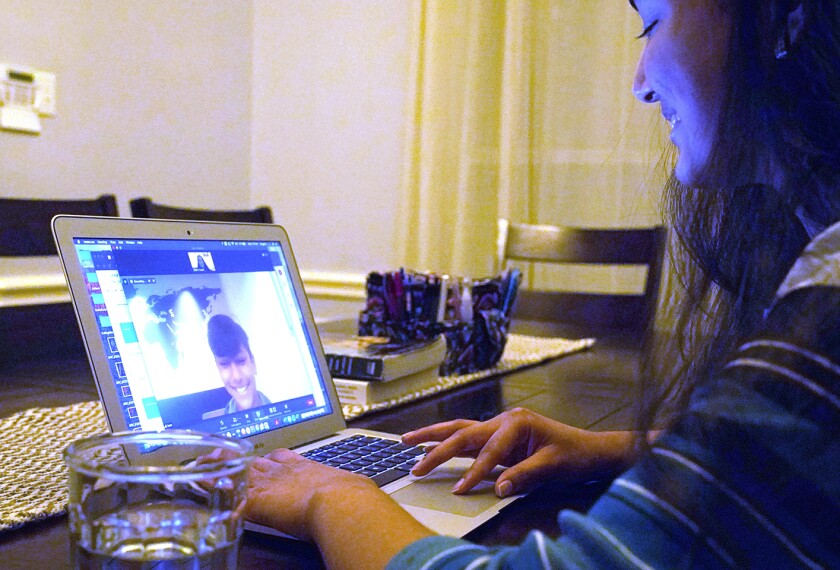
School districts across the country are turning hopeful eyes to tutoring programs as a way to help children recover academically from the COVID pandemic. Research shows that well-designed face-to-face tutoring can be a powerful ally. But there was little evidence that it could be done effectively online.
That’s starting to change. Two new studies from Spain and Italy offer encouraging signs that tutoring online can work to help children complete unfinished learning.
The findings are particularly noteworthy now, as schools search for as many good learning-recovery options as they can find. COVID-19 has not disappeared, and though the likelihood of widespread school closures appears to be low right now, it might not stay that way.
A by researchers in Spain documents the effects of an online math tutoring program provided for about 175 socioeconomically disadvantaged students 12 to 15 years old in Madrid and Catalonia in the spring of 2021, when schools had reopened after COVID-19 shutdowns.
The tutors were math teachers who’d undergone 15-20 hours of additional training in skills that included tutoring techniques.
Each tutor worked with groups of two students for eight weeks. After school, when students were at home, they went online to connect with their tutors for three 50-minute sessions per week. They worked on math skills and concepts, but the tutors also helped students build good work routines and supported their emotional well-being.
The researchers found that compared to a control group, students in the tutoring program had higher standardized test scores and grades, and were less likely to repeat a grade. They also were more likely to report putting increased effort into their schoolwork.
Researchers estimated that the rise in the students’ grades was equivalent to the bump that six additional months of learning would produce.
Test scores, attendance, rise after tutoring program
A focuses on an Italian tutoring program delivered by volunteer university students to middle school students from socioeconomically disadvantaged backgrounds in the spring of 2020, when schools were shut down.
The 523 tutors were from a Milan university; the 1,000 student recipients were from 76 schools all over Italy. The students completed online, self-paced training modules designed by pedagogy experts. Those same experts supported the tutors in their work during the program.
Each tutor was assigned to one student, and worked with that student for the entire program, connecting online three to six hours per week, for a total average of about 17 hours over the course of the program, which covered math and language arts.
Using pre- and post-tutoring tests and surveys, the researchers found the program improved students’ scores on standardized tests, their attendance, the amount of time they devoted to homework, and their sense of well-being.
Those effects didn’t vary by the type of device the students used; the impacts were the same for students who used smart phones as those who used laptops or other computers. But whichever device they used, effectiveness did drop for students who struggled to keep a good internet connection.

An American team of researchers, led by Matthew Kraft at Brown University, found only modest effects from an online tutoring program administered to Chicago middle school students in the spring of 2021. They theorized that impacts were small because students received only about three hours of tutoring over the 12 weeks of the program.
Interesting insights about online tutoring are emerging from a big research project based at Brown University’s Annenberg Institute for School Reform. Launched in 2020, the National School Support Accelerator Project is working with 12 pilot sites around the country as they scale up different models of tutoring. The project has also built a launch good-quality tutoring programs.
Annenberg Institute director Susanna Loeb, who supervises the Accelerator project, said its pilot sites are developing online and in-person models, structured in a variety of ways. Those building virtual programs have noticed that they tend to work better if the student is at school during online sessions.
The dynamics behind that effect aren’t yet clear, but Loeb said it seems less important for the tutor to be on campus than for the student. If that model works, it could ease one of the biggest stumbling blocks in bringing tutoring programs to scale: hiring enough tutors.
A model in which tutors remain online, while students are at school, opens up the possibility of drawing on a national pool of tutors, Loeb noted. It could also help schools locate tutors with niche or harder-to-find skills.


