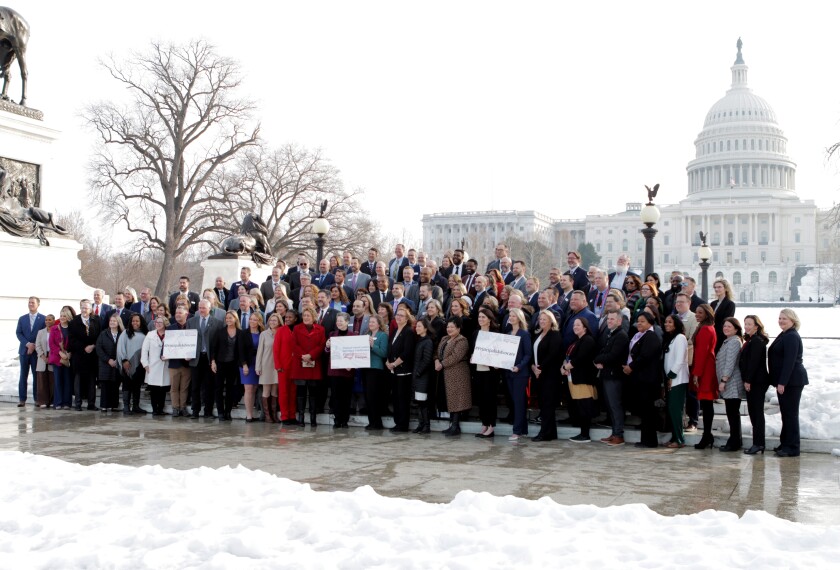
Any push for common national academic standards should take into account the needs of the workforce, the nation’s top state school officials asserted at their annual legislative meeting here last week.
To assure that U.S. students stay competitive in a global workplace, members of the Council of Chief State School Officers urged that business, nonprofit, and state and local officials be involved early in the process of coming up with any national standards.
But members of the organization also were wary of the prospect of a national exam or other mandates being imposed by the federal government, even as they discussed ways that the No Child Left Behind Act could be shaped to benefit the states.
“I worry about a national standard becoming a national test,” said Lucille Davy, the commissioner of education of New Jersey. She said she “would be leery of feds being at the helm of this.”
The state chiefs’ April 22-24 meeting took place at a time when the 5-year-old NCLB law is due for reauthorization. Members of the CCSSO also discussed such issues as the need to strengthen teacher quality and to improve assessment and accountability systems for English-language learners and students with disabilities as part of the reauthorization process.
“On the mind of every chief in this country is what’s going to happen to No Child Left Behind, and what the new language is going to look like,” Gene Wilhoit, the executive director of the Washington-based CCSSO, said at a press briefing on April 24.
The subject of what shape national standards could take—a common curriculum or a common exam, for example—arose several times during a session on the subject.
Michael Cohen, the president of the education policy group Achieve, supported a common curriculum. The Washington-based Achieve, which was formed by governors and business leaders to promote high academic standards, has worked with nine states to develop a common end-of-course exam for Algebra 2. (“Nine States to Be Partners on Algebra 2 Assessment,” April 11, 2007.)
“Students’ needs don’t depend on what state you grew up in,” he said.
Judy Jeffrey, the state director of education in Iowa, said that while she is not opposed to national standards as long as they are “somewhat broad,” she has concerns about where their emphasis would lie.
“I hear frequently about real workplace skills not being integrated,” she said. “You also hear about high school students not being adequately prepared for college.”
Many chiefs echoed her sentiments, calling for the involvement of industry officials in the development of national standards.
Wary of Washington
Washington’s role in developing national standards was one point of contention.
“I don’t think the federal government should be developing standards,” Bob Wise, a Democratic former governor of West Virginia who is now the executive director of the Washington-based Alliance for Excellent Education, said during the panel session and discussion. “This isn’t going to happen if we’re not all together in it—state, local, and advocacy organizations.”
However, Douglas D. Christensen, the commissioner of education in Nebraska, warned of the difficulty of finding common ground among states.
“If national standards means content, I think we’re so far beyond that,” he said. “Are we going to deal with something like evolution? Content is not the outcome. Performance is the outcome.”
Funding Concerns
A number of state schools chiefs voiced concern, meanwhile, about what they say is inadequate funding to meet requirements under the NCLB law. Joseph Morton, the Alabama state superintendent, said that federal aid has not come close to meeting his state’s increased costs of assessment and data collection in recent years.
“People are saying, ‘You’re getting more federal dollars,’ and I’m spending five times more state money than I’ve ever gotten,” he said.
Ms. Jeffrey, of Iowa, said: “I don’t think anyone has appropriately committed to what it takes to meet the goal of 100 percent proficiency [of students in reading and math by the end of the 2013-14 school year]. It’s a very ambitious goal, and it’s the right goal. We simply don’t have the resources to do this.”
Others at the meeting, both state chiefs and officials invited to address them, spoke about making the federal law less punitive. The law includes a range of penalties for schools that fail to meet targets for gains in student achievement.
“We sound like we’re trying to catch people doing something wrong, instead of trying to catch people doing something right,” U.S. Sen. Lamar Alexander, R-Tenn., told the chiefs April 24. “We’ve always given A-pluses for effort as well as for achievement. We need to find a way to reward teachers who find a way to help some children make progress.”
Sen. Alexander, a former state governor and U.S. secretary of education, has proposed a teacher-incentive fund to reward teachers for the longer days, longer school years, and more intensive training he said are necessary to help children deemed academically at risk succeed.
At the end of the conference, the state chiefs traveled to Capitol Hill, where they had the opportunity to voice their concerns to federal lawmakers.