
A Democratic governor who had been on the fence about participating in the new federal school choice program said Friday her state won’t participate, following the Trump administration’s release of a preview of how the program will operate.
Gov. Tina Kotek of Oregon said in a statement that the Trump administration’s information release “indicates states like Oregon will not have the flexibility they need to participate in alignment with our values.
“At this point, I simply cannot trust that any education policy coming from Trump’s White House is in the best interest of Oregon’s kids and our public education system,� she said.

Kotek appears to be the first governor to make a decision on the federal program since the U.S. Department of the Treasury on Wednesday it expects to officially propose by the end of September.
The program—a part of President Donald Trump’s tax cut legislation that Congress passed last summer—offers taxpayers dollar-for-dollar tax credits of up to $1,700 for donations to organizations that award K-12 scholarships. Those scholarships can cover private school tuition, home-school costs in some states, and some expenses for public school students, including tutoring, before- and after-school programs, technology, and uniforms.
The program takes effect next year, and governors have to decide whether to participate before scholarship-granting organizations, or SGOs, can give out awards to students in their states.
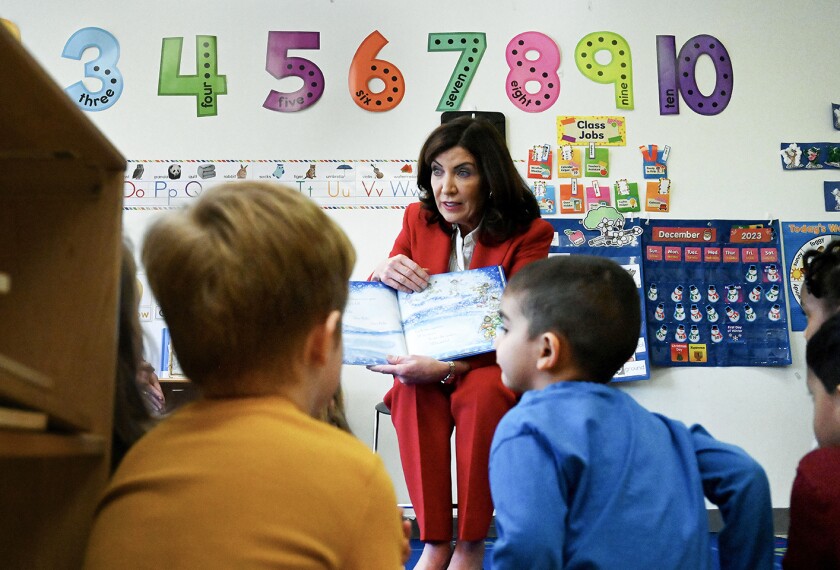
Kotek is the third Democratic governor so far to say their state won’t participate, after Govs. Tim Walz of Minnesota and Tony Evers of Wisconsin. Govs. Jared Polis of Colorado and Kathy Hochul of New York are so far the only two governors from their party to affirmatively choose to participate in the new program.
In three states with Democratic governors—Kansas, Kentucky, and North Carolina—Republican legislatures overrode gubernatorial vetoes of legislation opting their states in. In Virginia, Republican Gov. Glenn Youngkin days before before Democratic Gov. Abigail Spanberger took his place.
Altogether, 31 states are now on track to participate in the federal tax credit program, according to Education Week’s tracker of state decisions.
Students will be eligible for scholarships as long as their family income is 300% of their area’s median income or lower. That threshold encompasses most U.S. students, including families earning more than $500,000 in Westchester County, N.Y., on the high end and $114,000 in Wolfe County, Ky., on the low end.
A preview of program regulations from the Trump administration
Multiple Democratic governors have told Education Week they would await guidance or regulations from the Treasury Department on how the tax-credit program would work before committing either way.
One question has been whether states will be able to set requirements for SGOs beyond the rules outlined in the federal law. Among other criteria, SGOs must be nonprofit, award scholarships to at least 10 students who don’t all attend the same school, spend 90% of their revenue on scholarships, and verify students’ income eligibility.

Some Democratic governors have expressed a desire for the scholarship awards to help low-income or public school students, and that schools receiving scholarship follow state academic accountability and nondiscrimination requirements that would bar them from denying admission to LGBTQ+ students or students with disabilities.
But the Treasury Department confirmed Wednesday “impose substantive SGO-specific requirements that are more restrictive� than the law’s requirements.
Seven Democratic governors whose offices responded to Education Week inquiries after the Treasury Department’s information release said they hadn’t yet made decisions, with some saying they would await final regulations from the federal government.
Kotek responded that she won’t opt Oregon in.
Kotek initially said no before reconsidering earlier this year
Kotek was among the first Democratic governors last summer, soon after the policy passed, to say she wouldn’t opt her state in. But she and two other Democratic governors who initially said no later reconsidered and said they would await additional details before deciding whether to participate.
Democratic governors have been the target of intensifying advocacy from both program proponents and opponents.

School choice advocacy groups, including Democrats for Education Reform and the American Federation for Children, said the Treasury Department’s release should propel governors to opt in.
“Treasury has been very clear that all students in all educational settings, including home school in many states, are going to be eligible to receive scholarships,� said Ashling Preston, the American Federation for Children’s director of federal affairs. “Now that there is that clarity, there’s no reason left why any governor shouldn’t opt into this opportunity immediately.�
Democrats for Education Reform and favorable polling.
On the other side, the leaders of more than 30 state teachers’ unions on Thursday calling the tax credit program “part of a broader effort to privatize public education and erode public accountability� and urging them not to participate.
Melinda Person, president of New York State United Teachers, said she expected public school students “to get crumbs� from the program and that “the biggest winners are going to be those that are trying to privatize public education.�
Still, more public schools are starting to focus on how they can take advantage of the tax-credit scholarships coming online next year, including setting up or partnering with scholarship-granting organizations and considering which services they offer could be scholarship-funded.