Ķvlog

Law & Courts

Court Backs Department in Question Over Authority in Special-Ed. Case

By Julie A. Miller — September 18, 1991 2 min read
  • Save to favorites
  • Print
Email Copy URL

A Georgia school district challenging the Education Department’s authority to investigate certain special-education complaints as civil-rights violations cannot press its case in court until the agency has taken action on such a complaint, a federal appellate court has ruled.

The DeKalb County system in suburban Atlanta has waged a legal battle with the department’s office for civil rights since 1986, and the district’s federal funding was briefly cut off in April because it had refused to allow the O.C.R. to investigate eight pending complaints concerning the educational placement of handicapped children. The funding was restored after the district agreed to turn over information the office had requested, and the complaints are under investigation. (See Education Week, May 8, 1991.)

In its Aug. 30 ruling, the U.S. Court of Appeals for the 11th Circuit affirmed a district-court decision that the agency was justified in terminating funding because all grant recipients are required to cooperate with such investigations.

But the appellate court refused to rule on the central legal issue raised by the case: the proper relationship between the Education of the Handicapped Act, which entitles disabled children to a “free, appropriate” education, and Section 504 of the Rehabilitation Act of 1973, a civil-rights law that bans discrimination against the disabled in federally funded programs.

Residential Placements

The school district argues that Education Department regulations under Section 504 overreach the statute, that the E.H.A. preempted the earlier law, and that the E.H.A.'s appeal process for parents is the only vehicle through which the educational placement of disabled children can be properly challenged. In particular, the district contends that the civil-rights office overstepped its hounds in requiring residential placement for disabled children under Section 504.

The 11th Circuit said it could not judge whether that requirement was a “reasonable accommodation” under a relevant U.S. Supreme Court ruling without the factual record that would be provided if the O.C.R. were to find a violation and order the district to correct it.

The court also declined to address the broader issue of the relationship between the two laws “in the absence of a fully developed record and application of O.C.R.'S procedures to actual cases of alleged discrimination.”

The judges rejected the school district’s assertion that the 1984 Supreme Court decision in Smith v. Robinson, which held that parental appeal is limited to the E.H.A. process, proves their case, noting that the Smith ruling did not address limitations on governmental action.

A version of this article appeared in the September 18, 1991 edition of Education Week as Court Backs Department in Question Over Authority in Special-Ed. Case

Events

This content is provided by our sponsor. It is not written by and does not necessarily reflect the views of Education Week's editorial staff.
Sponsor
Artificial Intelligence Webinar
Managing AI in Schools: Practical Strategies for Districts
How should districts govern AI in schools? Learn practical strategies for policies, safety, transparency, as well as responsible adoption.
Content provided by 
This content is provided by our sponsor. It is not written by and does not necessarily reflect the views of Education Week's editorial staff.
Sponsor
Reading & Literacy Webinar
Unlocking Success for Struggling Adolescent Readers
The Science of Reading transformed K-3 literacy. Now it's time to extend that focus to students in grades 6 through 12.
Content provided by 
Jobs Virtual Career Fair for Teachers and K-12 Staff
Find teaching jobs and K-12 education jubs at the EdWeek Top School Jobs virtual career fair.

EdWeek Top School Jobs

Teacher Jobs
Search over ten thousand teaching jobs nationwide — elementary, middle, high school and more.
Principal Jobs
Find hundreds of jobs for principals, assistant principals, and other school leadership roles.
Administrator Jobs
Over a thousand district-level jobs: superintendents, directors, more.
Support Staff Jobs
Search thousands of jobs, from paraprofessionals to counselors and more.

Read Next

Law & Courts Birthright Citizenship Case Raises Stakes for Schools and Undocumented Students
Educators are paying close attention to the case on Trump's birthright citizenship order.
10 min read
President Donald Trump signs an executive order on birthright citizenship in the Oval Office of the White House in Washington, Jan. 20, 2025.
President Donald Trump signs an executive order on birthright citizenship in the Oval Office of the White House on Jan. 20, 2025. The order, now before the U.S. Supreme Court, seeks to limit citizenship for some children born in the United States to immigrant parents without permanent legal status.
Evan Vucci/AP
Law & Courts Appeals Court Revives Lawsuit Over 1st Grader’s Black Lives Matter Drawing
A court revived a 1st grader 's claim she was punished for giving a drawing to a Black classmate.
4 min read
Seen is the drawing made by Viejo Elementary School first-grader B.B. that was entered into evidence. B.B. gave the drawing to her classmate, M.C., who is African American. M.C. thanked B.B.
Pictured is a drawing by a 1st grader in California and given to a Black classmate that is at the center of a First Amendment legal challenge over the student's alleged punishment.
U.S. Court of Appeals for the 9th Circuit
Law & Courts Supreme Court’s Gender Identity Ruling Leaves Schools Seeking Clarity
Advocates say they would welcome more from the Supreme Court on gender-notification policies.
7 min read
The Supreme Court is photographed, Friday, Feb. 27, 2026, in Washington.
The Supreme Court is photographed, Friday, Feb. 27, 2026, in Washington. The high court recently ruled that California policies that sometimes limit or discourage schools from disclosing information to parents about children’s gender transitions and expressions at school likely violate parents’ constitutional rights
Rahmat Gul/AP
Law & Courts Supreme Court Backs Parents in School Gender Disclosure Fight
The Supreme Court restored an injunction blocking California policies on student gender transitions
8 min read
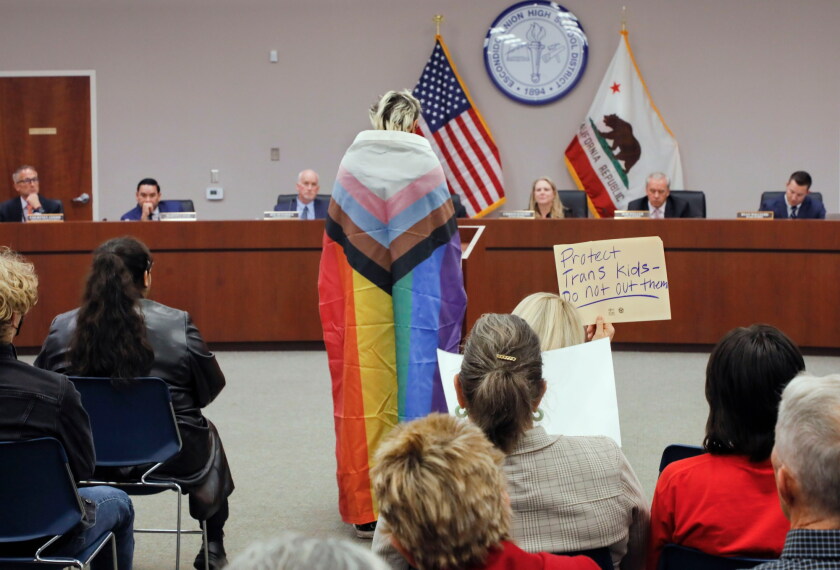
Teacher’s aide Amelia Mester, wrapped in a Pride flag, urges Escondido Union High School District not to have employees notify parents if they believe a student may be transgender in November 2025. A policy on the issue in the city’s elementary school district is the subject of a federal class-action lawsuit in which a judge just sided against the district.
Teacher’s aide Amelia Mester, wrapped in a Pride flag, urges Escondido Union High School District not to have employees notify parents if they believe a student may be transgender at a meeting in November 2025. Two parents and two teachers from the district sued in 2023, challenging California state guidance concerning student gender transitions and parental notification. The U.S. Supreme Court has now reinstated a lower-court decision overturning those state policies.
Charlie Neuman for The San Diego Union-Tribune/TNS