

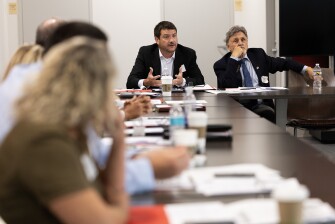
A group of principals from across the country met with Education Secretary Linda McMahon and federal lawmakers earlier this week to make one specific request—to continue the flow of funds and support that help schools recover from school shootings and other violent incidents, as well as damage from natural disasters.
The principals are members of the Principal Recovery Network, a coalition of leaders from schools that have faced school shootings and other violent incidents, which is convened by the National Association of Secondary School Principals. Led by Greg Johnson, a high school principal from Ohio, the school leaders asked policymakers to increase the budget of Project SERV, a grant to help schools recover from violence or natural diasters, from $5 million to $25 million. The SERV grant has been used by schools to hire mental health professionals and school resource officers.
The group also advocated for continued mental health funding under Title II and Title IV, which allow districts to hire mental health professionals and train teachers on safety protocols in schools.
The group made their appeals to federal lawmakers and McMahon just days after President Donald Trump released his full budget proposal for fiscal year 2026, detailing the potential future of funds that have typically helped schools recover from unexpected events. Congress will have to approve the budget for the fiscal year starting this October.
The budget proposal bundles Titles II and IV, along with 16 other grant programs, into a single funding stream worth $2 billion—currently, these 18 programs receive $6.5 billion in total, meaning there would be significant funding cuts. Title II, which supports teachers and principals, is currently funded at $2.19 billion, and Title IV, which supports student learning, is funded at $1.38 billion.
The National School Safety Activities program, which are competitive grants states and districts can receive, are among those folded into this proposed simplified funding stream. They currently provide $216 million in funding.
Trump’s proposed budget, though, reserves $10 million for Project SERV within the simplified funding stream, which would be disbursed at the education secretary’s discretion to “provide education-related services� to school districts and institutes of higher education “to recover from violent or traumatic events that have disrupted the learning environment.�
“I am somewhat encouraged that they’ve been responsive to preserving and increasing allotted funding for Project SERV,� said Warman Hall, a member of the PRN and the director of federal programs for the Aztec municipal school district in New Mexico. Hall was part of the team that met McMahon.

Still, questions remain. It’s unclear whether the secretary will lay out a new process for schools to apply for the SERV grant, he said. He’s worried that detaching the grant from where it was previously housed—under the National School Safety Activities program—will make it harder for districts to apply for this funding.
“It was housed in a well-defined grant program office that districts knew how to reach out to. They could look for it on grants.gov. I would like to see the administration define how this will happen now,� Hall said. “The last thing we need is a break in services to districts that face these types of tragedies.�
The Education Department did not respond to Education Week’s request for comment.
School leaders ask policymakers to protect mental health funding
McMahon and her federal colleagues “seemed responsive� to the stories she heard from the ground, Johnson said.
As a principal of a small rural Ohio school, Johnson had very little interaction with the federal government until 2017, when one of his students shot and injured another in the school’s bathroom.
Then, federal support, through Project SERV, helped the school hire school resource officers and mental health professionals to move on from the shooting. Johnson told McMahon that he’d like to see other schools be supported, too, with help from the Department of Education.
While the SERV grant extends just-in-time help during emergencies, improving school safety and climate is a longer-term project that involves better mental health services for students and training for teachers. This help, Johnson said, comes from allocations under Title II and Title IV funds.
“I think there is a misunderstanding that Title II is just used for academic-related professional development and sending teachers off to conferences,� Johnson said. “But a lot of schools use Title II funding for mental health training, suicide prevention training, and school safety training. Having that flexibility to compensate training your staff is an important thing.�
Johnson, Hall, and other principals in the PRN are now concerned that collapsing Title II and IV into a simplified funding stream—and significantly slashing their budget—will mean that states may be pushed to prioritize other needs over mental health staffing and training.
The PRN’s lobbying efforts come in the wake of an April billion-dollar cut to mental health grants that were given out to public schools under the Bipartisan Safer Communities Act, enacted in 2022 after 19 students and two teachers lost their lives in a mass shooting at an elementary school in Uvalde, Texas.
Members of the PRN, though, were assured by representatives from the departments of Justice and Health and Human Services that the Trump administration will take both a “hard and soft� approach to keeping schools safe, Hall said.
Hall said the core focus of the administration may be to “harden� schools against gun violence. But they also get “that there needs to be a heartening process,� Hall said, which involves providing mental health resources to schools that suffer from violence or natural disasters.
With all the proposed changes to the way federal grants are funded and administered, Hall said he remains concerned whether schools will get the support they need after a violent incident on campus.
“Even if the secretary directs states to keep a minimum threshold [for Project SERV], it could be haphazard disbursement based on political preference,� he said. “That’s not the kind of thing we need to be worried about.�


