ĚÇĐĶŻÂţvlog

Law & Courts

Teacher May Lead Bible Lessons at Her Own School, Court Rules

By Caroline Hendrie — September 22, 2004 2 min read
  • Save to favorites
  • Print
Email Copy URL

In a decision that legal experts are calling a first, a federal appeals court has held that a teacher can lead after-school Bible classes in the school where she works.

Barbara Wigg, a 2nd and 3rd grade teacher in the Sioux Falls, S.D., school district, sued last year after school officials told her she could no longer take part in meetings of the Good News Club, which included some of her students. The after-school group is one of nearly 1,750 run in public schools nationwide by Child Evangelism Fellowship, a Christian evangelical organization based in Warrenton, Mo.

By leading a club meeting at the school in the first hour after school, the district argued, Ms. Wigg ran afoul of a policy of the 19,600-student district that barred employees from participating in religious activities on school grounds.

The district argued the policy was needed to avoid the perception of government-endorsed religion, in violation of the U.S. Constitution. But Ms. Wigg countered that the district had violated her First Amendment right to free speech, because she was leading the club on her own time.

A federal district court in Sioux Falls split the difference, saying that Ms. Wigg could take part in Good News Club meetings at other public schools in Sioux Falls, although not at the one where she taught. Both sides appealed portions of the ruling.

In a unanimous ruling on Sept. 3, a three-judge panel of the U.S. Court of Appeals for the 8th Circuit, in St. Louis, came down wholly on the teacher’s side. It held that the district must allow her to take part in the meetings, even at her own school.

“Does a school’s concern for avoiding accusations of establishment of religion justify inhibiting the free speech and association rights of employees after work hours when the relevant activity takes place on school property?” the ruling says. “In this case, we do not believe so.”

Tom Hutton, a staff lawyer with the National School Boards Association, last week called the ruling troubling. He said it muddied the waters on an issue already “fraught with legal and political peril for the nation’s schools.”

“One of the relatively few clear and simple guideposts we have in this area of law is the widely understood rule that teachers don’t get involved with students in religious activities on school premises,” he said.

The NSBA filed a friend-of-the-court-brief in the case, which was joined by the American Association of School Administrators as well as the school boards’ associations in Iowa, Minnesota, and South Dakota. The 8th Circuit includes those states, as well as Arkansas, Missouri, Nebraska, and North Dakota.

Meanwhile, the head of a national organization that represented Ms. Wigg hailed the ruling, saying that “public school teachers across America have been waiting with anticipation for this decision.”

“Teachers who desire to take off their official teaching hat and put on a private one, step down the hall after the last bell, and participate in religious clubs have been finally liberated by this court’s decision,” Mathew D. Staver, the president of the Orlando, Fla.-based Liberty Counsel, said in a statement.

A lawyer for the Sioux Falls district said last week that it would ask the full 8th Circuit appeals court to rehear the case.

Events

This content is provided by our sponsor. It is not written by and does not necessarily reflect the views of Education Week's editorial staff.
Sponsor
Special Education Webinar
Hidden Costs of Special Ed Vacancies: Solutions for Your District
When provider vacancies hit, students feel it first. Hear what district leaders are doing to keep IEP-related services on track.
Content provided by 
This content is provided by our sponsor. It is not written by and does not necessarily reflect the views of Education Week's editorial staff.
Sponsor
Privacy & Security Webinar
How Technology Is Reshaping Childhood
How do we protect kids online while embracing innovation? Learn about navigating safety, privacy, and opportunity in the Digital Age.
Content provided by 
Budget & Finance Webinar Creative Approaches to K-12 Budget Realities
What are districts prioritizing in 2026? New survey data reveals emerging K-12 budgeting trends.

EdWeek Top School Jobs

Teacher Jobs
Search over ten thousand teaching jobs nationwide — elementary, middle, high school and more.
Principal Jobs
Find hundreds of jobs for principals, assistant principals, and other school leadership roles.
Administrator Jobs
Over a thousand district-level jobs: superintendents, directors, more.
Support Staff Jobs
Search thousands of jobs, from paraprofessionals to counselors and more.

Read Next

Law & Courts Birthright Citizenship Case Raises Stakes for Schools and Undocumented Students
Educators are paying close attention to the case on Trump's birthright citizenship order.
10 min read
President Donald Trump signs an executive order on birthright citizenship in the Oval Office of the White House in Washington, Jan. 20, 2025.
President Donald Trump signs an executive order on birthright citizenship in the Oval Office of the White House on Jan. 20, 2025. The order, now before the U.S. Supreme Court, seeks to limit citizenship for some children born in the United States to immigrant parents without permanent legal status.
Evan Vucci/AP
Law & Courts Appeals Court Revives Lawsuit Over 1st Grader’s Black Lives Matter Drawing
A court revived a 1st grader 's claim she was punished for giving a drawing to a Black classmate.
4 min read
Seen is the drawing made by Viejo Elementary School first-grader B.B. that was entered into evidence. B.B. gave the drawing to her classmate, M.C., who is African American. M.C. thanked B.B.
Pictured is a drawing by a 1st grader in California and given to a Black classmate that is at the center of a First Amendment legal challenge over the student's alleged punishment.
U.S. Court of Appeals for the 9th Circuit
Law & Courts Supreme Court’s Gender Identity Ruling Leaves Schools Seeking Clarity
Advocates say they would welcome more from the Supreme Court on gender-notification policies.
7 min read
The Supreme Court is photographed, Friday, Feb. 27, 2026, in Washington.
The Supreme Court is photographed, Friday, Feb. 27, 2026, in Washington. The high court recently ruled that California policies that sometimes limit or discourage schools from disclosing information to parents about children’s gender transitions and expressions at school likely violate parents’ constitutional rights
Rahmat Gul/AP
Law & Courts Supreme Court Backs Parents in School Gender Disclosure Fight
The Supreme Court restored an injunction blocking California policies on student gender transitions
8 min read
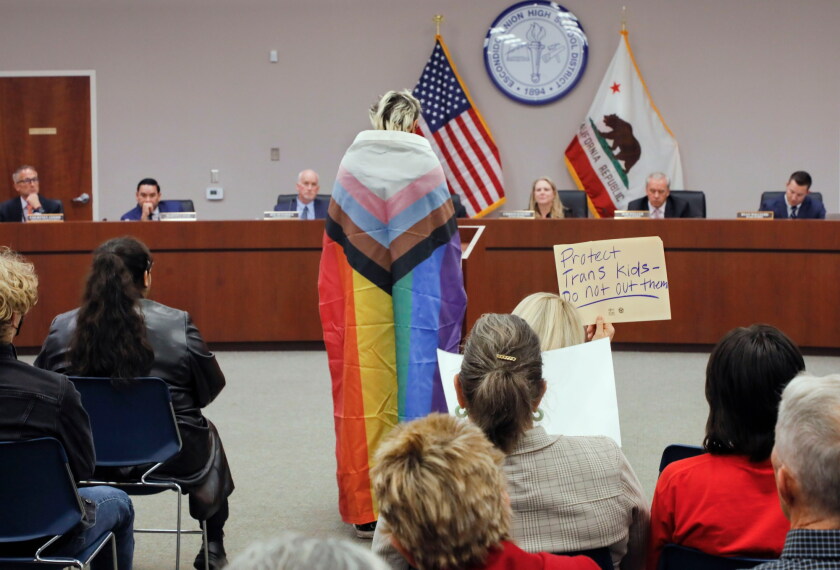
Teacher’s aide Amelia Mester, wrapped in a Pride flag, urges Escondido Union High School District not to have employees notify parents if they believe a student may be transgender in November 2025. A policy on the issue in the city’s elementary school district is the subject of a federal class-action lawsuit in which a judge just sided against the district.
Teacher’s aide Amelia Mester, wrapped in a Pride flag, urges Escondido Union High School District not to have employees notify parents if they believe a student may be transgender at a meeting in November 2025. Two parents and two teachers from the district sued in 2023, challenging California state guidance concerning student gender transitions and parental notification. The U.S. Supreme Court has now reinstated a lower-court decision overturning those state policies.
Charlie Neuman for The San Diego Union-Tribune/TNS