
U.S. Secretary of Education Linda McMahon has greenlit Louisiana’s request to combine state-level slices of four federal K-12 grant programs into a single, flexible fund that the state can direct to a range of statewide school improvement efforts.
The approval, announced May 20, marks the second time the department has given a state the go-ahead to merge its portion of funding for state-level activities for federal programs aimed at teacher training, services for English learners, student support and academic enrichment, and extended learning into one broad bucket.
Iowa received a nearly identical waiver from the requirements of the Every Student Succeeds Act in early January.
The change, which has been approved through 2029, will allow Louisiana to direct more than $18 million total to improving schools statewide, without cutting into individual districts’ piece of these grant programs. The $18 million represents the portion of each of the four grant programs set aside for state-level activities—typically 5% of each fund.
The money can be put toward any type of program allowable under one of the four combined funding streams.
Louisiana’s waiver is part of a broader push by the Trump administration to shift more authority over K-12 decisionmaking to state and local leaders.

Also on that policy agenda for the administration: Transferring management of key K-12 programs to the Labor Department, nixing nearly half the Education Department’s staff, and pushing to eliminate the agency entirely.
Cade Brumley, Louisiana’s state superintendent, said the state will consider directing the money to a priority such as foundational math, high school preparation, or training teachers in the science of reading.
“We want to execute on K-3 literacy and math screeners and make sure that teachers have good information on how to make instructional decisions, and parents have information on the status of their child’s ability or inability to read or do math,� Brumley said. “We want to continue to cut our teacher vacancies across the state. We know that one way to do that is to make the profession more fulfilling and sustaining, so we can use some of the funds to do that important work.�
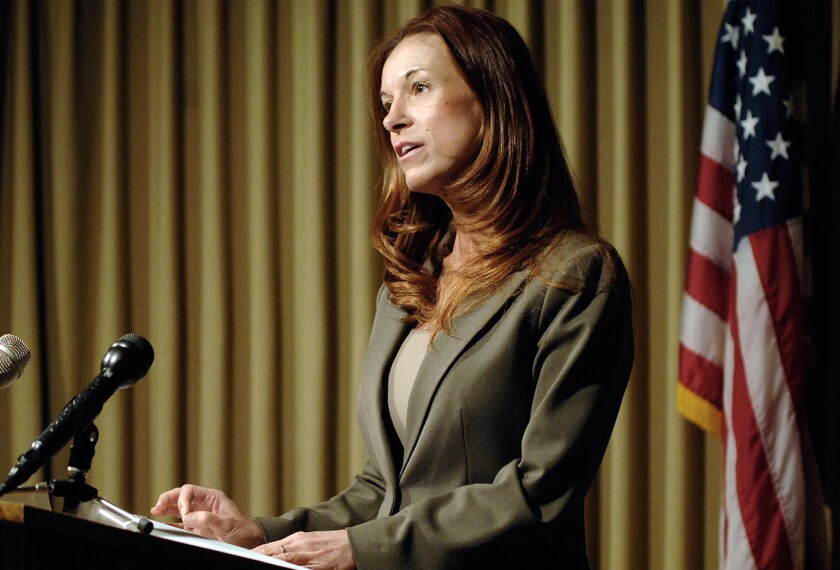
Kirsten Baesler, the department’s assistant secretary of education, said Louisiana will have to show how the change is improving student achievement.
“With more flexibility, comes more responsibility,� she said.
Louisiana was one of a handful of states singled out for making progress in reading as much of the country struggles to climb out of what researchers at the Educational Opportunity Project at Stanford have deemed a decade-long “learning recession.�
The Pelican State’s progress “just really proves that education leaders in states … know how to best serve their students,� Baesler said. “It’s not bureaucrats in Washington, D.C. I think what we’re doing right now is providing evidence that when we allow our states to have the flexibility with additional responsibility that will yield good results.�
She added, “Louisiana is a shining example of that.�
Advocacy groups, including All4Ed, EdTrust, the National Center for Learning Disabilities, and the National Parent Union, have raised concerns that the Trump administration’s ESSA waivers allow states to shift focus—and money— away from marginalized students.
For instance, Louisiana’s funding flexibility could erode state-level support for English learners, in a state with one of the fastest-growing English learner populations in the country, said Eric Duncan, the director of P-12 policy at the Education Trust, an organization focused on educational equity.
“This waiver approval is part of a larger federal effort by the Trump administration to abdicate responsibility for education by reducing federal funding and oversight,� Duncan said in an email. “All students can succeed when they’re given the supports they need; these changes put that assistance in jeopardy.�
At least 10 states are seeking other types of ESSA waivers, the Education Department said in a statement.

Though the department has currently only approved one type of ESSA waiver—nearly identical funding flexibility for Iowa and Louisiana—the agency is open to other possibilities, Baesler said.
“We are working hand in hand with states as we are exploring what’s possible within the law,� Baesler said. “Obviously, that’s a non-negotiable.�
The Pelican State’s waiver, however, doesn’t go as far as Louisiana’s original waiver ask, filed earlier this spring.
The state initially wanted to include other funding in the flexibility grant, including a small portion of its Title I grants for schools that serve disadvantaged students, as well as federal funding streams aimed at rural schools, neglected and delinquent students, and migrant children.
Those programs, however, do not include a portion designated for certain state activities, so the Education Department couldn’t approve the ask, Baesler said.
Louisiana is pleased with the flexibility the department granted, Brumley said. “We’re thankful for what they’ve approved.�
The department also recently OK’d requests from Florida and Illinois to join the Education Flex program, which allows states limited wiggle room from some of ESSA’s fiscal requirements.
Eighteen states have gotten the go-ahead for that leeway.
Participating states can give districts the go-ahead to carry over a greater share of their Title I funds for disadvantaged students from one year to the next without securing explicit federal approval. Or they can allow districts to spend a greater share of their Title IV-A grant funding on technology than is specified under the law. Title IV-A is a wide-ranging federal formula fund for student support and enrichment activities.
And the department sent to state education leaders highlighting existing leeway in ESSA to transfer funds between different federal K-12 programs (for instance, from teacher training to English learners) as well as funding flexibility for small, rural districts.