
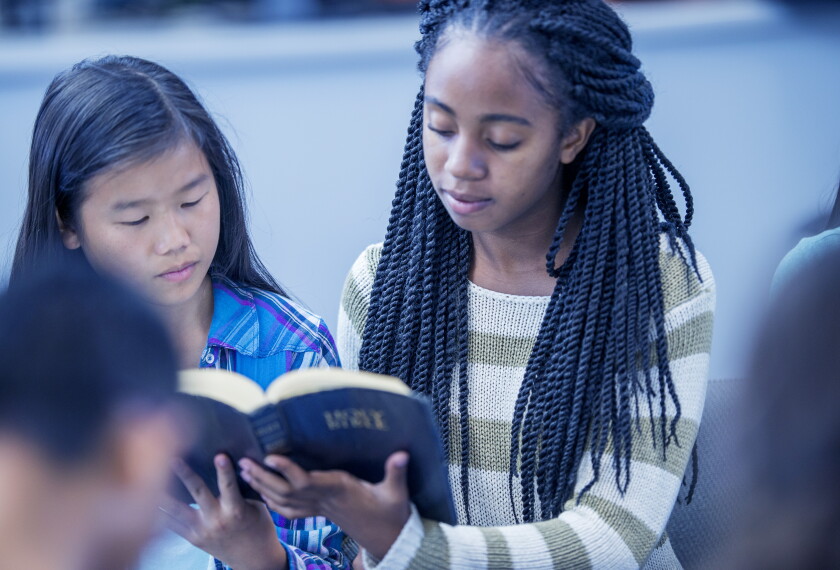
Texas is poised to further test the church-state divide in public education now that lawmakers there have passed a bill that would allow schools to set aside daily time for prayer and reading the Bible or other religious texts.
The bill, which awaits Republican Gov. Greg Abbott’s signature, would require all districts to vote on such a policy within six months after it is enacted. If schools have approved time for prayer and religious study, parents would have to consent for their children to participate by signing a form that waives their right to sue under the establishment clause of the First Amendment, which prohibits government-sponsored religious activity.
“This is a huge victory for religious liberty and allowing students and teachers to freely exercise their faith,� Republican Mayes Middleton, who sponsored the bill and is also a candidate for attorney general, after it passed on May 23. “Our schools are not God-free zones, and there is no such thing as ‘separation of church and state’ in our Constitution.�
The legislation is part of a growing wave of state efforts to test the boundaries of legally permissible religious activity in schools.
Supporters of the Texas legislation call it the “Coach Kennedy Bill� in honor of Joe Kennedy, a former Bremerton, Wash., high school football coach who won a 2022 U.S. Supreme Court case against his former district after leaders there disciplined him for continuing to pray on the field after games, even after they ordered him to stop.
A bill that would require display of the Ten Commandments in every Texas classroom awaits final approval by the state Senate. Louisiana and Arkansas have already passed similar legislation. (A federal court struck down Louisiana’s law in 2024.)
In November, the Texas school board approved optional curriculum that incorporates biblical passages and concepts like the teachings of Jesus Christ in the Sermon on the Mount into elementary school reading lessons.
In 2023, Texas became the first state to allow school districts to use religiously affiliated chaplains to counsel students during the school day. The law required all districts to vote on whether they would allow school chaplains, and a vast majority opted not to.
Opponents concerned about religious coercion
Opponents of such measures say they are often passed with the aim of advancing evangelical Christianity, and that they amount to unconstitutional religious coercion for students from other faith backgrounds or students who are not religious.
“Government-endorsed religious activity, even when technically ‘voluntary,’ pressures students to conform to the dominant faith tradition and risks isolating or stigmatizing others,� wrote Mansfield, Texas, resident Cynthia Daniels in public comments on the prayer and religious-study bill. “That is not freedom of religion, it’s coercion under the guise of tradition.�
The bill’s supporters say those concerns are overblown. Students can only participate with consent from their parent or caregiver, which can be withdrawn if desired, the text says. The bill would prohibit prayer or the reading of a religious text over a public address system, and it says time for prayer and religious study “may not be a substitute for instructional time.�
Participating districts would be able to schedule the prayer period before normal school hours. The period, according to the measure, may be held during the school day in classrooms or other areas in which a consent form has been submitted “for every employee and student present, which may include an entire school district or open-enrollment charter school campus if a consent form has been submitted for each employee and student at the campus,� the bill says.
Let me say this very plainly: We should be encouraging our students to pray and read their Bible every day, just as the authors of the Constitution did.
The bill says teachers may not require or coerce students to pray or abstain from praying, but lawmakers amended it to remove text that prohibits encouraging students to pray.
“Let me say this very plainly: We should be encouraging our students to pray and read their Bible every day, just as the authors of the Constitution did,� Republican state Rep. Brent Money said during debate of the bill on May 22.
Such encouragement by public employees is unconstitutional, said Amanda Tyler, the executive director of the Baptist Joint Commission for Religious Liberty, an organization that advocates for religious freedom.
“At its heart, there is an element of coercion when an authority figure inserts themselves into what should be private religious exercise,� she said.
Students and ÌÇÐĶ¯Âþvlog already have protected rights to prayer and religious expression in public schools, Tyler said, calling the Texas bill “a solution in search of a problem.â€�
Students of all religious backgrounds can pray at school when not engaged in school activities or instruction, and teachers and administrators can neither sanction nor discourage such prayers, courts have held.
Students’ rights to pray at school are protected by both the Constitution and the Elementary and Secondary Education Act, which that they have “no policy that prevents, or otherwise denies participation in, constitutionally protected prayer in public elementary and secondary schools� as a condition of receiving federal funds.
Republican lawmakers test the limits of religion in schools
Supporters of recent state bills seem to be attempting to further test the limits of what the court will allow, citing the 2022 Kennedy v. Bremerton School District case.
“Litigious atheists are no longer going to get to decide for everyone else if students and ÌÇÐĶ¯Âþvlog exercise their religious liberties during school hours,â€� Middleton to the Associated Press.
In the Kennedy case, the Bremerton district asked the coach to stop praying on the sidelines as more and more students joined him. Leaders said they were concerned about violating the First Amendment’s establishment clause by creating the appearance of a government endorsement of religion.
But a 6-3 court majority said that disciplining Kennedy for the prayers was a violation of his personal religious freedom and freedom of speech.
Before that ruling, federal courts had long held that public policies and practices violate the establishment clause if they aren’t primarily secular in purpose, if they promote or inhibit religion, and if they represent an “excessive entanglement� between church and state. In the Kennedy case, the court did not apply that test.
Some legal experts said the court’s decision in the Kennedy case left some confusion among district leaders and lawmakers about acceptable demonstrations of religion in schools. Conservative supporters of bills like Texas’ have said they welcome court challenges to determine how the principles outlined in the Kennedy decision will be applied in other situations.
The Texas bill says the state will cover any legal costs districts incur as a result of adopting time for prayer and Bible study.

Texas lawmakers are “overblowing the impact� of the Kennedy case by applying a decision about an employee’s personal prayers to support a broader policy of organized time for religious activities in schools, Tyler said.
In a 1949 decision in , the Supreme Court ruled that an Illinois school district violated the establishment clause when it released students from regular instruction time for voluntary religious classes and cooperated closely with religious organizations that conducted the lessons.
In a 1952 decision in , the high court ruled that New York City schools did not violate the Constitution when they allowed students to voluntarily participate in religious lessons off-site.
Neither of those precedents was overturned in the Kennedy case, Tyler said. The Texas law seems to attempt to thread the needle between the two decisions by having prayer time on campus but outside of instructional time.
“I think the [Texas bill’s] authors are trying to write something that cannot be challenged on its face,� she said. “But as applied, I think there are serious potential problems for religious freedom for these students, and potential problems for people who work at these schools as well.�


