
ÌÇÐ͝Âþvlog

Reading & Literacy Interactive

Book Bans Over the Years, in Charts

By Eesha Pendharkar — April 28, 2023 2 min read
The most banned books from the fall of 2022, according to PEN America.
  • Save to favorites
  • Print
Email Copy URL

Book bans have escalated for 18 months now, hitting an all-time high in December 2022.

Since June 2021, PEN America, a free speech advocacy organization that tracks bans, has recorded more than 4,000 book challenges and bans in school districts.

The actual number is estimated to be even higher because PEN America relies on media reports, publicly available documents, and school district meeting minutes to track bans.

Book bans have impacted a wide range of topics, from titles about LGBTQ+ characters, to books on sexual health, to books featuring themes of race and racism.

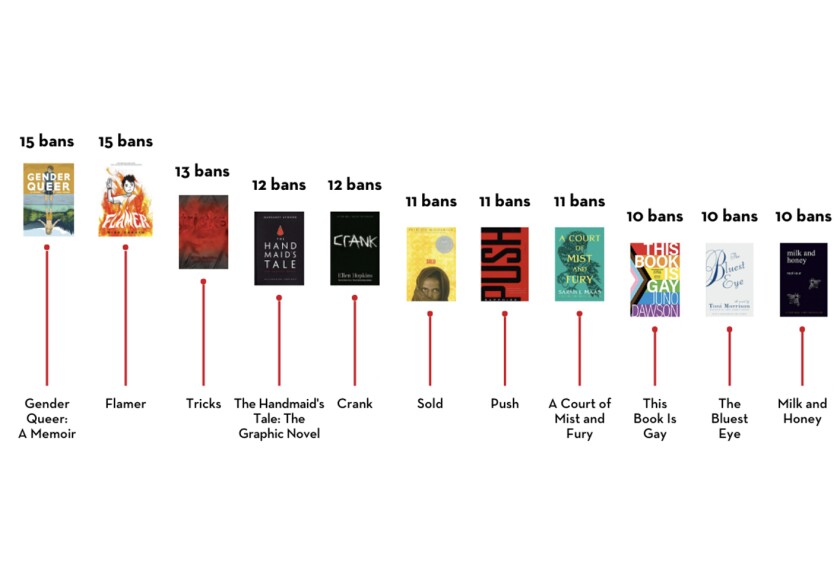
Here’s a visual representation of book bans, from June 2021 to December 2022, based on PEN America data:

How many books have been banned?

Book bans reached an all-time high during the fall of 2022. But since 2021, PEN America has tracked more than 1,000 instances of book challenges and bans during each six-month period.

What is the No. 1 most banned book?

Gender Queer: A Memoir by Maia Kobabe, is the most banned book over the last 18 months. The graphic memoir both written and illustrated by Kobabe chronicles the author’s life from adolescence to adulthood, detailing their experiences with their gender and sexual identity.

It has been banned 56 times in 18 months.

What is the No. 1 reason books get banned?

Books are frequently challenged for having inappropriate or sexual content, according to PEN America. In 2021 and the first half of 2022, more than 41 percent of banned books were about LGBTQ+ characters or stories. That changed in the latter part of 2022, with most banned books being about sexual experiences, violence, or sexual health.

However, many books about gender and sexual identity that chronicle LGBTQ+ experiences fall under these categories too.

Where do books get removed from?

Books predominantly get removed from school libraries, with only a small percentage of book bans impacting classrooms specifically. Most books are removed pending investigation, meaning that a book is removed whenever there’s a challenge for review.

Many of these books are removed from student access before due process of any kind is carried out, according to PEN America. In some cases, books can also be removed without challenges for review. These books often end up being unavailable for weeks or months.

Where are book bans happening?

Most book bans are happening in Texas and Florida, according to PEN America. Over the past year, Texas has seen more than 1,200 book challenges, and Florida more than 900. In some cases, state laws are responsible for causing districts to remove books to err on the side of caution, the report found. In other cases, districts are removing hundreds of titles for review.

Book bans have been recorded in at least 32 states.

Related Tags:

Events

This content is provided by our sponsor. It is not written by and does not necessarily reflect the views of Education Week's editorial staff.
Sponsor
College & Workforce Readiness Webinar
Smarter Tools, Stronger Outcomes: Empowering CTE Educators With Future-Ready Solutions
Open doors to meaningful, hands-on careers with research-backed insights, ideas, and examples of successful CTE programs.
Content provided by 
Reading & Literacy Webinar Supporting Older Struggling Readers: Tips From Research and Practice
Reading problems are widespread among adolescent learners. Find out how to help students with gaps in foundational reading skills.
This content is provided by our sponsor. It is not written by and does not necessarily reflect the views of Education Week's editorial staff.
Sponsor
Reading & Literacy Webinar
Improve Reading Comprehension: Three Tools for Working Memory Challenges
Discover three working memory workarounds to help your students improve reading comprehension and empower them on their reading journey.
Content provided by 

EdWeek Top School Jobs

Teacher Jobs
Search over ten thousand teaching jobs nationwide — elementary, middle, high school and more.
Principal Jobs
Find hundreds of jobs for principals, assistant principals, and other school leadership roles.
Administrator Jobs
Over a thousand district-level jobs: superintendents, directors, more.
Support Staff Jobs
Search thousands of jobs, from paraprofessionals to counselors and more.

Read Next

Reading & Literacy From Our Research Center Secondary Students Are Struggling With Reading, Too. A Look at the Landscape
Exclusive survey findings outline how ÌÇÐ͝Âþvlog perceive the obstacles affecting older students' reading.
5 min read
Students attend Bow Memorial School in Bow, N.H. on Oct. 29, 2025. Bow Memorial School is a middle school that has developed a systematic approach to addressing foundational reading gaps in middle school students.
New data show that many ÌÇÐ͝Âþvlog report that middle and high school students struggle with aspects of foundational literacy. At Bow Memorial School in Bow, N.H., pictured on Oct. 29, 2025, students work with reading specialist Loralyn LaBombard, who has helped pioneer a systematic approach to addressing foundational reading gaps in grades 5 to 8.
Sophie Park for Education Week
Reading & Literacy Opinion Students Need Anchors When They Read. How to Make Them Stick
I’ve taught English in China and Chinese in America. Here’s what it taught me about literacy.
Haiyan Fan
6 min read
Paper airplane tied to an anchor.
iStock/Getty + Education Week
Reading & Literacy A Popular Method for Teaching Phonemic Awareness Doesn't Boost Reading
In a new study, a highly used program didn't lead to improvements in students' word-reading abilities.
5 min read
Image of a student reading in the library.
New research suggests that exercises in phonemic awareness may be more impactful when connected to print and purposeful phonics teaching.
Allison Shelley for All4Ed
Reading & Literacy Opinion How Should Teachers Deal With Problematic Language in Literature?
Offensive prose does show up in books. Ignoring it doesn't help students.
10 min read
Conceptual illustration of classroom conversations and fragmented education elements coming together to form a cohesive picture of a book of classroom knowledge.
Sonia Pulido for Education Week
