Ķvlog

Opinion
Mathematics Letter to the Editor

Use Poetry to Create Safe Math Classrooms

July 15, 2025 1 min read
  • Save to favorites
  • Print
Email Copy URL

To the Editor:

The May 23 article, “Three Ways to Build Student Confidence in Math,” resonated deeply with on psychological safety and feedback in math classrooms. The article highlights formative assessments and student reflections as tools to gauge who needs help—but I’d argue we must also ask: How do students experience help?

As an instructional coach, I worked with 4th and 5th grade math teachers who used poetry reflections after exit tickets (a short assessment at the end of a unit) to hear students’ perspectives. These daily poems disrupted the notion of math as neutral, surfacing students’ fears, longings, and identities. One student wrote, “I want my teacher to pull me to the back table and help me.” That line reshaped a teacher’s entire feedback strategy.

The poems revealed something powerful: Academic performance didn’t guarantee psychological safety. Even students who scored high on formative assessments expressed anxiety about making mistakes. Their poetry made clear that math identity is less about competence and more about feeling seen and safe in learning environments.

What made these reflections transformative wasn’t the poetry alone—it was the teachers’ commitment to respond. Each week, they analyzed the poems and adjusted their feedback practices to reflect what students said they needed. This reciprocal feedback loop—students write, teachers reflect and respond, students notice the change—created classrooms rooted in listening, care, and belonging.

If we want to raise student confidence in math, we must go beyond identifying gaps in understanding. We must cultivate psychologically safe classrooms where students trust their teachers to help them learn—and listen when they speak.

Rachel C. Cason
Special Education Instructional Coach
DC Scholars Public Charter School
Washington, D.C.

Read the article mentioned in the letter

Fifth grade students attend a math lesson with teacher Alex Ventresca, right, during class at Mount Vernon Community School, in Alexandria, Va., Wednesday, May 1, 2024.
Fifth grade students attend a math lesson with teacher Alex Ventresca, right, during class at Mount Vernon Community School, in Alexandria, Va., Wednesday, May 1, 2024. Math anxiety prevents students from learning, but experts in the subject offer ways to help students.
Jacquelyn Martin/AP
Mathematics Three Ways to Build Student Confidence in Math
Jennifer Vilcarino, May 23, 2025
3 min read

A version of this article appeared in the July 16, 2025 edition of Education Week as Use Poetry to Create Safe Math Classrooms

Events

This content is provided by our sponsor. It is not written by and does not necessarily reflect the views of Education Week's editorial staff.
Sponsor
Artificial Intelligence Webinar
Managing AI in Schools: Practical Strategies for Districts
How should districts govern AI in schools? Learn practical strategies for policies, safety, transparency, as well as responsible adoption.
Content provided by 
This content is provided by our sponsor. It is not written by and does not necessarily reflect the views of Education Week's editorial staff.
Sponsor
Reading & Literacy Webinar
Unlocking Success for Struggling Adolescent Readers
The Science of Reading transformed K-3 literacy. Now it's time to extend that focus to students in grades 6 through 12.
Content provided by 
Jobs Virtual Career Fair for Teachers and K-12 Staff
Find teaching jobs and K-12 education jubs at the EdWeek Top School Jobs virtual career fair.

EdWeek Top School Jobs

Teacher Jobs
Search over ten thousand teaching jobs nationwide — elementary, middle, high school and more.
Principal Jobs
Find hundreds of jobs for principals, assistant principals, and other school leadership roles.
Administrator Jobs
Over a thousand district-level jobs: superintendents, directors, more.
Support Staff Jobs
Search thousands of jobs, from paraprofessionals to counselors and more.

Read Next

Mathematics Spotlight Spotlight on Creating a Positive Math Culture
This Spotlight explores instructional practices that help build students’ math skills, confidence, and willingness to tackle hard problems.
Mathematics 4 Research-Backed Tips for Mastering Math Facts
A new review of research offers evidence-based recommendations for classroom practice.
5 min read
A classroom at Lafargue Elementary School in Effie, Louisiana, on Friday, August 22. The state has implemented new professional development requirements for math teachers in grades 4-8 to help improve student achievement and address learning gaps.
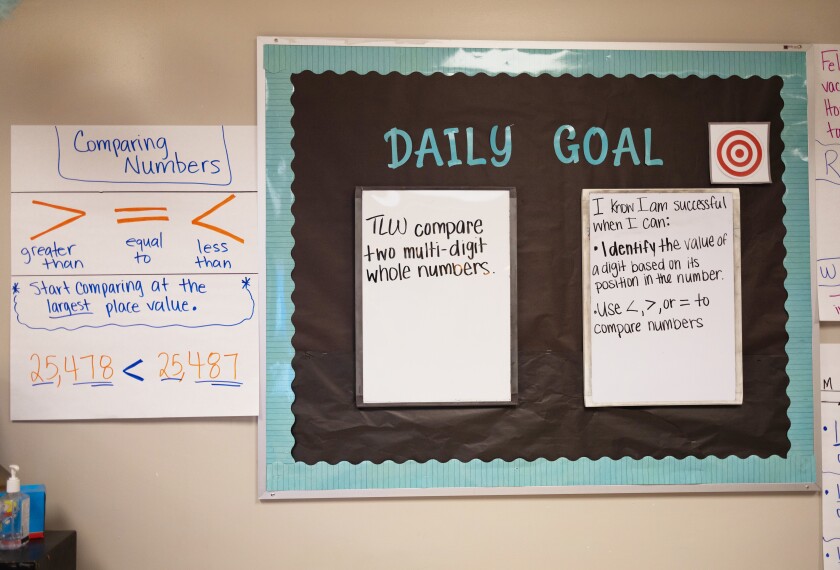
An elementary school classroom in Effie, La., shows how one of the learning goals is to master the ability to compare numbers, on August 22, 2025. New research points out steps teachers can take to memorize facts—through a combination of practice, drills, and playing with numbers.
Kathleen Flynn for Education Week
Mathematics Are Students Prepared for College-Level Math? A Senator Wants to Know
Cassidy has asked 35 institutions about incoming students' math abilities, citing a "crisis" in K-12 math education.
3 min read
Sen. Bill Cassidy, R-La., chairman of the Senate Health, Education, Labor and Pensions (HELP) Committee, strives for a closed-door meeting with fellow Republicans at the Capitol in Washington, Tuesday, Dec. 9, 2025.
Sen. Bill Cassidy, R-La., the chairman of the Senate Health, Education, Labor and Pensions (HELP) Committee, pictured on Capitol Hill on Dec. 9, 2025, has asked for details from colleges and universities about whether matriculants possess adequate math skills.
J. Scott Applewhite/AP
Mathematics Debates Over Math Teaching Are Heating Up. They Could Affect Classrooms
A controversial new movement promoting the "science of math" has come into the math establishment's crosshairs.
9 min read
Casey Dupuis points to class work for a one of her 5th graders during a math class at Lafargue Elementary School in Effie, Louisiana, on Friday, August 22. The state has implemented new professional development requirements for math teachers in grades 4-8 to help improve student achievement and address learning gaps.
A 5th grader works on a problem during a math class at an elementary school in Effie, La., on Aug. 22, 2025. A position paper on teaching math published by the National Council of Supervisors of Mathematics recently kicked off another round of conversations about what practices work best in the classroom—and what the ultimate goals of the subject even are.
Kathleen Flynn for Education Week
