It has been a tough sell that took several years to make, but South Carolina lawmakers adopted a career education program this year that they hope will prepare the state—and its young people—for the needs of a rapidly shifting economy.
The Education and Economic Development Act of 2005 requires each high school student, starting with next fall’s freshmen, to choose a “career major,� with guidance counselors’ help.
Under the law, all of the state’s public high schools must offer three or more clusters of courses focused on different types of work by the fall of 2007. The state has developed 16 career clusters that schools can use.
South Carolina leaders call it a model for the 49 other states.
“I believe the impact of this law will be to transform high schools in South Carolina,� said Inez Tenenbaum, who is in her seventh year as the state’s elected superintendent of education.
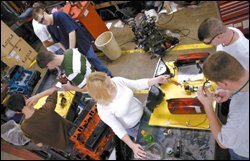
The new program shows that politicians and business leaders are becoming more interested in the career training that students receive in high school, said Richard Kazis, the senior vice president of Jobs for the Future, a Boston-based group that works with states on education and workforce policies.
Governors and legislators are realizing they can’t discuss high school improvement without focusing in part on career programs, he added. “These programs were invisible for a while in a lot of the education reform discussions,� he said.
Building Support
Ms. Tenenbaum and supporters of the effort spent a lot of time laying the foundation before the law was passed in this year’s legislative session.
The work began with a task force of business leaders and others appointed three years ago by Ms. Tenenbaum, a Democrat, and Gov. Mark Sanford, a Republican. The panel recommended a number of ways that high schools might better prepare young South Carolinians for economic changes in their state. It is just the kind of concern that is surfacing in other states as well. (“Idaho Board Softens Career Focus Following Criticism,� this issue.)
Once known for textiles and other types of manufacturing, South Carolina now relies more on tourism, but needs to create more jobs in technology and research, its leaders say.
“The goal is obviously to move toward the high-tech kinds of jobs,� said Bob Couch, the state director of career and technology education.
After developing the legislative proposal, state business leaders had to help convince lawmakers that career education was worth their time—and votes.
One of the biggest challenges was that some legislators had only distant memories of vocational education and wondered why such careers needed updating.
Some government officials questioned whether and why state funds earmarked for workforce development should go toward an education program.
“We had to get buy-in by some of the folks,� said Rep. Ronny Townsend, the Republican who chairs the House education committee.
A New Understanding?
The new law requires that schools begin developing career-inclusive individual education plans for 8th graders starting in the fall of 2006, with career planning starting for all students in grades 6-7 that year.
High school students must begin taking courses under those plans beginning in the fall of 2007, when high schools also must begin offering at least three of the state’s 16 approved career clusters.
Students will be asked to choose courses from those clusters that apply to their career interests, though they will be able to change their plans, Mr. Couch said. Clusters include courses on education, the arts and communications, hospitality, business, and information technology.
Full implementation of the law must occur by 2011. The career-planning process is modeled on the school improvement program called High Schools That Work, which is widely used by school districts across the country and is run by the Atlanta-based Southern Regional Education Board.
Several South Carolina districts are piloting career clusters and other strategies that are part of the new law. Some students already are able to choose from the 16 clusters designed by the state, and officials say the signs are promising.
“There’s the new understanding that high school students really do want to see what’s out there� in careers and training, said Wayne Brazell, the assistant superintendent for instruction in Lexington County School District One, a 19,000-student district covering some western suburbs and rural areas outside Columbia, S.C., that is piloting the career clusters.
Schools and districts with fewer staff members may have a hard time fully implementing the law, Mr. Brazell warns. “It does mean a school really has to think about what you’re going to offer, and then do some long-term planning,� he added.
The state plans to add more than 400 new career counselors in schools over the next several years. Ms. Tenenbaum said her fiscal 2007 budget plan would request $14 million to reduce the number of students that guidance counselors serve in some schools from about 700 to about 300.
Requiring students to plan ahead for classes and careers starting in middle school first was required in a 1994 state school-to-work law, but those rules have not been strictly enforced, Mr. Couch said. The state estimates about 60 percent of students go through the process.
The implementation of South Carolina’s new law will be guided by a state-level council, which will include the governor and the state superintendent, or their appointees.
The Dropout Problem
Under other key pieces of the legislation, districts are required to draft dropout-prevention plans that must be approved by the state board of education, and the state higher education commission must formalize dual-enrollment rules to allow more high schools students to take college classes for credit.
South Carolina’s on-time high school graduation rate is as low as 51 percent, according to the Washington-based Urban Institute. Mr. Couch said the state’s own best estimate is that 67 percent of 8th graders go on to complete high school within five years. And one-quarter of college students from South Carolina high schools need remedial classes, he said.
Rep. Townsend said he hopes the new law and its focus on career preparation will help improve on-time graduation rates in the state, which were among the nation’s lowest even before they declined in the past decade. “I think it’ll help [students] stay in school, because they’ll find more interests that they can develop through these clusters, and I hope it will help with the dropout rate,� he said.
Funding for the dropout-prevention programs could be expanded under the law in 2006, said Mr. Couch. The state already is piloting some dropout-prevention programs that could be included in future funding under the law.
One of them is the Star Academy, at Gettys Middle School in Easley, S.C. The academy enrolls about 75 students in the 8th grade who have fallen behind one or more grade levels. The goal is to help 8th graders catch up and proceed directly into the 10th grade, giving them a boost toward finishing high school.
“I think we’re finally on the right track� in helping more students graduate, said Mendell H. Stewart, the superintendent of the 16,400-student Pickens County schools, where the Star Academy is located.
In a county that has seen manufacturing drop from covering more than 50 percent of the local tax base to about 11 percent in recent years, Mr. Stewart said, schools must help prepare a new kind of workforce, ready for jobs in technology and research.
The new law will help in those efforts, he said.“It’s very important for public school people and superintendents and teachers … to understand the importance of education in reference to economic development in the state,� he said.


