Corrected: An earlier version of this article misspelled the name of Dale Farran, senior associate director of the Peabody Research Institute at Vanderbilt University.
State preschool funding has returned to pre-Recession levels, and slightly more students are enrolling, but the quality of these programs continues to vary widely, concludes the latest analysis by the National Institute for Early Education Research.
“It’s the first year that we really see a clear bounce back from the recession,� said W. Steven Barnett, the director of NIEER, based at Rutgers University. “Spending is up considerably over pre-Recession levels for the first time. Quality standards had been moving down, [and] are now back up.�
During the 2015-16 school year, state spending on preschool jumped to almost $7.4 billion, a $564 million increase from the previous school year, the institute’s annual “� report calculated. California and Texas led the way with increases of $200 million and $100 million, respectively.
But those increases didn’t always equate to higher-quality programs. In its report, NIEER rolled out 10 new benchmarks for program quality, which it said more closely align with the latest research on what constitutes an effective preschool program. Only two states—Alabama and Rhode Island—met all 10.

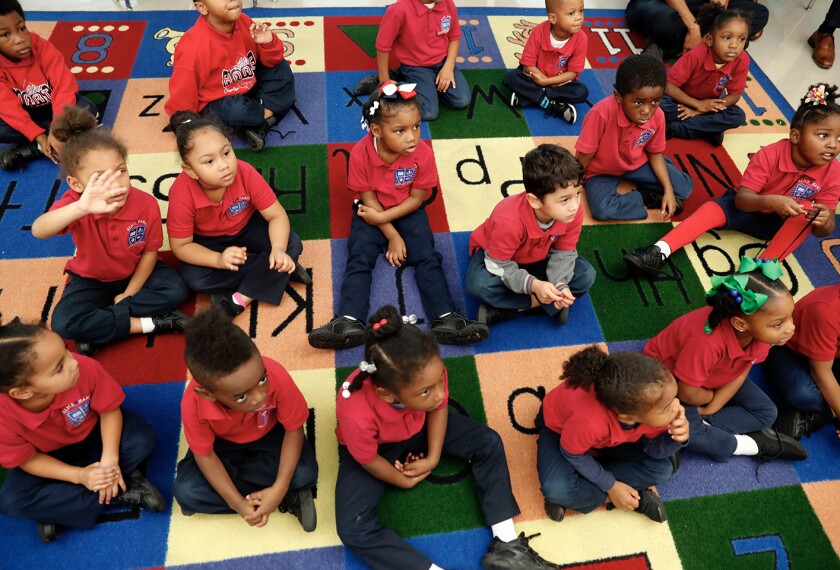
Enrollment increased nationwide from the previous school year by more than 40,000 for 4-year-olds and more than 2,700 for 3-year-olds. In all, nearly 1.5 million children attended state-funded preschool. Of that number, nearly 1.3 million were 4-year-olds.
Funding, Quality Markers
Average state preschool funding per child stood at nearly $5,000, not including local and federal contributions. Half of the states increased funding, with 12 states upping their spending by $10 million dollars or more. Just three years ago, state preschool funding was about $4,000 per child, the lowest level in a decade.
The federal government stepped in to help 18 states provide more money for preschool programs through Preschool Development Grants. These grants provided states with nearly $210 million during the 2015-16 school year.
The District of Columbia came out on top when it comes to spending percentage on state preschool. New Jersey, Oregon, Washington, and Minnesota round out the top five.
Barnett said NIEER made the decision to adopt new quality standards this year in part because states had made progress on the old standards, which were designed to be minimums.
The new benchmarks aim to go beyond criteria that are easy to quantify, such as class size, student-teacher ratio, and teacher qualifications.
Under the new benchmarks, programs are expected to provide comprehensive early-learning and development standards that are aligned with child assessments and with kindergarten through 3rd grade and—eventually—college- and career-ready standards and infant and toddler standards. These standards are also required to be culturally sensitive and supported through professional development.
Programs are also required to have continuous quality improvement systems in place, which include structured observations of classroom quality. These observations must be used to develop an improvement plan with teacher feedback.
“These are more directly related to what happens in the classroom, which determines how much kids benefit from programs,� said Barnett. “A fair number of states don’t do well on those.� Fifteen states met five or fewer.
The new standards do have some critics.
Dale Farran, senior associate director of the Peabody Research Institute at Vanderbilt University, is a big fan of NIEER’s annual report, but said there’s too much room for error under the new standards. “I think those things are exceptionally difficult to get a report from each state each year about,� Farran said. “I applaud their effort, but I think it’s going to be quite misleading.�
At least one state that ranked well on the report is using it as a source for self reflection.
North Carolina’s state preschool program, NC Pre-K, is administered by the state Department of Health and Human Services. The state was one of five to meet the 10 previous benchmarks for minimum state preschool quality standards. It also met nine of the 10 new benchmarks for quality standards.
Susan Perry-Manning is the state’s deputy secretary for human services. She said although North Carolina receives high rankings for its quality standards, the state still needs to do more to ensure that all eligible children have access to the program.
“Currently, approximately 40 percent of eligible 4-year-olds are being served,� Perry-Manning wrote in an email. “In addition, a recent study identified the need for more funding to maintain the current quality standards—particularly investments that help prepare, support, and retain qualified teachers.�
Challenges Remain
Small enrollment numbers remain a problem for several states. Fifteen states serve less than 5 percent of eligible 4-year-olds, NIEER found, including seven that do not provide any state-funded preschool.
Fourteen states are bucking this trend by enrolling more than 50 percent of 4-year-olds.
Many states in this report are doing well in one aspect but not another. For example, Florida ranks second for offering its state-funded preschool program to the highest percentage of children. But the state ranks near the bottom when it comes to spending and meets few quality benchmarks.
“It’s not just about providing seats,� said Barnett. “They have to be high quality. You can’t just articulate high standards—you have to actually put money behind it.