Ķvlog

Reading & Literacy Video

What Happens When Middle and High Schoolers Still Struggle to Read?

By Sarah Schwartz & Kaylee Domzalski — December 18, 2025 1 min read
  • Save to favorites
  • Print
Email Copy URL

There’s an old adage in literacy education: First students learn to read, then they read to learn.

In theory, children master foundational reading skills in the early grades, and then apply them to increasingly complex text. But it’s often not so simple in practice.

Teachers and experts alike say that many older students still struggle with the basics. They have trouble breaking down multisyllabic words, for instance, or can’t read with fluency. But by the time teenagers reach middle and high school, reading-support services have often dried up. Many secondary schools don’t have the specialized staff, materials, or dedicated time necessary to help older children who would benefit from more intensive intervention.

See Also

Photo illustration of a female teen hanging from the very top of a tall stack of books. The background is a sky with clouds.
iStock/Getty

In a new series of stories, Education Week reporters spotlighted schools and districts that are at the forefront of a movement to bring this kind of reading support to the middle and high schoolers who need it. The special report examines burgeoning professional development programs, offers a scan of state policies, and profiles one school that’s developed entirely new reading classes to address this challenge.

Watch the video to learn more.

Events

This content is provided by our sponsor. It is not written by and does not necessarily reflect the views of Education Week's editorial staff.
Sponsor
Special Education Webinar
Hidden Costs of Special Ed Vacancies: Solutions for Your District
When provider vacancies hit, students feel it first. Hear what district leaders are doing to keep IEP-related services on track.
Content provided by 
This content is provided by our sponsor. It is not written by and does not necessarily reflect the views of Education Week's editorial staff.
Sponsor
School & District Management Webinar
Turn Athletic Facilities Into School-Wide Communication Hubs
Districts are turning idle scoreboards into revenue streams, student learning opportunities, and community platforms. See how yours can too.
Content provided by 
Mathematics K-12 Essentials Forum Middle and High School Math: How to Get Struggling Learners on Track
Join this free virtual event to uncover the nature of students’ weaknesses in secondary-level math and find a path forward.

EdWeek Top School Jobs

Teacher Jobs
Search over ten thousand teaching jobs nationwide — elementary, middle, high school and more.
Principal Jobs
Find hundreds of jobs for principals, assistant principals, and other school leadership roles.
Administrator Jobs
Over a thousand district-level jobs: superintendents, directors, more.
Support Staff Jobs
Search thousands of jobs, from paraprofessionals to counselors and more.

Read Next

Reading & Literacy Yes, Teachers Do Still Assign Full-Length Books. But Numbers Vary
Most middle and high school teachers have students read books—but often just one or two a year.
4 min read
Laura Patranella, a 5th grade teacher at Vogel Elementary School in Seguin, Texas, distributes copies of “Bud, Not Buddy” to her students to read in class on Nov. 3, 2025.
Students in Laura Patranella's 5th grade class at Vogel Elementary School in Seguin, Texas, read copies of <i>Bud, Not Buddy</i> on Nov. 3, 2025. On average, middle and high school teachers assign four full-length books a year, a new survey shows.
Brenda Bazán for Education Week
Reading & Literacy Quiz Quiz Yourself: How Much Do You Know About Helping Struggling Students Get Back on Track?
Too many students struggle with reading. Test your knowledge of what works—and discover strategies to help them get back on track.
Reading & Literacy How the Science of Reading Is Reshaping Teaching: What the Data Say
A nationally representative survey shows how reading curriculum, PD, and teacher practice have shifted.
9 min read
Anjanette McNeely teaches a reading block with her kindergarten students at Windridge Elementary School in Kaysville, Utah, on Dec. 4, 2025.
Anjanette McNeely teaches a reading block with her kindergarten students at Windridge Elementary School in Kaysville, Utah, on Dec. 4, 2025. New research shows significant shifts in how teachers are teaching reading, as well as the materials and PD they receive, but some still use older methods.
Niki Chan Wylie for Education Week
Reading & Literacy How a School's Language Lab Teaches Non-Phonics Reading Skills
In 'language lab,' teachers work on vocabulary and syntax to help students understand complex text.
5 min read
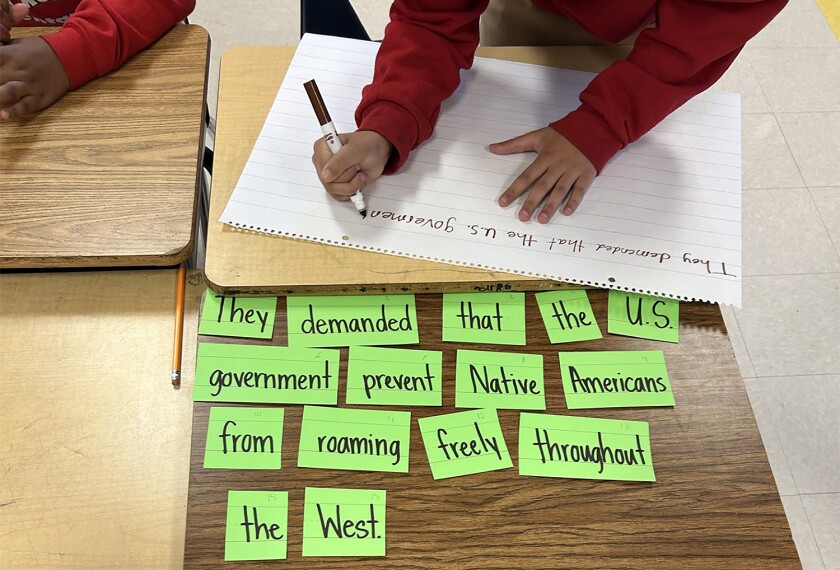
5th grade classroom in February. A morpheme word sort, sentence combining practice, and syntax surgery.
In a 5th grade classroom at Rock Rest Elementary, near Charlotte, N.C., students practice combining sentences and participate in "syntax surgery" to order the parts of complex sentence.<br/>
Madison Hart, Rock Rest Elementary