ÌÇÐ͝Âþvlog

Special Report
Curriculum

Who Takes the Hardest Calculus Courses?

May 05, 2020 1 min read
BRIC ARCHIVE
  • Save to favorites
  • Print
Email Copy URL

National and international tests often highlight achievement gaps among U.S. students in math, but digging a little deeper into the data can reveal ways in which differences in the content students can access can widen those discrepancies.

For example, part of the Trends in International Mathematics and Science Study gauges the skills of advanced students from the United States and more than 40 other countries and education systems at the end of their secondary school careers, and it also collects data about what courses these student take. Just over 12 percent of all U.S. 12th graders participated in the test in 2015, according to the most recent data released.

Read More: Special Report: Leveling the Playing Field in Math

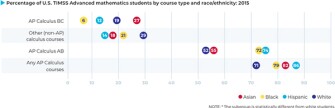
An analysis by the National Center for Education Statistics finds that significantly greater percentages of black and Hispanic students than their white or Asian counterparts reported that the highest math course they had taken was Advanced Placement Calculus AB, the standard AP calculus course covering about a college semester’s worth of material. The proportions were reversed for AP Calculus BC, a class of equal difficulty but covering a year’s worth of material, according to the College Board.
BRIC ARCHIVE

Why does that matter? Because the TIMSS Advanced shows students who completed AP Calculus BC scored significantly higher than students who took other Advanced Placement, honors, Regents, or other advanced calculus classes—not just in calculus problems, but those involving algebra and geometry, too. Students in these classes were also more likely to perform at the highest achievement levels overall.

BRIC ARCHIVE

Related Tags:

A version of this article appeared in the May 06, 2020 edition of Education Week as Calculus: Who Takes the Hardest Courses?

Events

This content is provided by our sponsor. It is not written by and does not necessarily reflect the views of Education Week's editorial staff.
Sponsor
Reading & Literacy Webinar
Unlocking Success for Struggling Adolescent Readers
The Science of Reading transformed K-3 literacy. Now it's time to extend that focus to students in grades 6 through 12.
Content provided by 
Jobs Virtual Career Fair for Teachers and K-12 Staff
Find teaching jobs and K-12 education jubs at the EdWeek Top School Jobs virtual career fair.
This content is provided by our sponsor. It is not written by and does not necessarily reflect the views of Education Week's editorial staff.
Sponsor
College & Workforce Readiness Webinar
Climb: A New Framework for Career Readiness in the Age of AI
Discover practical strategies to redefine career readiness in K–12 and move beyond credentials to develop true capability and character.
Content provided by 

EdWeek Top School Jobs

Teacher Jobs
Search over ten thousand teaching jobs nationwide — elementary, middle, high school and more.
Principal Jobs
Find hundreds of jobs for principals, assistant principals, and other school leadership roles.
Administrator Jobs
Over a thousand district-level jobs: superintendents, directors, more.
Support Staff Jobs
Search thousands of jobs, from paraprofessionals to counselors and more.

Read Next

Curriculum The Case for Choosing a Physical Book Over a Digital Reader
Physical books encourage a deeper reading of a text than digital devices do, some experts argue.
2 min read
Stack of library books with two blurred people in the background.
iStock/Getty
Curriculum Opinion Should Curriculum Teach Students to Obey or to Improve Society?
If ÌÇÐ͝Âþvlog are focusing on priority standards, they’re missing the big picture of curriculum-based teaching.
Thomas R. Guskey
5 min read
Guskey
Canva
Curriculum Should Cybersecurity Be a Graduation Requirement? This State Thinks So
North Dakota is requiring all students to study either cybersecurity or computer science content to graduate.
3 min read
Senior Brings Rain Demaray works on a computer during a Senior Seminar Class at New Town High School. The course is aimed at having seniors become Choice Ready, a North Dakota state initiative.
North Dakota adopted computer science and cybersecurity standards in 2019. Students must study either cybersecurity or computer science to graduate.
Kristina Barker for Education Week
Curriculum Opinion Students Have Climate Anxiety. Here’s What Educators Need to Be Able to Help Them
Teachers and administrators want to help prepare students for a changing world. Three important steps can get them started.
Judy Braus & Maya Morales Garcia
5 min read
Illustration of chalkboard with climate change illustration.
Dusan Stankovic / Getty<br/>