

Updated: The Centers for Disease Control and Prevention are reconsidering social distancing guidelines for schools with universal mask wearing, in response to new research suggesting that spacing students 3 feet apart may be sufficient to ward off outbreaks of COVID-19 when all other safety measures are followed. Read more.
Making space to separate students and teachers remains one of the biggest challenges to in-person instruction during the pandemic, and many administrators are dismayed that the Centers for Disease Control and Prevention are not following the in setting physical distance guidelines closer to 3 feet instead of the current 6 feet.
“The single biggest obstacle to fully reopening schools is the 6-foot distancing requirement, as we don’t have the physical space or staffing to bring all students back five days a week with this distancing in place,� Thomas Putnam and Mark Elledge, the superintendent and the board president, respectively, of Penfield, N.Y., public schools, earlier this month.
Yet research seems somewhat mixed about whether schools need 3-foot or 6-foot spacing, or something else entirely.
The new CDC guidelines, like older versions, stress physical distancing as one of schools’ core mitigation strategies to prevent COVID-19 outbreaks, particularly when infection rates are high in the larger community. And recent studies of U.S. schools have focused primarily on the 6-foot distancing rule, rather than comparing it to the closer WHO distance.
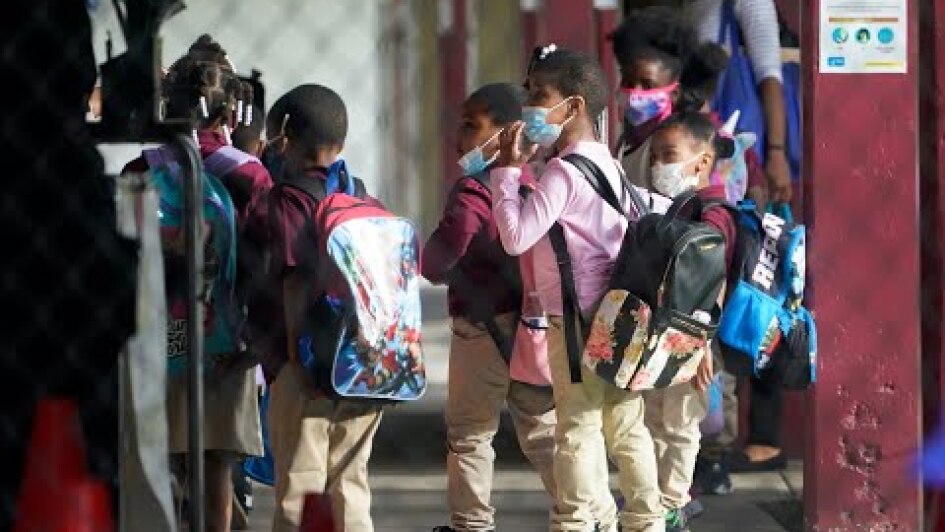
For example, one released just this week found all nine clusters of COVID-19 outbreaks in the schools involved “less than ideal physical distancing,� often involving teachers coming too close to students and their colleagues. In many cases, students sat less than 3 feet from one another or from the teacher, with only plastic dividers distancing them.
“In general, physical distancing of >6 [feet] was not possible in the district elementary schools because of the high number of in-person students and classroom layouts,� Jasmine Reed, a spokeswoman for the CDC, said in an email, explaining why the study did not compare transmission rates at different distances.
That’s not uncommon. While classroom building regulations varied from state to state, no state required sufficient classroom size for 6-foot spacing around students and teachers in the average 21-student primary class or 25-student middle school class, and a majority of teachers reported classroom crowding even before the pandemic. Since the pandemic hit, schools have struggled to find enough space and staff to group students safely in person.
Of course, many European schools are even smaller in square footage, so could 3-feet distancing suffice? A 2020 study in the found that, across 16 countries, social distancing of at least 1 meter (3.3 feet) led to significantly lower transmission rates, but it did not compare 1 meter to 2 meters or more.
The 6-foot distancing guideline has been a rule of thumb since the 1800s, in the earliest studies of infection spray in sneezes and coughs. But in a released this summer, Lydia Bourouiba, a professor at the Massachusetts Institute of Technology’s Fluid Dynamics of Disease Transmission Laboratory, and her colleagues called both 3-foot and 6-foot rules “outdated,� and found the risk of airborne transmission of COVID-19 was based not on simple distance, but whether people were in a generally crowded area, a well- or poorly ventilated space, whether they were wearing masks, and whether they were speaking softly or loudly, among other factors as the chart below shows.

In a highly used, poorly ventilated room—a small, older indoor cafeteria, for example—students laughing might propel aerosol farther than 6 feet. The CDC has also noted that may have higher transmissibility.
Districts Look for Compromise
The CDC guidelines are likely to run up against closer state distancing rules. For example, just a few days before the CDC guidance came out, Indiana reduced its school distancing requirement from 6 feet to 3 feet in classrooms (though they would still have to keep 6 feet apart on buses, and all distancing rules require students and teachers to wear masks.) That may leave districts in that state up in the air about which guidelines to follow.
The 2,600-student Danville, Ind., school district had already been using the closer distancing since October, according to Tim McRoberts, the school board vice president.
“Every week we were getting reports from our superintendent about how many kids were being quarantined due to close contact, and the numbers were just staggering of kids that we had missing school,� said McRoberts, who also serves as associate executive director of the Indiana Association of School Principals. In secondary schools, contact tracing for each positive case turned up on average 20 to 30 students who had to enter quarantine for 10 to 14 days, he said, “but we weren’t having any spread in the schools. … None of the kids we were quarantining were ending up getting sick.�
The district came to a compromise with the local health department: It continued to conduct contact tracing on everyone who came within 6 feet of an infected person for a total of 15 minutes over a 24-hour period, but those who had been more than 3 feet away were told about their exposure and offered a choice to keep their student home or in school, as long as they continued to monitor symptoms.
No parent chose to keep their child home, McRoberts said—and the students in the 3-to-6-foot buffer zone didn’t increase the district’s infection rate, either.
Yet McRoberts said the district continues to monitor contacts and infection rates closely, and tightly implements other mitigation strategies, such as masking and sanitation. He advised any district considering a closer physical distancing buffer to ensure all other mitigation strategies are rigorously monitored.
Adolescents, in particular, may require close monitoring regardless of where administrators set physical distance limits: A separate 2020 study ofsuggested their share of coronavirus cases rose compared to those of older people in part because they were less likely to follow physical distancing rules more generally.
“If you think about it, it makes sense that the most stringent ... places in our state and probably all across the country where the kids are following all or most of those guidelines are in our schools,� he said.


