The No. 2 official at the Department of Education, who spent the past four years helping to sell the Bush administration’s sweeping education plans across the country, said last week that he intends to resign.
The departure of Deputy Secretary Eugene W. Hickok, a former Pennsylvania education chief, had been predicted by many insiders since President Bush’s re-election and the Nov. 15 announcement that Secretary of Education Rod Paige would step down. Mr. Bush has nominated Margaret Spellings, his chief domestic-policy adviser, to lead the Education Department in his second term. She is expected to face little opposition during confirmation hearings likely to be held in January.
In a letter to the president made public on Dec. 2, Mr. Hickok lauded the No Child Left Behind Act, saying it has “given birth to a new era in this country.”
“Today we talk about accountability and results,” he wrote of the bipartisan school improvement law that has been the centerpiece of the administration’s education agenda. “We confront the achievement gap instead of closing our eyes to it.”
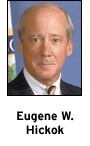
In a statement, Mr. Paige lauded Mr. Hickok as someone who brought a “deep understanding of education policy from the states’ perspective” to the table.
“His policy acumen and knowledge of the Constitution have been tremendously helpful as No Child Left Behind went from an idea to legislative language to passage into law,” Mr. Paige said, referring to the 3-year-old reauthorization of the Elementary and Secondary Education Act.
It is widely believed that President Bush may seek to elevate Raymond J. Simon, the department’s assistant secretary for elementary and secondary education, to replace Mr. Hickok as deputy secretary. No information was available on what Mr. Hickok may plan to do next, and he was unavailable for comment. Mr. Hickok plans to leave his post in January, said Susan Aspey, a department spokeswoman.
Mr. Hickok, 54, who became widely known while serving as Pennsylvania’s secretary of education, was originally suggested as a possibility for U.S. education secretary four years ago. But the Carlisle, Pa., native started out as undersecretary of education, the department’s No. 3 job. He brought his state-level experience and a conservative bent that caused some detractors to see him as an ideologue. (“Doing the ‘Right’ Thing,” April 16, 2003.)
“Gene Hickok has been famous for being his own fellow,” said Justin Torres, the research director at the Thomas B. Fordham Foundation, a Washington-based group that has generally been supportive of the Bush administration’s education initiatives. “He’s willing to be confrontational when he needs to be. I wouldn’t say he has a take-no-prisoners style, but it sure comes close.”
Mr. Hickok spent six years as Pennsylvania’s education chief and 16 years before that as a political science professor and constitutional-law scholar at Dickinson College in Carlisle. In 1995, he helped coordinate the defection of several state schools chiefs from their leading Washington advocacy group, the Council of Chief State School Officers, to form the conservative-leaning Education Leaders Council.
Mr. Hickok was under secretary and deputy secretary, a post he took up in July 2003 on an acting basis. Just last month, he was finally confirmed by the Senate.
In both those roles, he was often the point man for overseeing implementation of the No Child Left Behind Act, which calls for increased testing and accountability in schools. He also advocated for the law’s parental-choice provision, which allows students to change schools under some circumstances, and for charter schools.
“He has been a real pathbreaking reformer,” said Clint Bolick, the president and general counsel of the Alliance for School Choice, a Phoenix-based organization that pushes for school vouchers nationally. “He not only talks the talk, but walks the walk. In the Department of Education, he has been an anti-bureaucrat.”
State Experience
During the most intensive implementation phase of the No Child Left Behind law, Mr. Hickok spent months scheduling meetings with state education chiefs, often collecting details on the difficulties they were having with the law. His own experience as a state chief brought him credibility and an added depth of knowledge of the challenges faced by states, said Ronald J. Tomalis, a former counselor to Mr. Paige and a one-time chief of staff to Mr. Hickok.
“He was very instrumental in understanding the dynamics of what happens at the state level,” Mr. Tomalis said. “A lot of us in Washington forget … that these state chiefs are dealing with their own legislative bodies and their own pressures.”
Mr. Hickok often appeared on Capitol Hill, explaining the nuts and bolts of the law to members of Congress, sometimes under harsh questioning.
“He was sort of the go-to person on No Child Left Behind in terms of concerns, complaints, enforcement, and the details of it,” said Rep. Michael N. Castle, R-Del., a member of the House Education and the Workforce Committee.
But Mr. Hickok and some groups—the National Education Association in particular—often squared off over the details of the law. The 2.7 million-member NEA at times accused Mr. Hickok of having tunnel vision when it came to the school law’s implementation.
NEA President Reg Weaver said the union was hopeful that Mr. Hickok’s departure “represents another indication that the administration is serious about changing the tone of its discourse with the education community.”
Mr. Hickok didn’t escape controversy at the department. As a co-founder of the Education Leaders Council, he was often asked about his connection to the group, which has received more than $10 million in federal grants under the Bush administration.
It remains unclear whether Mr. Hickok was asked to leave his post, as some people believe occurred with Mr. Paige. But one source close to Mr. Hickok said his departure had been in the works for several months.


