With the congressional effort to reauthorize the No Child Left Behind Act at a standstill, schools and districts will need to stay on target toward the law’s goal of 100 percent proficiency in reading and mathematics in the next six years—or else face sanctions or interventions.
That process will be especially hard in 23 states that made the achievement targets relatively easy to meet in the first years of implementing the 6-year-old federal law. Starting with the current school year, schools and districts in those states will have to make annual gains of 10 percentage points or more in the proportion of students scoring as proficient in those subjects, says released last month.
“These states were seemingly prudent in the beginning … because they felt they weren’t prepared” to help schools achieve rapid increases in student achievement, said Jack Jennings, the president of the Center on Education Policy, the Washington research group that produced the report. “But in a way, they delayed the day of reckoning.”
The process of determining whether a school makes adequate yearly progress, or AYP, under the federal law is so complicated that it’s impossible to estimate how many schools will fail to meet their AYP targets because their state will require these more-extensive achievement gains, Mr. Jennings said in an interview. But it’s clear, he added, that dozens—perhaps hundreds—of schools will fail to meet goals established in states that assumed that schools would be ready to make dramatic increases in student achievement in the years closer to the deadline.
“The odds are there will be a large number of schools not making adequate yearly progress” in those 23 states, he said.
‘Backloading’ Goals
Shortly after President Bush signed NCLB into law in 2002, states negotiated with the U.S. Department of Education over how they would design their testing systems to assess students in grades 3-8 and once in high school in reading and math. The plans also must chart the annual goals that schools and districts need to meet each year to make AYP.
Every state’s plan needed to culminate with all schools reaching the law’s goal that all students be proficient in the two subjects by the end of the 2013-14 school year.
Twenty-three states chose to set modest goals in the early years of implementing the law, with the belief that schools would rapidly improve student achievement as the deadline approached. Those decisions, which the report terms “backloading,” were based on research that suggests that efforts to improve schools start resulting in gains several years after they have been launched.
“It takes two to three years before things pick up,” said Arie van der Ploeg, a senior researcher for Learning Point Associates, a nonprofit research and consulting group based in Naperville, Ill.
The states also set modest goals at the start because they didn’t want to identify large percentages of schools for intervention under the NCLB law, mostly because they didn’t have much experience turning around low-performing schools.
“People said: ‘We have to invent the interventions,’ ” said Brian Gong, the executive director of the National Center for the Improvement of Educational Assessment, a Dover, N.H., nonprofit group that assists states in designing their state testing and accountability systems. “They said: ‘We’re going to build in some time because we don’t quite know what to do.’ ”
Schools also were faced with new challenges, such as assessing students with disabilities based on their understanding of grade-level subject matter, said Mitchell D. Chester, the Massachusetts commissioner of education since May, who helped design Ohio’s “backloaded” achievement targets as a state education official there.
“It’s too early to tell,” Mr. Chester said, “whether we’ll see the acceleration in [achievement] gains.”
While those may be legitimate reasons to postpone ambitious achievement goals, states may also have made their decisions based on political considerations, said Kevin Carey, the research and policy manager for Education Sector, based in Washington.
Many of the 23 backloading states’ plans projected that major increases were to happen starting in the current school year, with an underlying assumption that Congress would have revised the 2013-14 goal or extended the deadline when the law was scheduled for reauthorization in 2007, he said.
“My guess is that those decisions were made with the reauthorization calendar firmly in mind,” said Mr. Carey, who compared the achievement timelines to adjustable-rate mortgages that offer homeowners low monthly payments in the short term. “They thought Congress would come along and refinance it for them.”
But the effort to reauthorize the NCLB law stalled last year. After failing to generate consensus for a proposal to renew the law, Rep. George Miller, D-Calif., the chairman of the House Education and Labor Committee, halted work on the bill last year. Sen. Edward M. Kennedy, D-Mass., has said he would bring an NCLB bill before the Senate Health, Education, Labor, and Pensions Committee, which he chairs.
But the committee’s agenda is uncertain after Sen. Kennedy announced last month that he has been diagnosed with brain cancer.
Now that it appears as though the achievement targets will remain in place, the 23 states identified by the Center on Education Policy “are just setting themselves up for failure,” Mr. Carey said.
‘Rapid and Steep Jumps’
Each state set targets for the percentage of students scoring as proficient—also called annual measurable objectives, or AMOs—based on the scores on its state test when the NCLB law was enacted. Many set the same AMOs for the first three years under the law, with the target jumping for another three years. Then the AMOs rise gradually as the 2013-14 school year approaches.
In analyzing the trajectories of all states, the Center on Education Policy found that 23 states set goals with small increases in the early years of the law’s implementation, followed by ambitious goals as the law’s deadline approached.
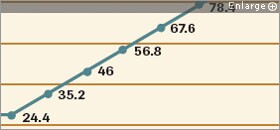
For example, California set its initial AMO for its middle school reading test at 13.6 percent of students scoring as proficient. That goal increased to 24.4 percent for 2004-05. Starting in the current school year, the AMO increases to 35.2 percent and will be followed by increases of more than 10 percentage points every year until 2013-14.
California set modest proficiency goals for its elementary and middle school tests in English language arts for the first five years under the No Child Left Behind Act. Starting this year, the trajectory assumes rapid jumps.
SOURCE: California Consolidated State Application Accountability Workbook
By contrast, South Carolina’s AMO for high school reading started at 33.3 percent in the 2002-03 school year, and rose to 52.3 percent in the 2005-06 school year. It will increase to 71.3 percent in the 2008-09 school year before jumping to 90.3 for the 2011-12 and 2012-13 school years.
California’s trajectory requires schools to make “rapid and steep jumps” every year when the deadline is approaching, the report says, compared with South Carolina’s large increments every three years in the process.
California could have established more challenging AMOs than it did, said Mr. Carey, because it had several years of experience with its own accountability system before the NCLB law’s enactment.
“They delayed the hard work of having to identify and turn around the lowest-performing schools,” Mr. Carey said. Even though the state had an accountability system in place starting in 1999, it didn’t fully align the testing system with its standards until 2003. State officials decided to set low targets at first, said Deb V.H. Sigman, California’s deputy superintendent for assessment and accountability.
“The system was different enough, so we wanted to make sure people had full knowledge” of it before accelerating expectations, Ms. Sigman said in an interview.
‘Well Aware’ of Calendar
In Kentucky, another of the backloading states, officials set the AMO for elementary school math at 32 percent in the 2006-07 school year, and it is scheduled to increase by almost 10 percentage points each year until 2013-14.
The state decided to backload the goals as a way of phasing in the federal accountability system, which had expectations different from those of the state’s system, said Lisa Y. Gross, a spokeswoman for the Kentucky education department.
Kentucky ÌÇÐĶ¯Âþvlog know the state is expecting big increases starting in the current school year, Ms. Gross said, and are working to make their federal goals.
“Many schools are well aware of the rapidly approaching deadline for proficiency and are doing things to ensure that they are positioned to meet those goals,” said Ms. Gross. “Staff here is monitoring the progress closely, so that we can provide interventions and other services if needed.”
In the end, schools are unlikely to make such rapid progress, the CEP’s Mr. Jennings said.
The report notes that a recent evaluation of the NCLB law’s Title I program by the federal Education Department concluded that as few as 12 states would reach the goal of 100 percent proficiency based on their rates on increases in student achievement since 2002.
“The more serious question is whether this is the right target, and whether test scores are the right means for measuring which schools are meeting the targets,” Mr. Jennings said.


